Thursday 30th August

We had breakfast before dawn. Our route took us initially over flat scrubland. Eventually we turned again on to the North West Highway. There was more traffic on the road and some of it showed evidence of the nomadic life of some of the travellers. The signboard showed the vast distances between our location and the rest of the world……

We came across another Overland group in real trouble. Apparently the truck company’s fuel card had been refused at the previous stop and the passengers had clubbed together to cover the cost of the fuel with the promise from the company that money would be put on the said card before they needed more fuel. They had just stopped for that refuelling and the card was still not operational and the passengers (understandably) were refusing to fund the company again for fear and of not getting their money back. We subsequently learned that they were there for three hours before the situation was resolved. When they reached the National Park the rangers went on to the truck, found it wanting in many ways and this, added to the fact that the company had not paid the Park accommodation fees for over 6 month’s, led to the Overland Company being closed down. The poor backpackers were to be taken to Broome, the next major town,where their tour would end. The moral of the story I guess is to check the viability of your tour company….

Back to our trip. We drove on through the day, eating the lunch sandwiches made at breakfast on the way.

Our next stop was in iron ore mining country. By now the hills had turned deep red and showed the scars of mining. The ant hills were markedly darker. Our road had passed over a long conveyor belt that disappeared over the horizon on both sides of us. This apparently is the means of getting the spoils from the mines to distributing junctions. The town built to support this mining activity is called Tom Price. We reached the Tom Price mid afternoon. After a visit to the supermarket (and bottleshop) for supplies we rode the final comparatively few kilometres to Karijini National Park which was to be our base for the next three days. At Karijini we stayed at an Eco Retreat run by the Gumala Aboriginal Corporation.
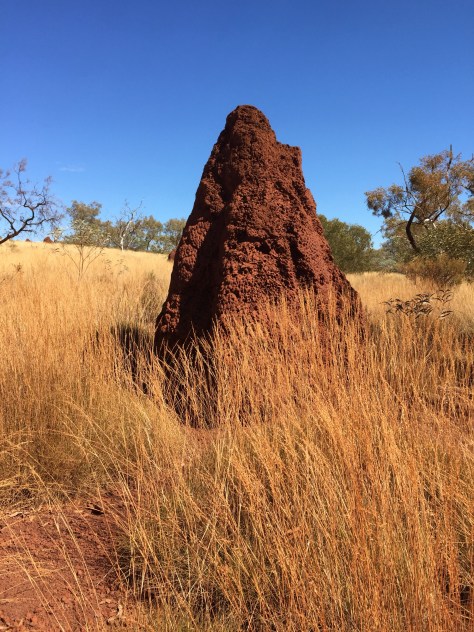
We were camping again, but once again the tents were already erected. The first thing you become aware of is the red dust. The earth is red. The terrain I felt was very similar to the African savannah. We watched the sun go down soon after we arrived but weren’t really to appreciate the magic that is Karijini until the following day.

After a good meal it was time bed. As I have said, I had known I was in trouble when I opened up my sleeping bag and read the ‘tropical’ label. In my effort to ensure the smallest pack, I had gone for the lightest – not at all good this night when, as happened, the temperature dropped to 3 degrees overnight. I was cold. I had added the fleece and socks to my usual Overland night attire (a silk shalwar chemise built for me in India). All very exotic but not very warm. Even again adding Keith’s travel towel (I have lost mine and now have a Postage Stamp piece of towelling in penance) I was no warmer. I swear I was shivering so hard the tent was shaking at one stage!

Tuesday 28th August

There was a lot of early morning activity as the young people left to swim with manterays and whales or snorkel around the coral reef. Lacking the swimming skills to take advantage of these activities, we had a restful morning as our only committed activity was to take the rather pedestrian glass bottomed boat out to see the coral, which can be found only meters from the shore. After taking advantage of the resort bakery to have breakfast we did our laundry and hung it to dry with a colourful array of other people’s washing…….

Having nothing more pressing to do, we decided to use the morning well by walking to the next bay along, Skeleton Bay. This is what you might call a shark nursery, where shark Mums bring their young. Sort of an early learning centre for sharks I guess…… the most notable in these parts are the whale sharks, the largest known fish. The tide was up, so there was just a small strip of sand between the water and the spiky vegetation that sparsely covers the sand dunes that rise up behind the shore line.

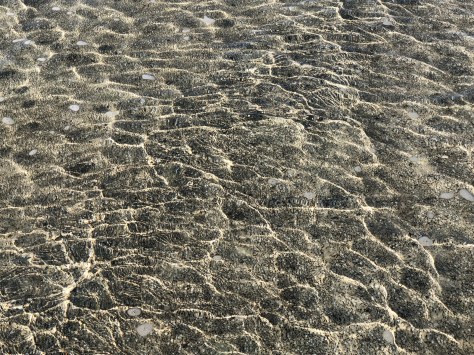
We picked our way along the sea short, initially along the sand and then the flat rocks that straddled the way. The water was totally clear, bar the ripples caused by the tide and breeze. Further out the water was blue before changing to indigo and then there was the white surf breaking over the reef. We wandered along, walking in and out of the shallows.

We met few people but watched the water keenly for shark life. With our usual inimitable timing we were of (of course!) a few days out of time to really expect any sightings – sharks use the area from September to March. No surprise then that we did not see any! We did see a couple of dark shapes moving through the water which we were led to believe were sting rays. We also saw an eel like creature dart away from the shore as we approached and a couple of leaping fish. Despite our lack of shark like sightings, it was a very pleasant stroll and we only turned back when dark clouds gathered over head.

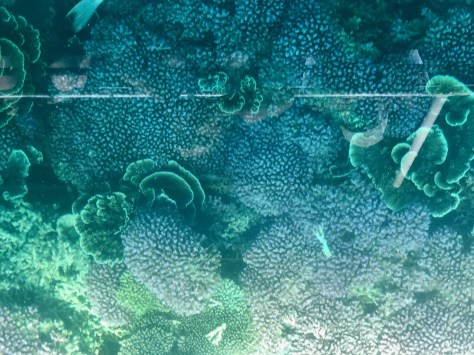
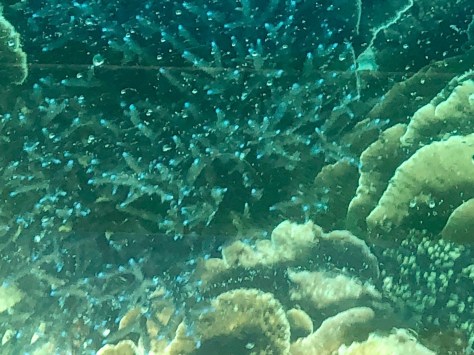
After a fish and salad lunch we set off to learn a bit about coral. There were only a few us on our glass bottomed boat, but we spent a very interesting hour in the shallow water looking at the amazing coral beneath us.

It was fascinating! The Ningaloo Reef stretches from south of Coral Bay up to Exmouth, the most westerly point of Western Australia. There are thought to be over 200 species of Coral in the Ningaloo Reef area. They were all sorts of shapes and surfaces – some like oversized cauliflowers and others had spiky fingers with blue tips. The whole seabed was covered with coral. Most of the coral here is described as ‘hard coral’ and relies on sunlight to survive. Some of the coral started life 35,000 years ago. Occasionally large fish appeared briefly – but there was a constant display of small, colourful fish darting in and out of the coral of the sort found in tropical aquarium shops at home.

The excitements of glass bottomed boats over, it was back to base to pack up our kit on to the bus and a shortish drive to our next destination, Exmouth (pronounced Ex Mouth here!). The terrain was low vegetation with frequent large anthills.

It was becoming dusk as we reached Exmouth. A military town, it is now primarily an Airforce base. We did not in fact stop in Exmouth, but continued on to a campsite at Yardie. We had reached the North West Cape. Here our tented accommodation was already erected (bliss for us seasoned tent putter-uppers!). The tents were also quite tall so you could stand up in them, another appreciated feature after our sometimes tortured experiences of the Peninsula on the Silk Road. They had other useful additions – a 2 inch thick sleeping mat (luxury) and for some a low camp bed ( the height of luxury!). On returning to our tent I was accosted by an Australia bustard (I am reliably informed) that was determined to get into our tent at all costs. I spent some time trying to dissuade it from this course of action and in the end had to abandon my tent visit until it had evacuated the area!

Camp life centred around a central catering hub, very well equipped with barbecue space and tables and chairs and a fire pit. As the evening wore on the wind gathered momentum and it was an extremely turbulent night. All night long the wind whipped around the tent and everything that could, flapped. Not the most restful of sojourns!!

I also discovered with some dismay that my sleeping bag, opened up for the first time and chosen from an array at home on account of its size was ‘for tropical use’. Great when you are in a desert that gets very cold at night. By morning I was found to have socks on, a fleece and Keith’s towel. It was still cold!

Please note the red dust which was to become a long term feature and constant companion of the trip and caused the demise of some favourite items of clothing…….

Monday 27th

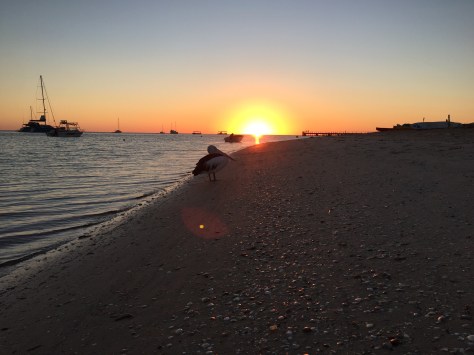
Somehow we got our timings wrong for getting up.  The benefit of our mistake was that we saw the sun rise over Shark Bay, us and a single pelican that had arrived early for the dolphin feeding which was to take place further along the beach a little later.
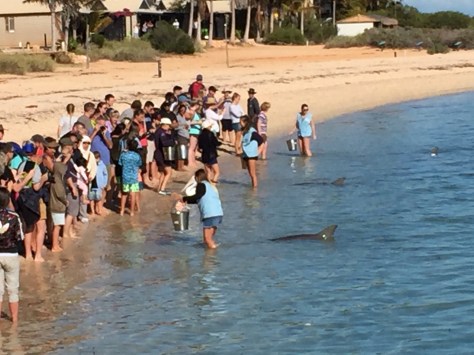
We attended this daily spectacle a little late when, true to form, four dolphins appeared within inches of the edge of the water waiting for their breakfast.   Members of the watching audience were invited to assist in their feeding.  The dolphins were not huge and the whole event was interesting, but I felt, not over exciting.  It was made more so by a pelican (several had materialised, like the dolphins, from nowhere) determined to come between the fish pail and the dolphin being fed.
Disappointingly for some of our party, none of our group were invited to be dolphin feeders. That excitement over we set off for the long ride to north to Coral Bay.  Back we went down the peninsula and once again took the North Western Highway as it snaked it’s way northward.
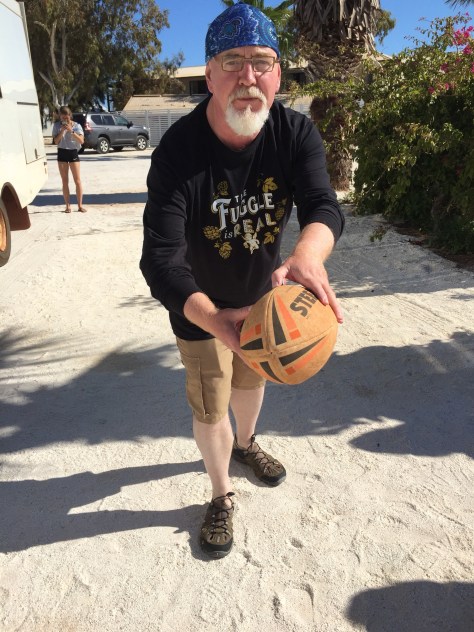
It was to be a long days drive.  There was a bit of exercise before we left,
(Keith exercising!)
but the rest of the day, apart from a couple of stops was spent on the road. Even our lunch was eaten on the move – the lunch sandwiches having been made at breakfast.
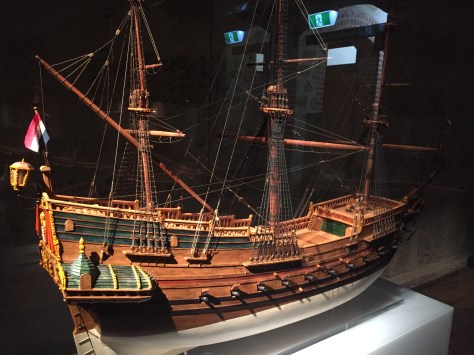
Shark Bay covers a large area and was the nautical graveyard of many ships such as the Batavia which we discovered in the Shipwreck Museum in Fremantle.  It was also the place to make a name for  privateers (or pirates) such as the famous William Dampier. In his quest for the silver booty found on the Spanish ships roving the seas, he predated Drake and Cook in his discoveries.  He sailed into Shark Bay and was to make a study of the Aboriginal people, although he described them as a ‘wretched people’ a description that sadly remained of them for several hundred years.
We arrived at the resort of Coral Bay in time to see the sunset from the beach.
It was quite cool but beautiful.  The red rocks behind us bore the pockmarks of the creatures that had been fossilised in the rock over millennia and exposed over time by the wind  and sea.   The water was calm and it was our first sighting of the reef that was to remain with us for several days.
The sun sank gradually and then was suddenly gone, leaving behind a red hot sky that was to turn even more red over the next hour.  Our supper was an excellent hamburger served at the backpackers centre where we were staying.
Our dormitory held 10 people and ours (considered to be the quiet Room) was over subscribed.

Sunday, 26th August

Kalbarri National Park was beautiful in the bright morning sunlight that emerged once the sun had risen (we left the hostel at 6.15).
As we drove into the park, red brown sandstone rocks came into view and gradually we began to see the spring flowers as the light came into the day.  We took the rocky path down to the cliff, formed over time by the winter rain water flowing off the land out to the sea.
We wandered down towards the Murchison River. Having clambered over the boulders in our path, we eventually came to a point when the decision had to be made – to absail or not to absail.   In the event I decided to do it and Keith, probably wisely, decided not to.  All the other chaps and a number of the girls were keen to go.  I wasn’t exactly keen but felt it ought to be done. A great chap called Phil – the absail guru and a man very obviously skilled in the art of getting people ‘over the top’ – briefed us on equipment, health and safety (😳) and approach. Then, before I knew it, I was dangling over the cliff, talking nonsense to Phil and swinging on the end of a rope.
It was not a skilled or graceful demonstration of the art – but I did it!  Having said this, I decided not to take advantage of the opportunity to do it again!  I was not sure my jelly legs would get me to the jumping up point again!  I cringingly watched the finesse of the others…….
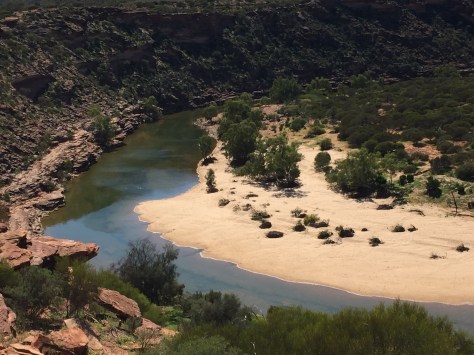
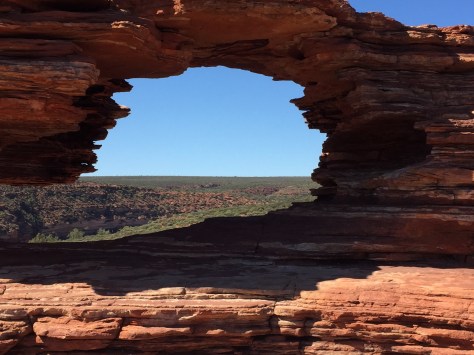
We watched as everyone took their turn and then (leg wobbling having calmed down!) went down to the waters edge.  Currently a very tame trickle of what must be a roaring torrent when it is in full spate, the water twinkled in the light. After a bit of sitting around, desultory conversation and cairn building,  it was time to clamber back up to the top of the cliffs from whence we came and to drive to our next stop – rather sensationally called Natures Window.  This was an amazing rock formation, much higher above the same river. The walk down to the viewing point once again gave a great opportunity to look down on the river as it meandered through the valley it had carved out for itself below us.
It was a busy spot.  There were a number of people making the journey down and not everyone had the opportunity to have the photo of a life time that gave the spot its name – a rather natty hole in the rock providing the perfect frame for the perfect holiday photo.
Having had a quick peek at the view through the ‘window’ I did not dally too long  but left others to pose gracefully and returned to the truck and Keith (the dizzying drop was too strong for  his taste).  Our second truck lunch followed, watched rather disparagingly by other sightseers who I feared rather resented our space……..
The days tend to warm up quite dramatically and by the time we left the area the truck was quite hot. Small flies have also made themselves felt….. irritatingly.
Fed and watered, it was time to ‘cover some K’s’ as Brenten (he did eventually introduce himself!) calls it and we settled down to several hours of driving. Leaving the Murchison river area saw us move out of the ‘wheat belt’ and into Gascoigne Country and effectively enter the true desert of Western Australia. This covers the area from Halls Creek, to Alice Springs and Perth*. The move away from the river also marks the move away from the animal control zone which incorporates the National Park. This means that things like the goat population increases. Farming has more or less ceased here but for us the wild flowers have quite noticeable increased, with carpets of white flowers right up to the road.
 This is a land of no fences and roaming cattle herds.  The history of raising cattle here seems to have had a chequered experience of success and failure as the price of beef has fluctuated.  At the moment there is a call for not only beef but also goat meat as trade agreements with Korea, Japan and China have created new markets. For some the beef of Western Australia is the best in the world.  It is supposedly tougher but more flavoursome….. I think we should be the judge of that!
Our next and final stop was the Billabong Roadhouse.  in the middle of nowhere, these oases of life provide the fuel for both vehicles and passengers on the long drive north to south.
We were heading for the Shark Bay Wild Heritage Centre, another World Heritage Site
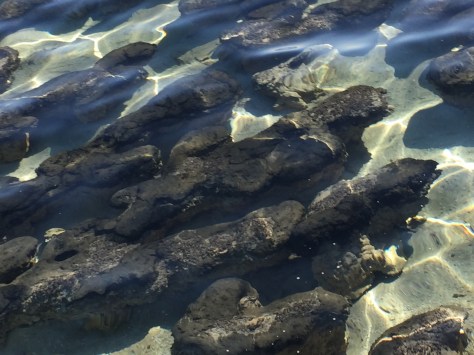
First stop was the Hemmelin Pool where a combination of shallow water caused by a sand bar and the doubly salty water created makes it home to only seagrass and cockles.  However it has also created the ideal conditions for the microbial mats and stromatolites found here.  (Please note my new marine knowledge!) This marine eco system is similar to that which formed the basis of evolution 3 million years ago.
I found it and its history both fascinating and awesome. The place had a strangely peaceful quality as the water lapped over the rocky outcrops underneath totally clear water as it had done for millennia. Biologists only identified the importance of the site (it is one of only 4 places in the world that it exists) in the 1960’s.  Before that it was being used as a boat ramp by the locals!
Beyond the sandbar Dugong graze (they weren’t evident but I found a sketch for you)
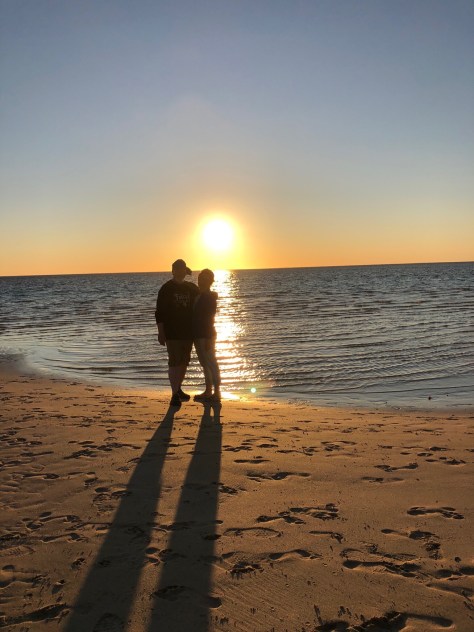
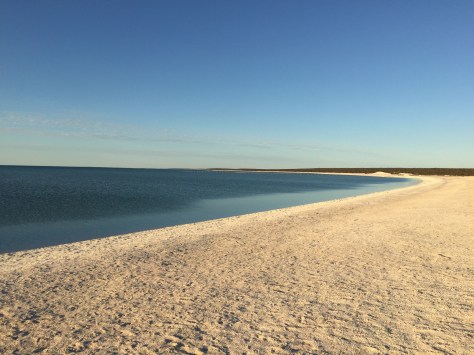
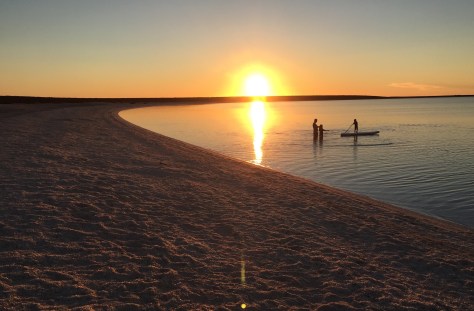
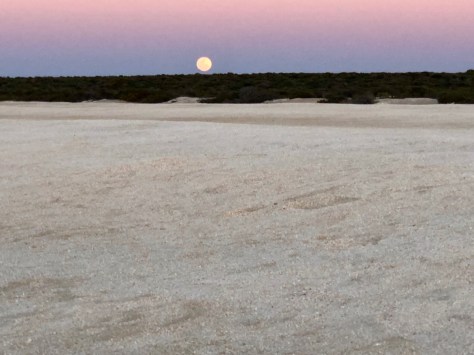
and dolphins and whales use the area as a nursery before travelling both north and south. Leaving this ancient waters behind, we travelled north onto the peninsula with water appearing on either side of us.  All of the Beaches in Shark Bay are formed totally of cockle shells.  Nearing the Monkey Mia resort where we were to spend the night, we stopped at a beach to watch another sun set. We crunched over the shells to the edge of the shallow water of the bay.  It was absolutely beautiful.
We stayed for an hour watching the sun slip out of the sky and disappear over the watery horizon while behind us the moon came up – amazingly quickly I thought.  I could not help thinking that sunsets, like funerals, always make you think of those you have experienced in other places.  The favourites that I thought of were the sunset watched from a huge rock in the Wadi Rum in Jordon, returning from whale watching in Argentina, watching it from our boat on the Nile, the fast sunsets of Kenya and Tanzania ….. and of course. there are the pretty cool sunsets over the orchards of Peckham Bush!

Saturday 25th August

It was not a good night. Fear about not waking up together with angst regarding the trip itself rendered us both restless and wakeful. At well before 5.00 we were both awake but somewhat reluctant to be off. Would we be rejected for being too old, too unfit or maybe just not being ‘backpackers’?

We had to admit to a fair degree of trepidation as we set off into the dark pre dawn street. There were no people about. A lone car passed by. As we approached the Britannia we saw a tiny figure waiting outside with an enormous rucksack on her back. It turned out to be Maya, a soon to be fellow traveller, from Japan. I think we were all pleased to see each other as an acknowledgement that we were in the right place.

As the day began to get light there was the roar of a truck. The vehicle to be our roving home for the next three weeks had arrived. Our driver/guide/cook/mechanic got out, read our names from a list, let down a short ladder from the back of the truck to take our luggage on board and told us to get in. He made no further comment. We guessed we had been accepted! Next stop Perth youth hostel….. here the balance of the party climbed on board. In our estimation all were under 35: the majority under 30 and the majority of these were under 25. We could have been the grandparents of all of them!

I am sure our assessment of the situation was as quickly assessed by them…. their faces on seeing us was a picture!

All aboard (the bus was full), we took off.

9077D53B-79FC-41E3-B543-AC677F42A97A

The route!
It did not take long to leave Perth and we were soon out on the Indian Ocean Highway. In ancient times this area was a vast sea, giving rise to the salty limestone sand of the area. We were travelling at sea level. It was what we have come to experience as bush country. The ‘Black Boy’ grasses we had seen on previous visits were very much in evidence. Very little of the land had been cleared for farming. There were few crops. When they did occur, vast sprinkler systems could be seen.

There was very little traffic. The ubiquitous telephone wires ran parallel to the road. There were very occasional buildings. Our first stop was a town called Lancelin. Originally a whaling town (whales were hunted for oil), conservation has seen an end to this industry and it has become an area based on fishing, mainly lobster. Most of the large villas dotted around the town are the holiday homes of high earners from the mining industry east of Perth. It had all the trappings of a sleepy village by the sea. The deep blue ocean ran up as white foam onto the beach. We headed to the bakery which was doing a great trade in breakfast pies and sausage rolls……. we sat outside the bakery making the small talk of a newly gathered group of people – all secretly weighing up each other, and all wondering what these two elderly people were doing there, including us!

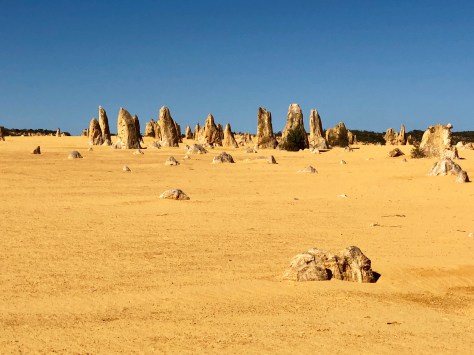
As we left Lancelin behind, the trees stopped and we were looking east over a flat fertile plain and soon came to our next stop, the Pinnacles. These were stone pillars bristling out of bright yellow sand.

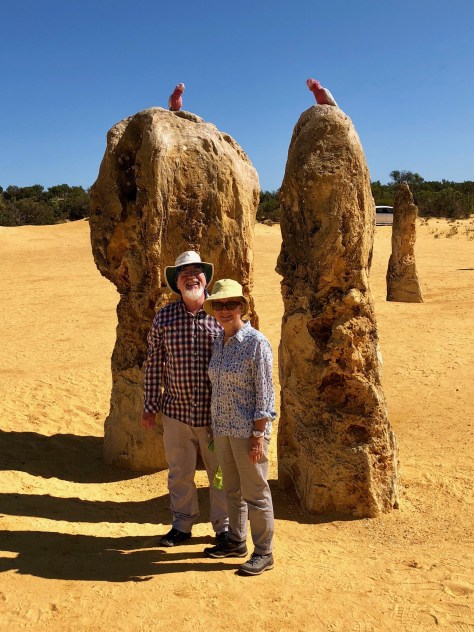
It was a remarkable sight. Initially we were reminded of the rocks of Cappodocia in Turkey, but on closer inspection they had a very different form. The limestone columns were around a maximum of three meters high. There are various theories about their formation, but there seemed to be no clear front runner. Several theorists describe them as the solidified tree roots exposed over time by winds. Who knows – but they made an interesting interlude of walking and pondering in bright but breezy sunshine.

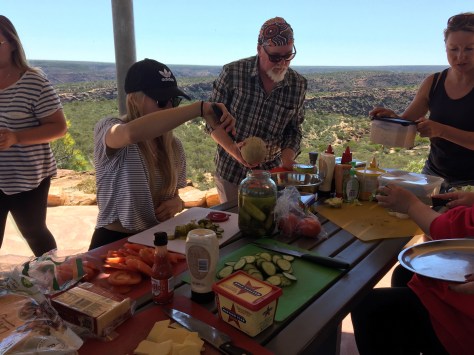
We drove on and eventually stopped for lunch at Jurien Bay. Another whaling town now reduced to fishing village. We stopped on the coast road and had our first truck lunch of the trip. It went very well (from our experience!). The truck larder was well stocked with goodies and people in the main turned to to lend a hand.

Shortly after lunch we stopped at the Sandy Cape National Park where sand boarding took place for those who wanted to partake of the activity. Keith and I watched with others as they hurled themselves down the dunes on candle waxed boards. Interesting ……

Back on the truck it was, apart from a brief stop for petrol, and a later stop off at a bottle shop to take on alcoholic ‘vittels’ for the long haul to Kalbarri, our stop for the night. Although only 7.30, it had been dark for some time when we arrived and we had driven for well over an hour in the red after glow of an amazing sunset. By Kalbarri we were in total darkness save the light of a nearly full moon.

We unloaded our bags and decamped into our dormitory accommodation. It was communal but clean and the shower was good. We had a good supper during which the vexed question of who wanted to do some abseiling on the morrow was raised. I think I might……..

Friday 24th August

We needed to get to Perth before the end of the day but arranged with Dana that we could leave our luggage in the apartment after check out time in order that we could spend our last morning in Fremantle.  Having packed up we were out early.  Our first stop was to visit the market – a vibrant mix of rather odd things you can easily live without and really colourful, interesting food.  The market only opens at weekends so it was our first and last chance to experience it.  After a brief coffee stop, I just had to return to the optician that supplied the Ann and Valentin spectacles and I am ashamed to report that a purchase was made – I could not resist them and decided they are to be my birthday present to me!
Moving swiftly on….!
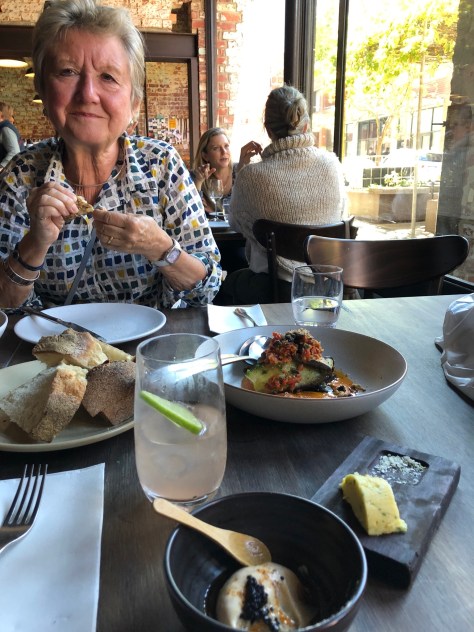
We went back to Bread in Common for an early lunch.
1E1787B2-CDBF-42A6-88D0-68D92D0A1AC0
Another excellent meal later and having picked up our baggage we found a bus just outside our accommodation that would take us, albeit convolutedly,  to Perth from where we picked up another bus to our hotel.  A result.  Buses in Central Perth are free.
Having booked in, it was time to find where we were to be picked up for the trip as it appeared that it would not be from our hotel as previously indicated.  The. ‘Britannia Hotel’ turned out to be a backpackers hostel…….  more of which later!  Pick up time there was 6.45 in the morning.  Time from our hotel – about 20 mins. That was where we had to get with our luggage by 6.45
Having eaten a good lunch we went in search of something snacky for supper and having failed to find a supermarket found a sort of dried goods / delicatessen which appeared like the queen of all food shops with L large bins of nuts, spices, grains and pulses.  It was a great middle Eastern food Kasbah. Unfortunately we weren’t into that sort of need but found hummus and sumdried tomatoes  for our repast.   After a quick beer on the way back, it was home to take advantage of the Wi-fi as it is likely to be the last we can rely on before Darwin..
… and so to bed.

Thursday 23rd August

A much brighter day but a sharp wind saw us out and catching the bus opposite our accommodation heading for Cottesloe Beach.   The original plan had been to go to Penguin Island a boat trip away.  However, our on-going quest to see penguins in Australia was once again thwarted as rough seas had demolished the jetty on Penguin Island ……..
So Cottesloe Beach it was to be.  After a short bus ride we were delivered to Cottesloe town and headed over the railway line and over the hill to the beach.
  Here we found a number of surfers in the water looking, I thought,  like sharks themselves in their black wet suits and surf boards.  I have to report that Keith saw no similarity at all.  Having watched the surf for a bit, we decided to walk back to Fremantle along the path parallel to the Ocean.  It was a very pleasant stroll of about 5 miles and very satisfactory apart from the frequent note in the hedgerow drawing our attention to the need to ‘Beware of Snakes’.   Great! I had not expected to be threatened with challenging wild life at this early stage of the trip.  I have to report there was in fact no sign of wild life.  Ho hum.
Our Ocean stroll took us eventually back over the railway line away from the sea and back into Fremantle.  We popped back home for a sandwich before heading out again, determined to see the sun set over the harbour……..
…. and what a sunset it was!
  We sat at the Bathers Beach House Cafe and watched elegantly dressed wedding guests gather for a sunset wedding with eye wateringly high stilettos and the nervous laughs of those unused to such grand attire (it was probably the altitude).  Just as the sun hit the horizon the bride arrived as we turned away from the ocean and home to supper.
Our last evening in Freo.  As we took a final  look out over the Indian Ocean and the golden reflection of the sun in the water, we marvelled again at the good fortune of two very ordinary kids from not the necessarily best side of the tracks and how far we had come……..
How lucky are we.
Tomorrow Perth.

Wednesday

22nd August

Yesterday prisons. Today shipwrecks.  Although not raining, the day was quite fresh so we decided another indoor activity was required and set out to find the Shipwreck Museum down near the harbour.  En route, Keith took advantage of a coffee at the Ghetto Blaster Cafe – literally a hole in the wall on the Pakenham Road. Here we got into conversation with a lady wearing stunning glasses who came from London and had worked for the BBC in Tunbridge Wells….. amazing!  To add to her attraction was her incredible glasses……. the name of the opticians was duly noted!
The Museum was great. We spent a long time looking at the relics from the Dutch East India Company ship Batavia (model below – I cannot imagine why anyone would take off for the other side of the world in such a small boat…..)

5F552286-CAA8-4A16-8330-32ABB1FC9B40

The wreck of the Batavia together with its chests of silver, ceramics, bricks and cannon ware were found in the 1950’s but it was not until a major excavation was undertaken in 1972 that the extent of the treasure was retrieved from the sea.   At that time a full stone portico was found amongst the artefacts recovered.
428D76F8-F849-4BE1-9B5C-99C42E18CE16
??!?
The retrieved timbers of the ship have been preserved and now form part of the exhibition.
6B649CFA-E484-43FF-85F3-9A58809E1666
There were a number of shipwrecks described in the Museum and the artefacts found were very well displayed in the exhibition, including a steam engine built at the time of the Crimean War, still in working order having spent years under the sea…….
A number of things struck me about the whole shipwrecked business
that this sailing malarkey was not for the faint hearts
– taking the wrong turn in the Roaring Forties was a bit worse than a ‘whoops moment’
– that chaps whipped up and down from Europe to the Antipodes with amazing regularity (some arrived, returned to Europe and were back within 2 years!)
– the Dutch were well ahead of the English in this business!!
Having left the shipwrecks behind, we found an amazing exhibition of the entries for the Australian Wildlife Photography Exhibition tucked away in a side room.  What a treat. The most incredibly photographs….
What rich pickings the morning had provided.
We had ate lunch at a very interesting restaurant called Bread in Commn.  A great place with really interesting food…….

Tuesday

Tuesday, 21st August.
We woke to grey skies, heavy showers and a brisk wind.  Fine weather for the Fremantle Prison tour.  Suitably dressed to get wet (and we did!) we headed off to the prison which although originally built by the first convicts themselves, was fully operational until 1991.
First English settlers arrived in Western Australia in 1829 – a group of would be ‘gentleman farmers’. There were no roads, bridges or labourers to build them.  It was against this background that the stagnating colony applied to England to request the introduction of convicts to provide much needed labour and capital.  Transportation to the Eastern Australian colonies had drawn to a close and given the continued overcrowding in British Prisons, the British Government in 1849 agreed to send selected well behaved prisoners to what was called the Swan River Colony.  The first 75, all male, prisoners arrived in 1850.  Over 9,000 convicts were to follow.   Initially housed in a rented warehouse on the beach, the prisoners were put to work building the prison which was to hold them.   Subsequently they undertook many other public works under the guidance of a regiment of Royal Sappers and Miners.
Our visit took us through a large metal gate across a broad parade ground to the main prison block.  Four stories high and made of local lime stone, the prison was built to house 1,000 prisoners at any one time.


The mainly single cells were just 7 foot long and 4ft wide. A hammock was hung from an iron hook at each end of the cell.  A small stool, flap up table and toilet bucket formed the only furniture.  Originally there were no lights in the cells and just kerosene lamps in the outside corridor.  Apart from electric lighting, little changed when the prison became an Australian penitentiary in its later years. 1F9C9FC2-9714-4DDC-9051-E0D7CE4BEB9D
The Association Room and light airy chapels gave evidence of the more enlightened regime at the Fremantle Prison compared to that we saw when visiting Port Arthur in Tasmania on our last trip. The convicts invariably earned their ‘ticket of leave’ the first stage in the final release process. Shortly prior to receipt of their ‘ticket of leave’ prisoners were moved to the Association Room to enable them to integrate with others.
E11BF515-8923-4810-8348-58D6987F5936
As they had no where to go unless they found work, the convicts were able to remain in the ‘Association Room’ until an employer was found.
One of the single rooms was recently found to have all its walls covered with paintings that had been whitewashed over.  The pictures had been etched by a prisoner who had been sent to the Colony having been found guilty of forgery.
 He subsequently became a recognised artist with works currently displayed in national art galleries. On the other hand, the first governor was found of defrauding the prison to fund his gambling habits- he was subsequently imprisoned in the place he used to govern………
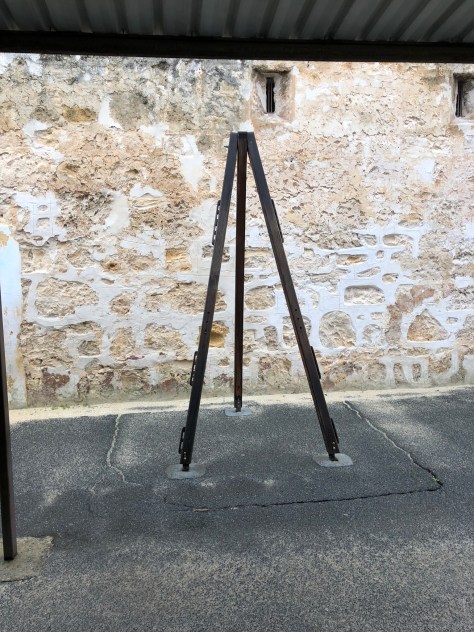
After visiting the rather sinister punishment block and looking with some anguish at the whipping post (a sobering thought – if you received short of the number of lashes you had been given as your punishment before it was decided you had had enough for the day, those were allowed to heal and you were given the ‘balance at a later date……….)
E8A4B775-FE1A-4769-A044-33FC53CEF52A.jpeg
……..we decided we were ‘prisoned out’.
The inclement weather continued, so after another foray into the supermarket, we adjourned home to close down for the evening with Jane Austen, having found an old copy of a Sense and Sensibility DVD in a cupboard.  Who would have thought it!!