Category Archives: Uncategorized

Saturday – Lagodekhi to Sighnaghi

After a wet night and waking up to a slightly damp sleeping bag, it had actually stopped raining when we got up. However it was still very wet underfoot and rolling up a wet tent was not much fun, but all got done and we left the Nature Reserve around 9.30 am. The local people had been in the forest mushrooming since early morning.

Our route took us out through the town of Lagodekhi. Many of the houses, although somewhat dilapidated, have courtyards with an overhead vine held up by a trellis arrangement. Once out of the small town, there was every indication of a poor rural economy. Many of the houses looked like small holdings with ducks, chickens, pigs (we are now in Christian territory) and often a house cow in evidence, but everything looked fairly run down. The countryside was heavily wooded.

After only a couple of hours the town of Sighnaghi came into view across the valley. The town from a distance has definite Italian architectural overtones, complete with the terracotta coloured buildings and tall cypress trees. We were unable to find the source of the Italian connection and close to it was less Italian than at a distance, but it was certainly an attractive place, perched on a hill with cobbled streets and the large overhanging balconies that continue to be popular.

We were staying at a home stay called ‘Nana’s’. The rooms were fine but it was a bit short on bathrooms, having only two for 10 of us and the family.

We had heard that there was an organic vineyard in town called The Pheasants Tears that did wine tasting together with a good lunch, so in no time six of us were off to try it out. What a good move that turned out to be! After a tricky start, a table for six was found and we were served by an American from Boston working there to learn the language. So we sat down to an excellent lunch, all chosen by the restaurant and those of us who wanted to tasted four wines. The method of wine making in Georgia is quite different in the use of the whole grapes and the fact that is made by burying it in earthenware pots underground. The wines certainly have a different taste and are referred to as white and black wine. I preferred the red – or black as they call it. After our meal we had a tasting of the local fire water – grappa which certainly had a kick.

Feeling quite mellow after all this, I set off with Peter and Helen to walk to the local monastery 2 kilometres away. Despite asking the way, we could find no signs to the monastery but ended up at a large Convent where St Niño was buried. There was a small chapel with a bell tower with a lot going on in terms of pilgrims and candle lighting. The second building was a church in the process of being built. The main brickwork had been completed but it had no doors or windows. The whole complex, including a large accommodation building and pilgrims cafe area looked out of the deep valley. These religious houses often have amazing views in my experience and this one was exceptional! They even had a holy spring and there was a good trade going on in plastic bottles being filled with the holy spring water. The whole place had a very festive air, with horse rides available. The horses were rather interestingly equipped with high heeled horse shoes to help them keep upright on the slippery cobbles – it gave them a rather haughty stance. Another rather quirky thing was the fact that the intricately etched maps of the complex all had three ‘you are here’ points on them. All very confusing!

Anyway, after thoroughly investigating the area, we asked a young English speaking nun if there was a more rural route back to Sighnaghi. She assured us there was and gave us directions. However, there wasn’t and before long we were scrambling up a steep tree covered bank to get back on the busy road we had previously walked on and had probably added three kilometres to our journey.

Having successfully returned to the town we collected Keith and set out to try to walk on the town walls that we had seen in the distance around the top of the hill. It just was not our day. By the time we had puffed up to the top of the hill, it became clear that our information was incorrect. There was no path around the top of the walls. We decided to have a drink on the way down to console ourselves and then continued our descent back to ‘centre ville’.

It was just as we reached our home stay that we found Diane’s head sticking out of a cellar cafe that she and Barry had retired to for supper. It took very little to persuade us to join them and a very merry evening was had by all, with interesting meals washed down with ‘black’ wine and served by a man in a track suite who plied us with grappa half way through the meal. No-one drank it but rather than offend we decanted it into an empty coke bottle for Keith to use as a fire lighter at our next bushcamp….,,,,
Friday – the Khans Palace and on to Georgia

We woke up to a dull and miserable day. Last nigh’s rain had stopped but it was still very damp and there was a chill in the air. It felt very autumnal. Season of mists and all that.

We breakfasted in our room on nuts and Pringles and the goats cheese purchased for our Caspian crossing, there being no breakfast supplied. There was good news of Sarah and Wendy though. Sarah is out of the clinic and they are hoping to catch us up in a few days. Very good news.

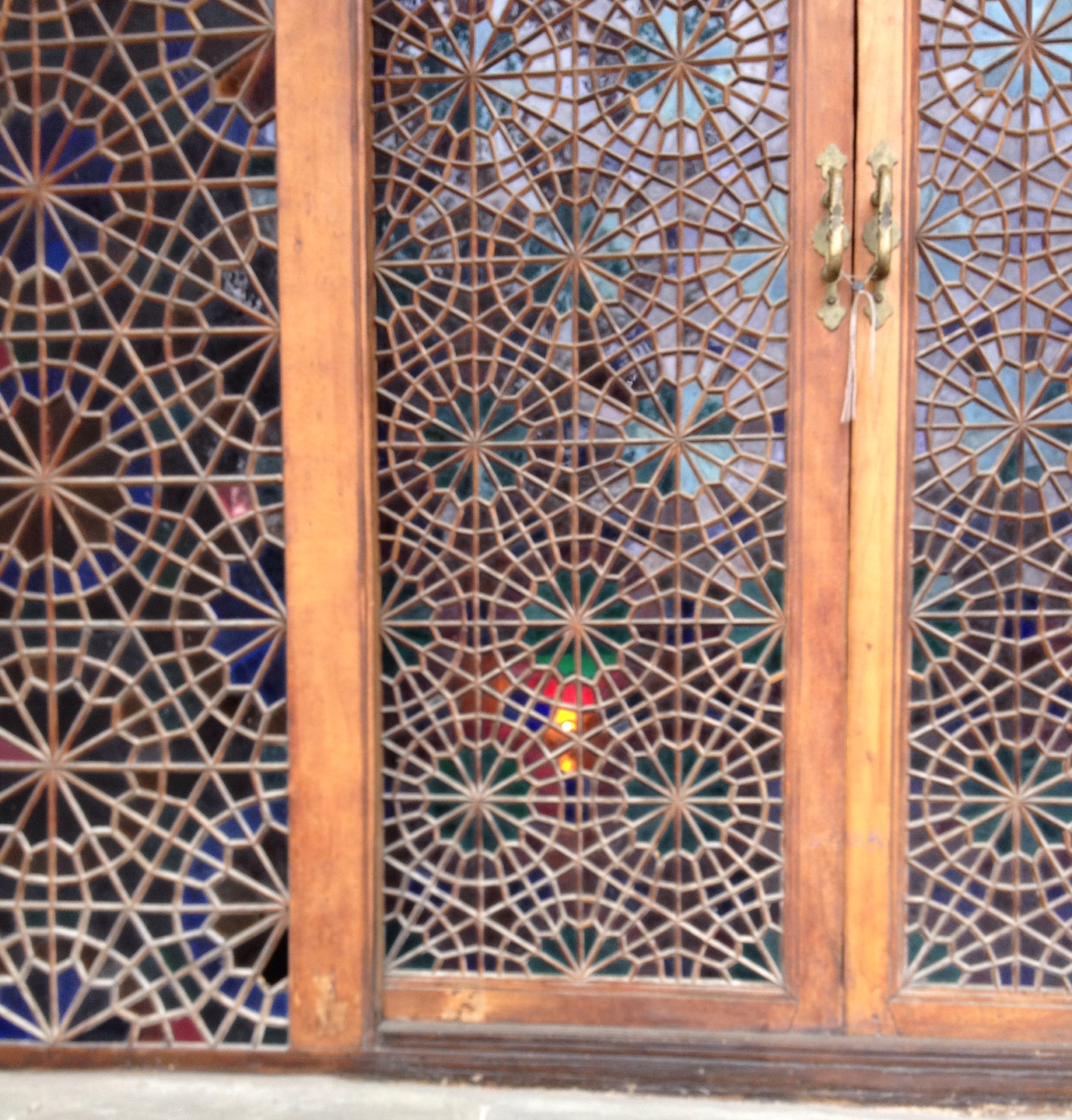
We then set off for the Khans Palace, just a few hundred metres up the road. Here I have to make a correction on yesterday’s publication. I talked of the Sheki windows being jewel coloured glass held in by wrought iron. It is not. It is held together by wood. I only realised this on close inspection at the palace, where every window is made of small pieces of jewel coloured glass set in a nail free wooden fret work. They are stunning,

The palace is dated 17th century and regrettably photographs could not be taken on the inside. We arrived to be told to put on j cloth foot coverings before we could cross the threshold….

It was worth it. The interior was incredible. Every wall and ceiling was covered in hand painted pictures. Battle scenes, flowers, dragons, trees. All were there, meticulously painted on every surface stone surface. The frustration of not being able to record the wonders photographically was immense. We wondered through the rooms spell bound by the pictures.

We eventually emerged to the outside by giant stone steps (these Khan types must have had very long legs) and wondered back to the truck, resisting the opportunity to buy a pot of hand knitted roses at the craft stall on the way.

We left the wooded hills and Sheki after our brief stay. It seemed dryer as we descended into the valley. We were back into the countryside and heading for the Georgian border as Penelope’s 72 hours in Georgia was running out. Our drive took us deep into rural Georgia. It was a chilly day , the coldest so far. The big fields we passed were ready for planting. The route was lined with trees and there were people with bags picking up hazel nuts from the copsed hazel nut trees.

Our route was lined by green grasslands and much more greenery that we recognised. There were chestnut trees, blackberries in the hedgerows and stinging nettles. We saw turkey’s, ducks and horses grazing by the side of the road. There were also signs of the oncoming winter with horse drawn carts stacked high with wood for winter fires. We passed small settlements with lots of cars parked haphazardly and large groups of men around, often the indication of a stock market of some kind. There were very few women or children about. As we drew near to the border the road became more bumpy and it seemed a very far cry from the sophistication of Baku.

The Azerbaijan/Georgian border was a dream compared to the others we have crossed. There are no visas required for Georgia. The only thing to comment on really were two long corridors. The first came after we had been ‘stamped’ out of Azerbaijan. Picking up our bags that had eventually passed through the broken X-ray machine, there was a long cream painted outside corridor with steps. As you walked along it, to the right was a brick wall. To the left a glass window. The path gradually climbed up to the office to receive the Georgian entry stamp, after which there was a similarly lengthy corridor which, after a similar length of climb, brought you out on a bridge guarded by a man with a gun. After walking over the wide expanse of the bridge looking down onto a stoney riverbed with very little water in it, you were in Georgia. As I said, a very easy and quick crossing, but I could not help feeling that if you had a false passport or were trying to smuggle something through, you would have a very long tramp with your heart pounding wondering if you were going to get away with it…. As neither of those things applied there were no such fears, but I could not help but ponder on the topic during my lonely walk into Georgia.

The border behind us, we set off with our Georgian guide – ZsaZsa (a bit unlikely I know and even more unlikely if you saw him! ) – to find our camp site. It was by now pouring with rain, so to say enthusiasm was low was something of an understatement! We were headed for a town called Lagodekhi and it’s nearby wooded parkland. Here Penelope skidded to a alt under dripping trees. We had arrived. In the distance we could see one or two large buildings through the trees – a nature centre project funded by UNESCO. We were to find that this housed a wonderful clean loo – what more could we ask for!!?! Perhaps to camp indoors……

As we are made of sterner stuff, the Ritz was set up and we retrieved our sleeping equipment from the truck, trying to keep it dry as the trees and the heavens continued to pour.

ZsaZsa (mid 50’s sporting a hunters waistcoat under his jacket, grey moustache and hair and glasses on a cord around his neck) then produced a huge plastic container of his friend’s home brewed red wine, which it seemed rude to refuse. Keith, now nominated fire monitor, set about building a fire with very wet wood and we all huddled under the shelter of Penelope’s awning. Up until now this has been our sun shade – now it is the rain tent.

A thick vegetable stew was produced for supper which was good and we sat around chatting and drinking our home brew wine and some ventured out in the rain around the fire, but overall it was a very early night and we went to sleep with the sound of rain ringing in our ears.

Thursday – onwards to Sheki

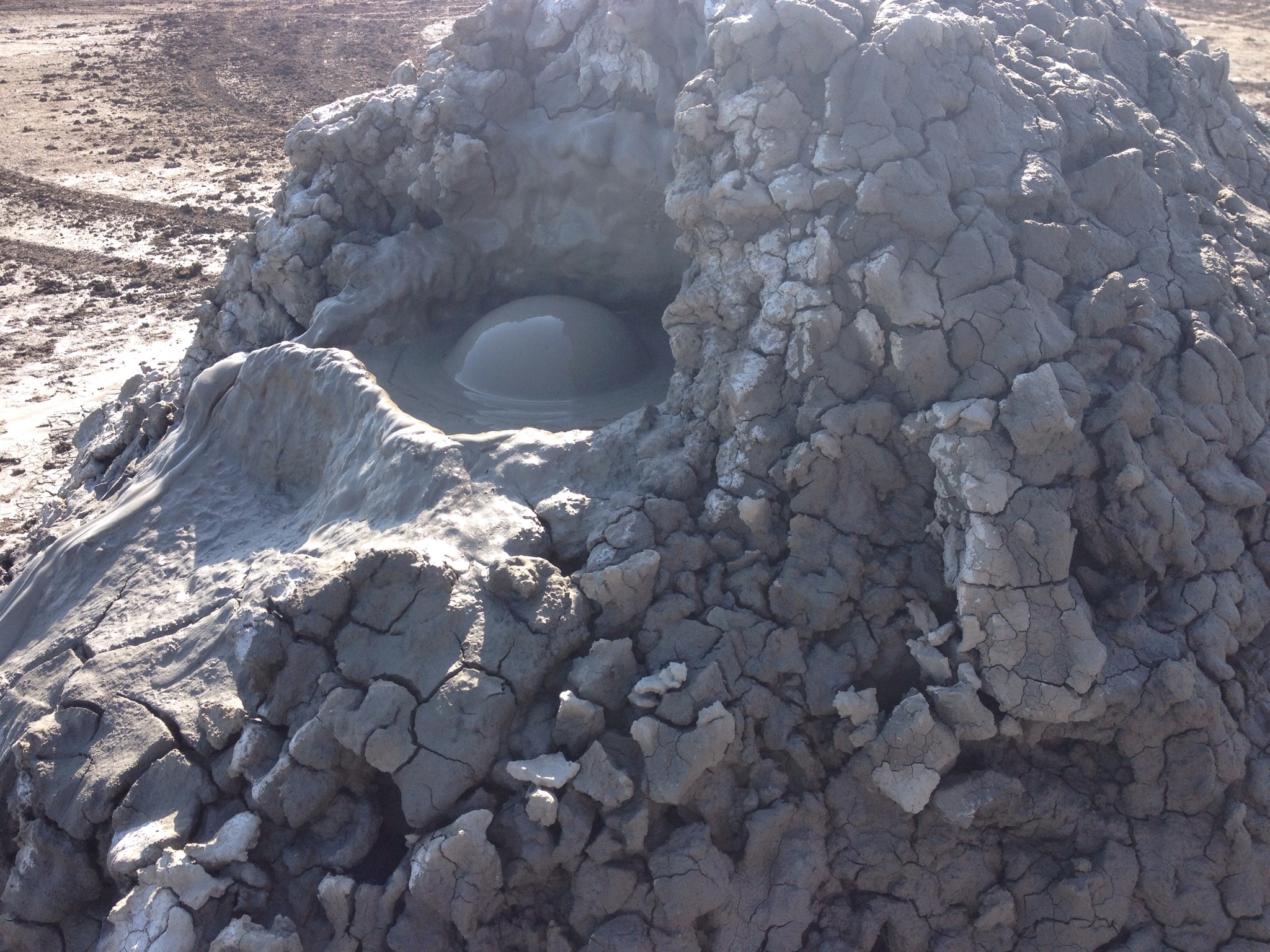
The sun rose over the mini mud volcanoes and was reflected in the muddy pools at their base. We made breakfast and then left this moonscape, bumping back to the track and railway lines onto the road.

Although we have long since left the sophistication of Baku and are in rural Azerbaijan, there is still evidence of a more wealthy economy than we have seen in some of the other desert countries we have travelled through. There were neat single storey houses along the way with smart maroon roofs and new larger buildings, some complete and some in the early stages of development. At one stage a large roadside restaurant was well advanced and was obviously intended to entice the hungry traveller at some stage in the future.

The road itself was still under construction and we were occasionally riding along the edge of the desert to allow a new section to be completed. Where the desert had been tamed the fields looked mostly unkempt and deserted. There is no cotton picking here.

Along the roadside the usual enterprising locals had produce for sale. Though the stalls were mainly selling tomatoes, I saw one car literally full of apples – it’s boot piled high and it’s back window full of bright red and yellow fruit. Others in the group saw a fish stall and live turkeys standing like people at a bus stop, waiting to be purchased. The gardens we passed often had fruit trees. Pomegranates grow here in abundance. In the misty distance mountains appeared a mauve grey on the horizon. Near the road, and somewhat alarmingly, unattended cows wandered and Simons main use of our very loud horn was to warn them that they were getting too close to Penelope’s path.

As the day wore on we entered scrubby pastureland and could see flocks of sheep and cattle either under the care of shepherds on foot or stockmen on horses.

A right turn saw us back over the railway line and our road gradually travelling up towards Sheki which nestles in the wooded foothills of a mountain range. Autumn has definitely arrived here, with the leaves on the trees starting to change colour and the breeze has an edge to it. We drove through the town, the road lined with tiled buildings and probably the most local shops we have seen in any town of its size. Our accommodation is in a large converted Caravanserai. This is the ancient traders accommodation that we have come across so frequently along our route. This was a very large edition. We entered a domed stone courtyard and then mounted steep stone steps up to our room on a stone arched corridor facing into a courtyard where the animals would have been kept. The accommodation itself comprised of an arched ceilinged narrow room, curtained off from wooden steps leading to a bedroom. It had heavy double wooden doors at its entrance and a shower room and toilet arrangement off to either side just before the steps up to the sleeping area. Although the floor was wood, the rest of the walls and ceiling were stone, so it was quite ‘fresh’ shall we say……

There was still enough of the day left to walk back down into the town. Initially there were touristy shops selling the usual ‘tatt’ but we came to realise the majority of the rest of the shops sold sweets!! Mysterious sugary confections lined the counters and boxes were stacked up on shelves. Keith’s view was that a good dentist could probably make a fortune here!

The town of Sheki is renowned for its stained glass windows. The glass is jewel coloured in a wrought iron framework. We saw it in the palace in the Baku old town. There was evidence of it in the windows of several of the buildings in the square and I guess we will see it in the Khan’s summer palace which we are to visit.

We took our supper in a low vault like restaurant that felt as if it was underground. The service of our food took place over a lengthy two hour period. When the final dishes arrived we had more or less forgotten what we had ordered and had made the mistake of filling up with bread while we waited. Disaster!

So was the pouring rain when we emerged……

Wednesday – more Baku then bubbling mud volcanoes

We had another lazy start to the day (you have to make the most of them on this trip!). We met some of the others at breakfast who recommended the museum, but as it was a nice day we decided to forego the culture and walk along the esplanade to make the most of our time by the Caspian Sea. As Diane, our representative from New Zealand, was finding the traffic a bit challenging, she came too.

Sadly there was no news of Sarah.

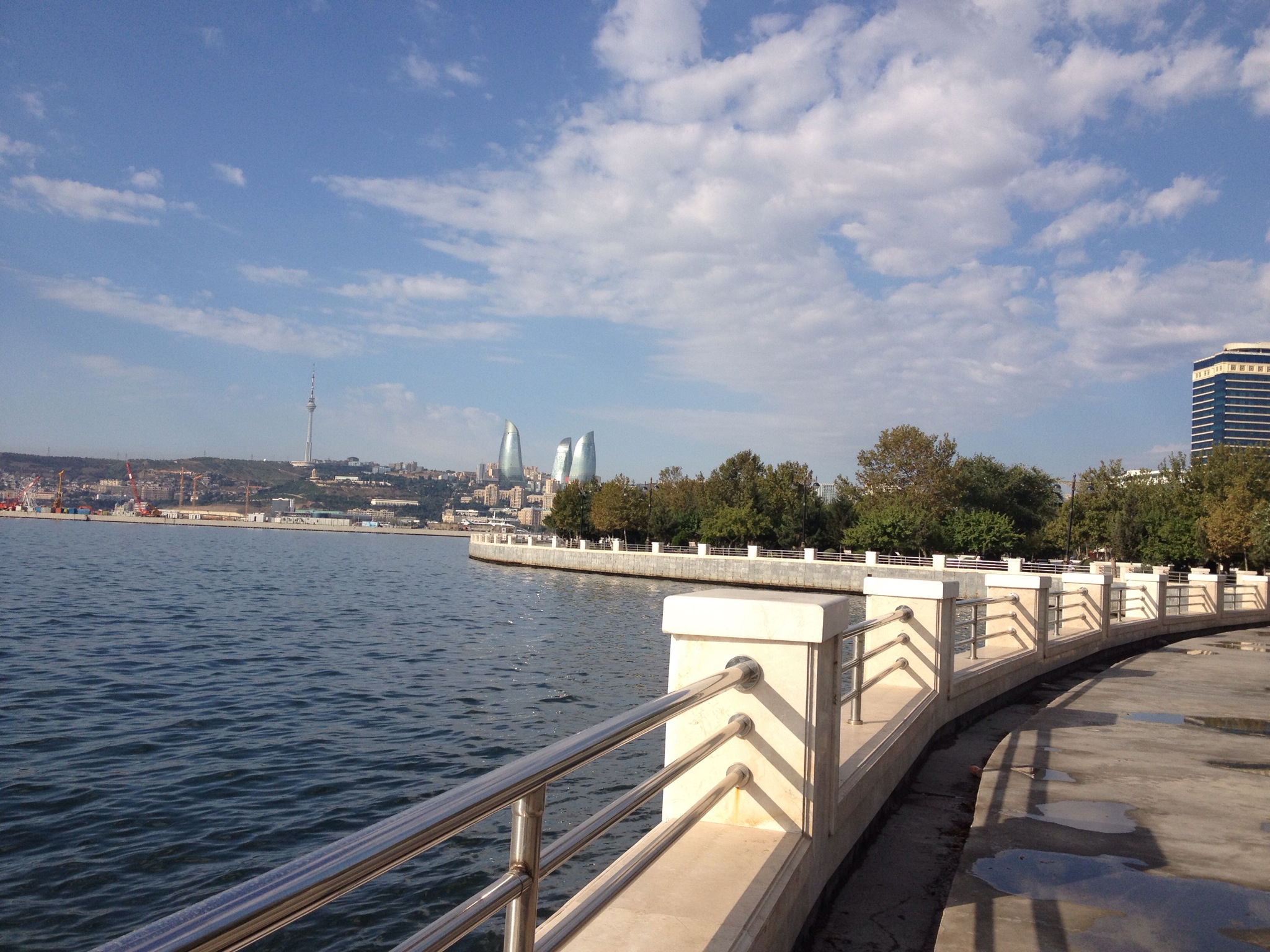
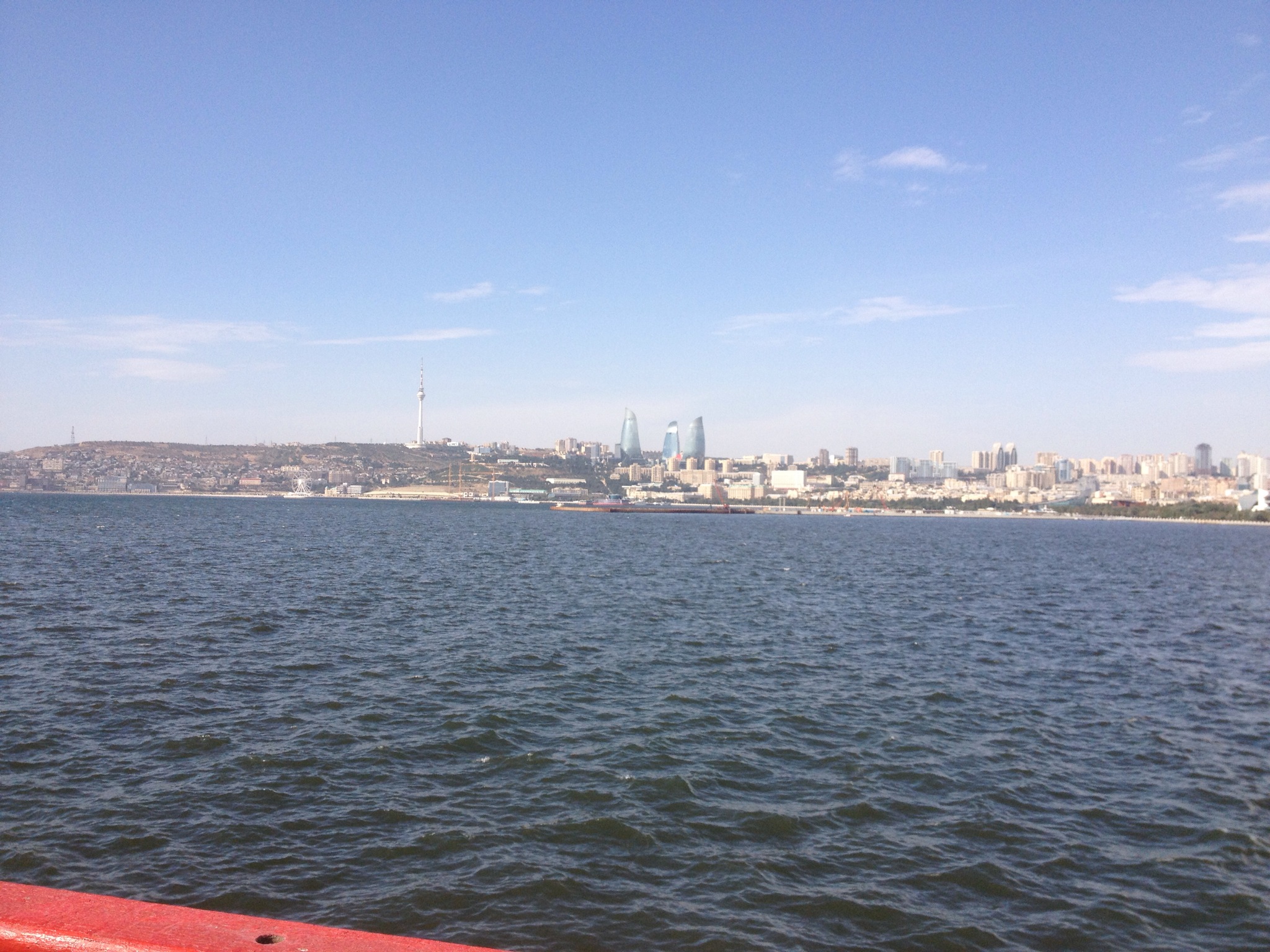
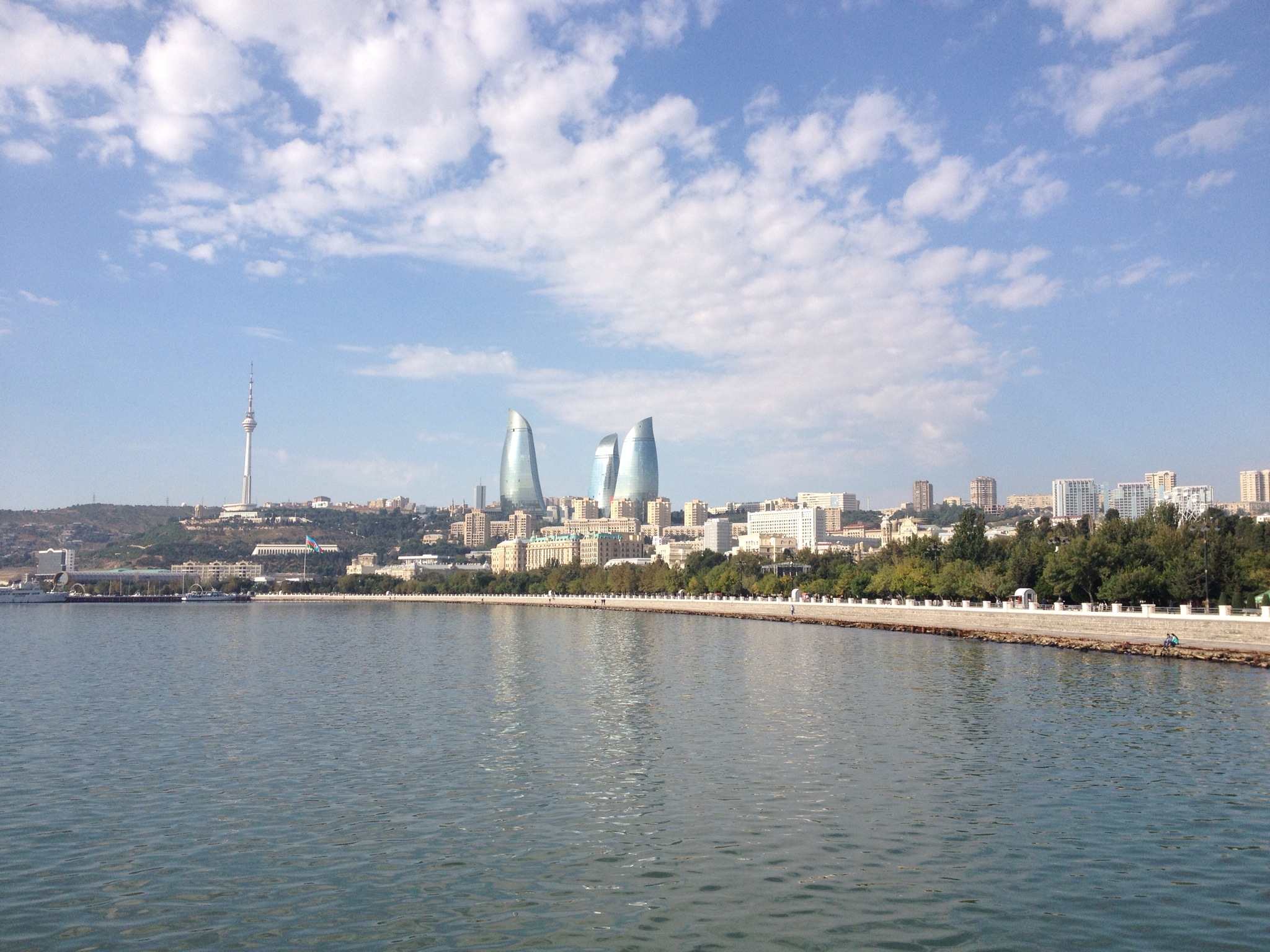
We sallied forth towards the sea and found that we almost had the sea front to ourselves. The broad white marble promenade had wonderfully lush gardens on the land side, the sea glistened in the sun and before us was the wide sweep of the bay of Baku, with its distinctive architectural fins in the middle distance. From this angle, three fins are clearly visible, although you usually see only two at once, thanks to some fancy perspective magic. Apparently one of them is an hotel, one is apartments and one a financial building.

We wondered along towards them, with our back to the docks where the ferry had berthed. This was a very different aspect of Baku to the old walled town we explored yesterday. It was definitely the playground of the oil barons and a showcase for their oil wealth. Their exotic boats, bristling with antennae and beautifully designed water going javelin shapes, could be seen tied up on jetties and in the yacht marina. They seem to bob up and down in the water in a very superior fashion……..

There was a ‘wooden’ pier jutting out into the water – all very tasteful with a sculpture of an angler in bronze hanging over the railing. There was no sign of a any human fishermen daring to fish and sully the landscape with maggots! We continued our walk. At ntervals there were cafés and kiosks selling cool drinks, occasionally there was a young Mum with a child in a jolly upmarket pushchair conveyance – we could have been in the south of France. What was conspicuously absent were joggers. Any long flat expanse like this at home would be a magnet for Lycra bound runners showing their paces.

After walking for over an hour by the sea we came to the carpet museum – shaped like a giant roll of carpet! It was close to the building created to host the Eurovision Song Contest a few years ago (that’s where you might have heard of Baku). We decided to take a look at the Museum. The carpets were amazing. The museum took you through from the old carpets of Persia through to modern designs and processes. We saw how they made a sort of shelter of carpets thrown over bent saplings for travelling and how the Silk Road travellers used carpeting for travelling bags and saddles for their camels and mules. The designs and patterns were exceptional. The skill taken to make them phenomenal. It was a really good insight into the history of carpet making in the area and well worth a visit.

Having educated ourselves on the vexed question of carpet manufacture and all that it entails (no photography was allowed) we wandered into the old city for lunch and then back to our hotel for a 2.00 pm departure to some bubbling mud volcanoes where we were to camp for the night.

Sarah is still in the clinic so has to be left behind. She and Wendy will try to catch up with us when Sarah is well enough to travel. I was really saddened by this news as they are a lovely couple and I am not sure if they will be able to make contact again as we are out in the wilds for several days and co-ordinating transport is not easy in these parts.

We shall see, but it was a sobering lesson that if for any reason you can’t keep up, the journey rolls on without you. We are now down to eight travellers plus two crew. Given that the trucks capacity is 20 (which would be ghastly!) we are beginning to rattle around a bit!

Anyway, after saying fond farewells to Wendy who had come to take their belongings from the truck in case they cannot catch up, we set off for our bubbling mud. We followed the bay road out of town, soon leaving the sophistication of the new city, into the industrial outskirts. In the sea one or two oik rigs could be seen not far from the shore. Eventually we ran out of the urbanisation and back into the desert.

The ubiquitous railway line ran parallel with the highway. After a couple of hours we turned right into the desert on a sandy track. We bumped along, crossing several railway lines and a big pipeline. The track surface got worse, we lurched over it, the truck rocking from side to side. Our route began to climb and pointed hillocks like giant ant hills appeared. The only thing growing on the sandy mud was a prickly shrub which seemed occasionally grow to a small bush size. Penelope ground to a halt. We were at our bush camp.

We piled out and scrambled up to the top of the hill where the bubbling rock pools were. Sure enough, every few seconds there was a gurgle and a large bubble would appear on one or other of the pools. The bubble would then burst with a plop and all would be still until the next bubble. Wet streaks running down the side of these peaks would indicate that occasionally more energetic bubbling causes the wet mud to breach the mud craters and run down the side of the hills. This process has obviously been going on for hundreds of years as this flaw in the earth’s crust allows something of its inner workings to be exposed. I couldn’t help but feel that it looked like a working demonstration of earthly indigestion……..! A little underwhelming perhaps, but yet another new overland experience. Having captured a bubble on camera – not quite as exciting as getting that photograph of a whales tail, but similar – we trudged back down to the campsite to dig out The Ritz and make our nest for the night.

Tuesday – sightseeing in Baku

We had a lazy start to the day. It was raining. Not what we are used to and Keith had left his wet weather gear on the truck and we had no access to it. As the rain showed no sign of stopping we set out, bought him a jacket and then went to revisit the old town. This time with a guide and a camera!

Baku really is a fascinating place and our guide, Raphael, brought it to life for us. We started with the Maiden’s Tower which was apparently at one stage on the edge of the sea. It’s dimensions are amazing – 5 metres thick and 28 metres high. It has been used as safe haven, a defence, a light house and an observatory. It’s top is also now at sea level so the whole of current Baku lies below sea level!

The tower is built of the local limestone, as is much of the old city. There is evidence of a church beside the tower. Azerbaijan was one of the first countries to be converted to Christianity. The name Azerbaijan means ‘land of fire’ and before Christianity the people were fire worshippers.

Of the 90 million Azerbaijani people living in Azerbaijan, 30 million live in Baku. 45 million Azerbaijanis live in Iran. Another result of the moving borders issue. Oil was discovered in Azerbaijan in the 1800’s but they have exhausted the oil to be found on land and their oil now comes from under the Caspian Sea.

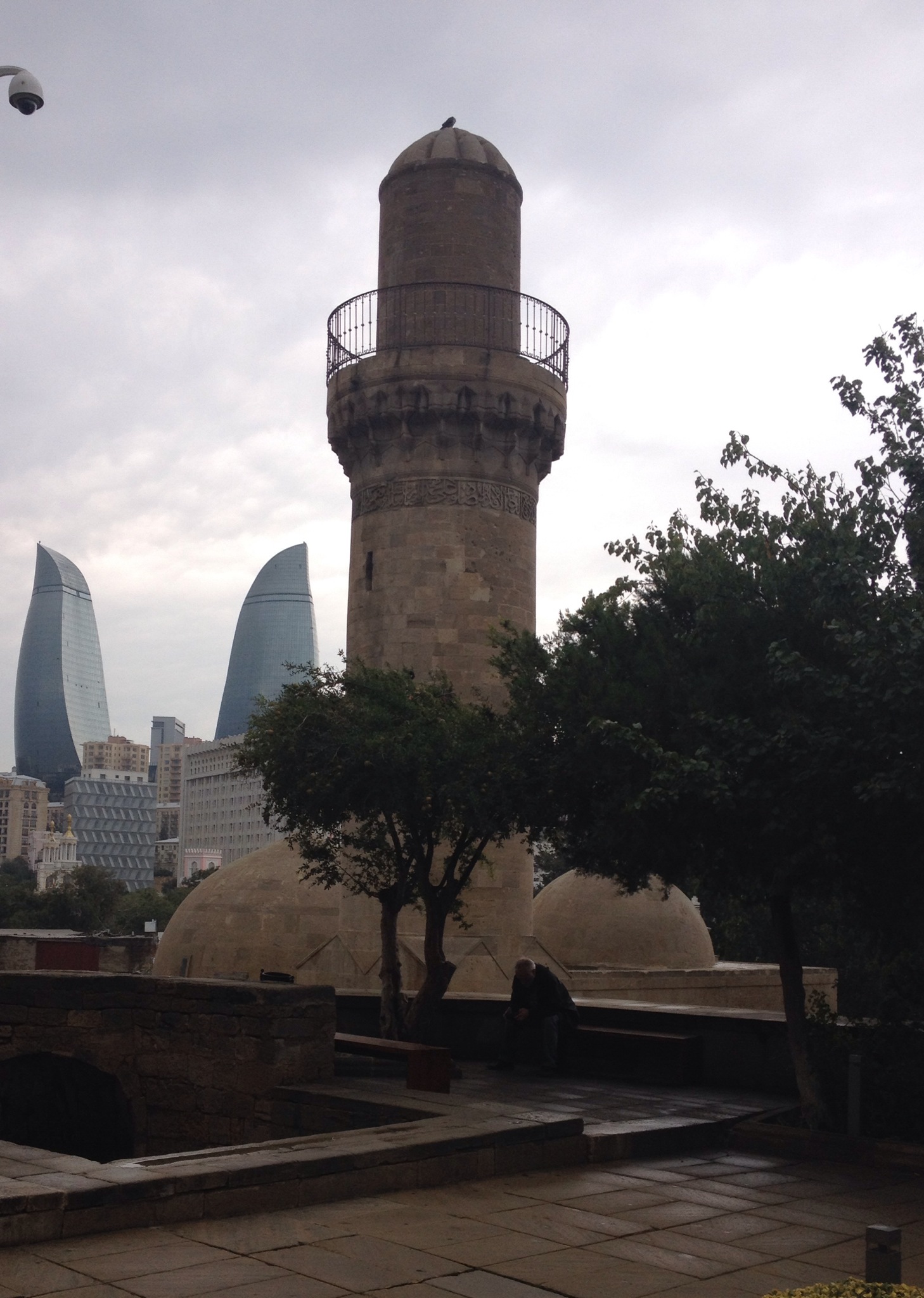
The Palace that we had already visited was part of the tour and a lot of new things became clear. For instance, In the courtyard of the domed palace there are a large number of stone slabs with Arabic writing on them. They were apparently rescued from the large castle now under the sea in the bay. They are incredibly well preserved, given that they were under the sea for many hundreds of years. The palace itself is lovely. Built in the sandy limestone of the area it has many rooms and a large bathhouse built on the side. At one point there is an amazing view of the palace mosque with the huge fins of the new city behind it. Old meets new Baku style!

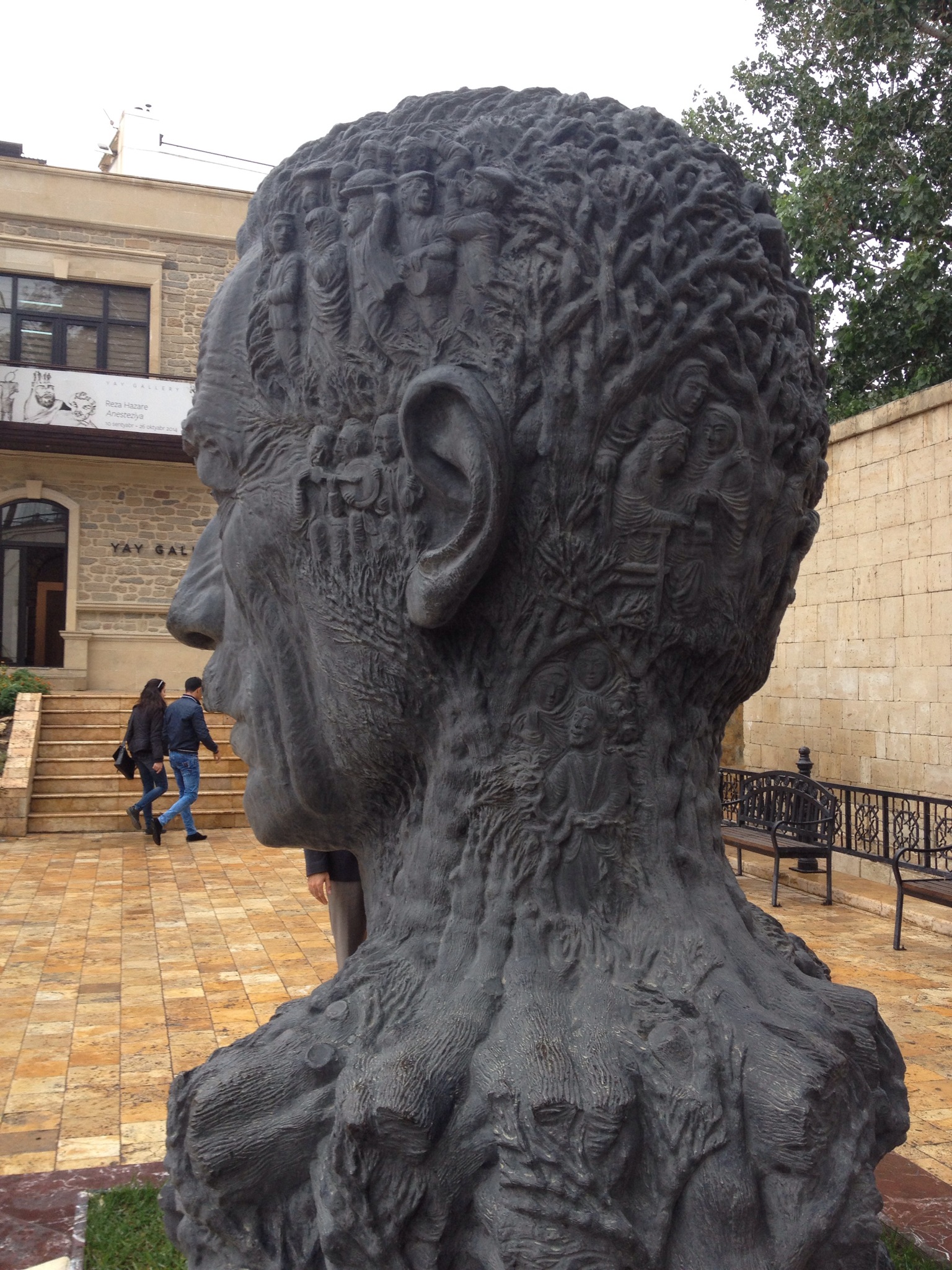
In the old city square there is as sculpture of a famous poet and philosopher of the region. It is the work of three sculptors and at close range his hair is comprised of all sorts of figures and activity associated with his writing. Fascinating!

After several hours of his time, Raphael left us to have his lunch and wandered outside of the old city walls to find somewhere to eat ourselves. We found ourselves in fountain square a large garden area with lots of trees and, as it name implies, lots of fountains. Lunch eaten we strolled back to the hotel. It was still drizzly and overcast, so it was blogging time for the Gregory’s. It was good to have time to catch up and reflect on the last few days.

Sadly we also learned that one of our party had been taken into hospital with tummy problems. It was one of our lovely Australian ladies. We were very concerned for her. Hopefully there will be better news soon.

We strolled out again in the evening by ourselves and after a light supper returned for an early night, we take off again tomorrow and it is a bush camp overnight.

Monday – arrival in Baku

I woke to the sound of the anchor being rolled out. It was 6.00 am. We were ‘parked’ out in the channel outside of Baku harbour. Dotted around were other vessels waiting to dock. I had had a good sleep so got up to watch the sun coming up. It was a beautiful sunrise. The morning was quite grey, but the sun appeared as a salmon pink ball on the horizon.

As daylight came we could gradually make out the amazing architecture of modern Baku. There are some terrific designer buildings that compare very well with modern buildings in London or Dubai. It was not at all what we were expecting! Having said this neither of us had heard of Baku! Two enormous grey fin like structures were particularly noticeable. When the cloud dispersed they shone in the sunlight. There was a lot of glass and wonderful shapes to be seen from our vantage point in the harbour. Baku is a wealthy city and it shows.

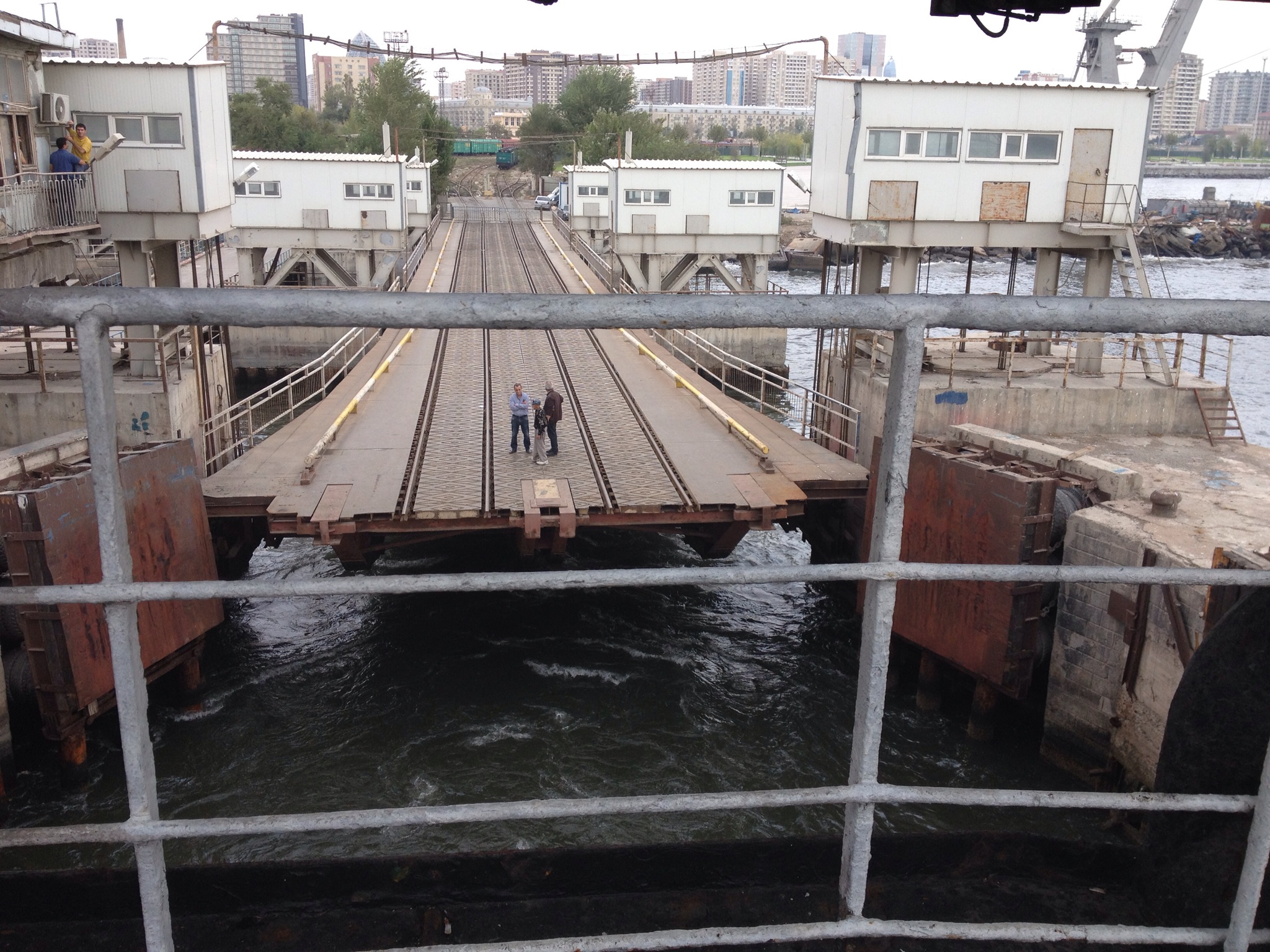
We then had a long wait. When it was allowed to approach the dock, the ferry had two attempts to lock on to the rails on the jetty to enable it to unload its train. I found it a very tense business, although I think our Captain had done it before! Once the berthing had taken place, all sorts of upmarket passengers emerged who we had not seen on board before. They were certainly not in our accommodation! We were definitely in ‘steerage’ – I am not sure what that means but it was certainly mentioned on the TItanic!

We eventually got off the ferry at about 12.30. Following a lengthy border control and customs process (we were behind the televisions, washing machine and carpet) we arrived at our hotel at 3.00, having left Penelope in the border control car park. Penelope can only be in Azerbaijan for 72 hours, so the longer the truck can stay in their compound the later it is before the clock starts ticking for us to leave Azerbaijan. All very technical!

We dumped our bags at the hotel and set out for the old town. We had already experienced Baku traffic during our brief taxi ride from the port. The jams were chronic. Every cross roads was completely gridlocked. The cars were very upmarket with Porsches, land cruisers and range rovers all very much in evidence. Surprisingly there are also London taxis! I think their traffic light system could do with attention!

Apparently Baku is one of the oldest cities in the world with evidence of a town here back as far as 600 BC. It is much bigger now than it was and has extended way beyond its old boundaries, but many of the outer walls of the old city remain. The skyline of the old town is dominated by something called the Maiden’s Tower a very oddly shaped building – a tower at one end and a stabilising brick wall to one side. At the base of this are some old buildings including three Caravanserai – the ancient traders accommodation we have seen all along the Silk Road. Today these are now an upmarket shop and restaurants.

We wandered the old narrow streets and up and down the steps inside the city wall. There were some distinctive old houses with huge wooden balconies, two mosques and an amazing palace which we went in to investigate. I was very frustrated in that I had no means of taking photographs as my phone had completely run out of charge following our Caspian Sea crossing.

Having had a thorough wander around the old town, we set off to find Paul’s, a bar said to sell champagne. We found the bar – no champagne, but excellent wheat beer and wonderful steaks – after two days of snacking we really enjoyed our meal. Steak has never tasted so good!

It was then home to bed with the thought of not having to get up in the morning!!