Category Archives: Uncategorized

Wednesday – sightseeing, retail therapy and Armenian culture

A walking tour of Yerevan had been booked for us and we set off with a beautiful young Armenian woman whose name I will not even start to pronounce. She gave us a most informative tour of the city, together with a useful history of Armenia’s struggles explained patriotically but with a wry humour, something we have rarely experienced from our guides to date. Bless her. She said that in her view Yerevan was the most beautiful city in the world. Keith and I could not help but think of Florence and Venice and how lucky we are to have seen these wonders….

There is evidence of a settlement in the Yerevan area 2,750 years ago, but the current city is mainly modern having suffered the ravages of first the Persians and more recently the Russians in addition to occasional earthquakes. Although previously Islamic, it now has only one mosque that was not destroyed because of a last minute intervention of one brave soul when the Russians were attempting to wipe out all religions.

Half of Armenia became part of Persia, modern day Iran, and Mount Ararat (of Noah’s Ark fame) used to be in Armenia and can be seen from Yerevan but is now part of Turkey, much to the Armenians frustration. A lot of the buildings, although of Russian origin, look different because they are built in the local rose coloured stone, rather than the usual ugly Russian grey concrete.

Armenian Christianity, the state religion, sounds pretty strict with a requirement for the whole congregation to stand throughout a two and a half hour service that is carried our in ancient Armenian, which few but the old can understand. By all accounts there is little interaction with the congregation. It sounds a long way from the happy, ‘clappy’, hand shaking trends of the Church of England. Despite all this, the numbers of young people taking up religion is increasing, although our young informant said she was not sure whether this was ‘out of habit or belief’. Nothing if not honest.

Yerevan is also the home of Ararat Brandy that was apparently Sir Winston Churchill’s brandy of choice. Apparently they shipped it over to him in vast quantities. He is said to have noticed when its taste changed at one stage, due to Stalin sending the brandy maker to Siberia for his political activities. Stalin was pressed to authorise the man’s release in order that the Ararat Brandy, factory which was nationalised, could retain Churchill’s custom. The brandy factory is built on the site of an old fort.

The majority of Armenians live outside of Armenia in the United States, Russia and France. Some live in England. Most of the wealth of Yerevan comes either from people living abroad sending money back or is held by the few oligarchs who live in the city.

There is a huge statue called ‘Mother of Armenia’ high up on the hill, looking down on the City. She is on the site where Stalin’s statue used to stand.

The central area of the city around the Republic Square is dedicated to cafe street life. Controversially the old centre has been demolished except for one road where the people are refusing to move to make way for a new, marble pavemented, pedestrian walkway, already lined with international designer shops, although they are still laying the pavements. Walking down through this area proved quite hazardous as we tried to avoid men drilling the pavement tiles and laying cement.

The huge opera house dominates the end of this street. This huge building, ‘Stalinesque’ Russian dark gray, dourly peers down on the glass covered shop fronts of Armani and Burberry, seeming to exude an utter condemnation of the excesses brought about by a hedonistic and frivolous age.

The final place on the tour was what I can only describe as the Yerevan, much larger and not yet finished, equivalent of the Spanish steps in Rome. Called ‘the Cascade’ it is a central marble fountain that goes right up to the top of a not insignificant hill with steps on either side. There are terraces at various levels where pieces of art – the collection of an extremely wealthy benefactor – are displayed.

The tour finished, we set off to a well deserved lunch and then a bit of a spend as I purchased not one, but two sweaters. The ease with which one can get back into the saddle of spending money does not cease to amaze me!

Keith and I then went back to look more thoroughly at the art gallery around and within the Cascade and then walked back to our hotel on the outskirts of the city – no mean feat as it took about an hour, mainly uphill!

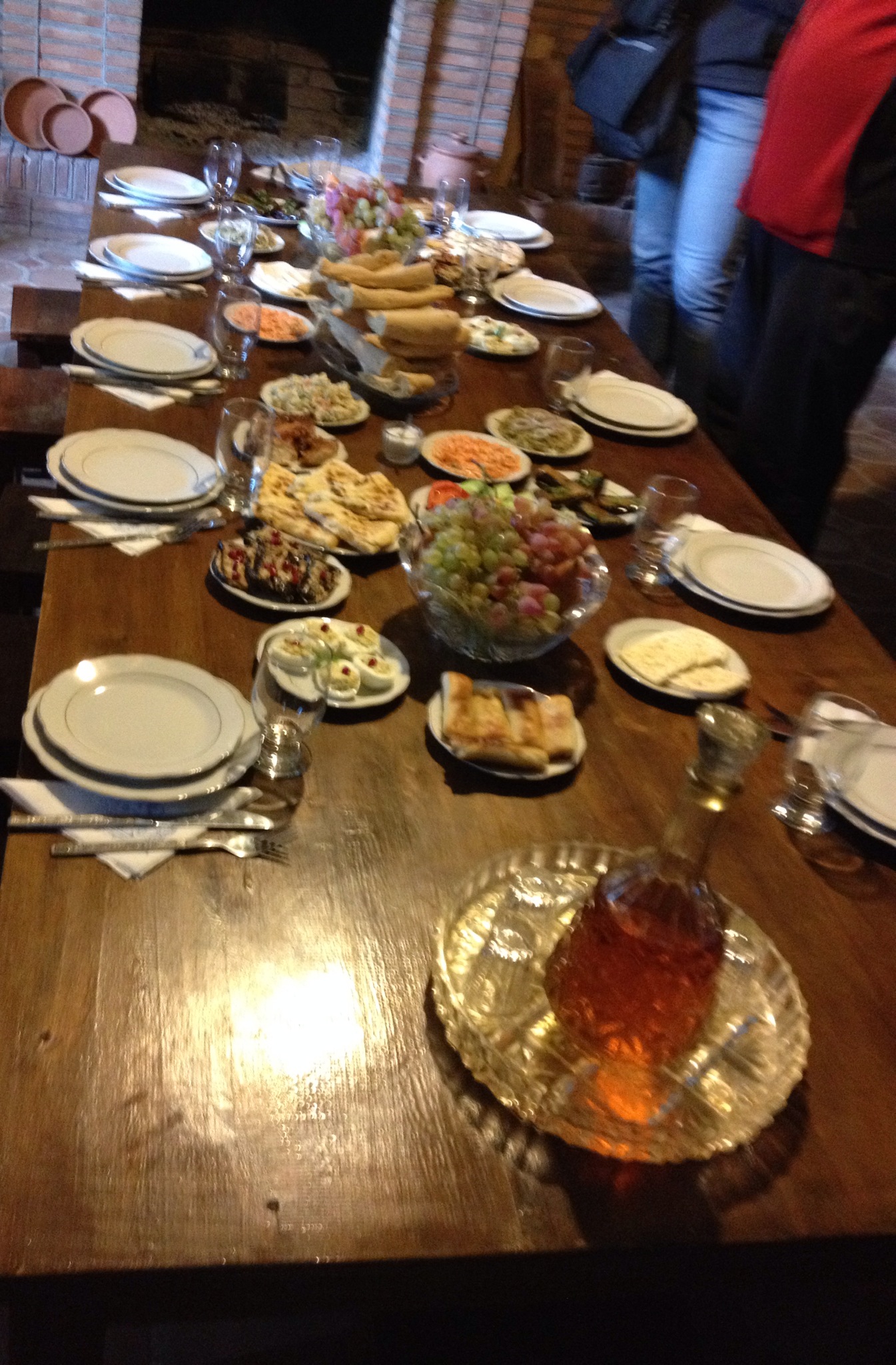
Our supper was a group meal of typical Armenian food. It was served Russian style – always a danger as you consume vast quantities of the plates laid out and then an equally vast number of additional dishes arrive! So it was on this occasion, but we had a jolly meal washed down by Armenian wine served in stone jugs.

Then home to bed. Very full, but happy and finding it difficult to believe there is only just over two weeks of trucking left.

Tuesday – Armenia and Yerevan

We were breakfasting at 7.00 so it was still dark as we packed up the Ritz. It had stopped raining but was still damp and I was on breakfast duty. Despite all this, we were on parade on time, but once again sleeping bags had touched the edge of the tent in the night so could not be put away and my trousers were distinctly wet in places when I put them on. Not ideal….

We left the bushcamp at 8.00 and were at the Armenian border by 9.00. Our crossing was particularly easy as UK citizens do not need visas for Armenia – all other nationalities represented in our group had to buy visas at the border while we trotted through and chatted to the border control police. They were great fun. We felt sorry for the others filling out forms in the rain, but I was a bit concerned about what the British had done to be visa free. This trip has made us much more politically aware of the issues of these countries and the sensitivities between them. The border is closed between Armenia and both Turkey and Azerbaijan. We were warned not to mention some of the countries we had come from or were going to for fear of reprisals……

The young border police said we would like Armenia better than anywhere else we were going. We mentioned the rain that was at this time falling fast – their view ‘you are from England – the English like the rain!!’ I am not sure.

The countryside carried on where Georgia left off – not surprisingly as they were both part of the moving borders game. The windows on the truck became steamy for the first time and the floor is covered in mud, but it is no longer my problem. I have moved from cleaning duties to security and waste – a rather amusing turn of events given that most things are pretty insecure when in my possession and wasteful is my middle name. Hey ho!

The first town we passed through had the usual Russian look of crumbling concrete and greyness, but the scenery started to get hilly again and through our steamy windows the autumn colours of trees became evident again. We passed through wooded valleys and then the concrete and washing festooned tenements of towns with lots of rusting carcasses of cars, the all wheels gone. These are rural settlements where money is scarce and employment hard to come by. The natural gas pipes are still with us.

Mountains came into view with towns and villages nestling in their foothills. The sun came out and we had a camp lunch by a pine plantation. Some German travellers stopped to chat and said that they had decided not to venture further east because it was getting too cold and that they were going to turn back.

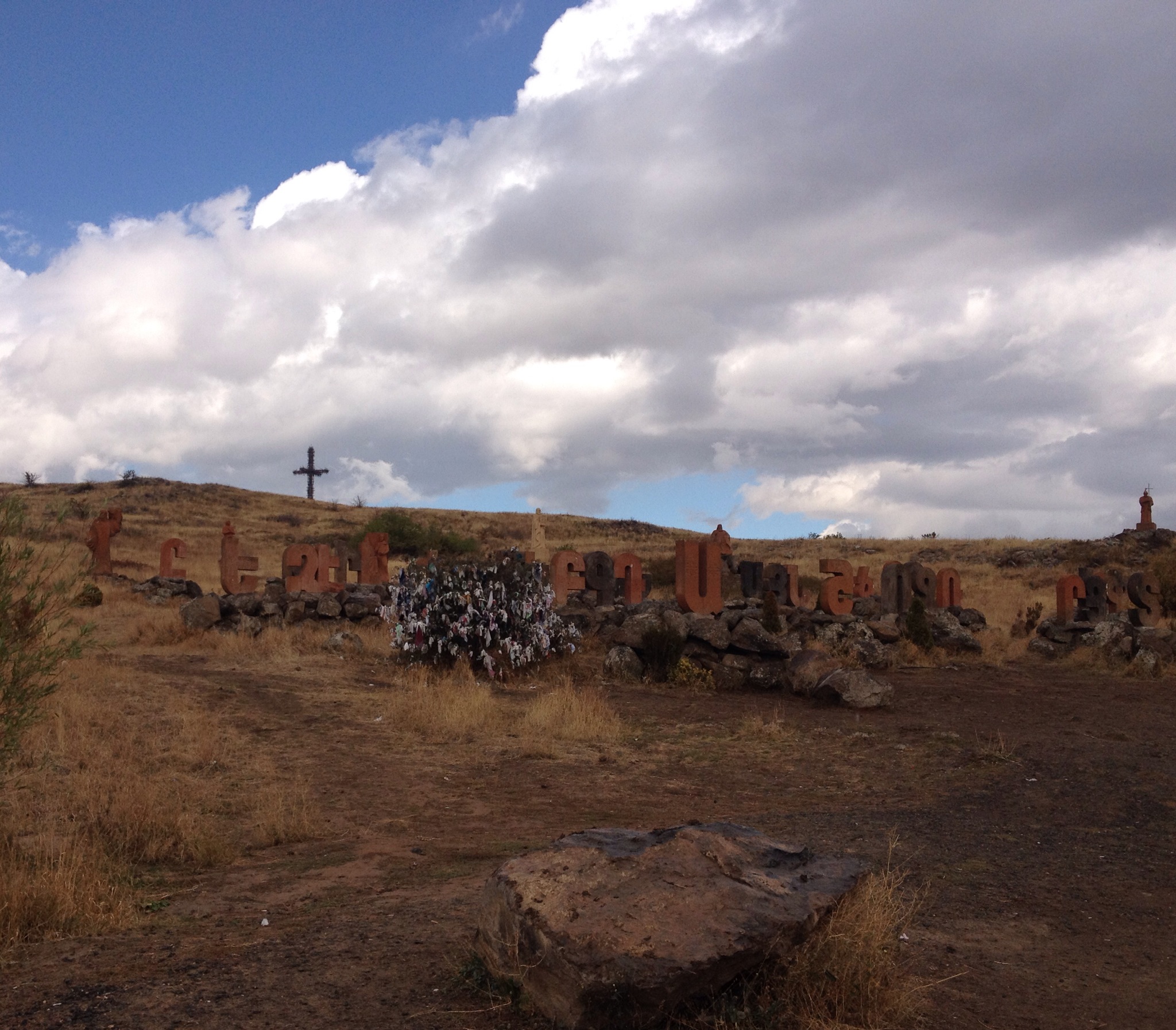
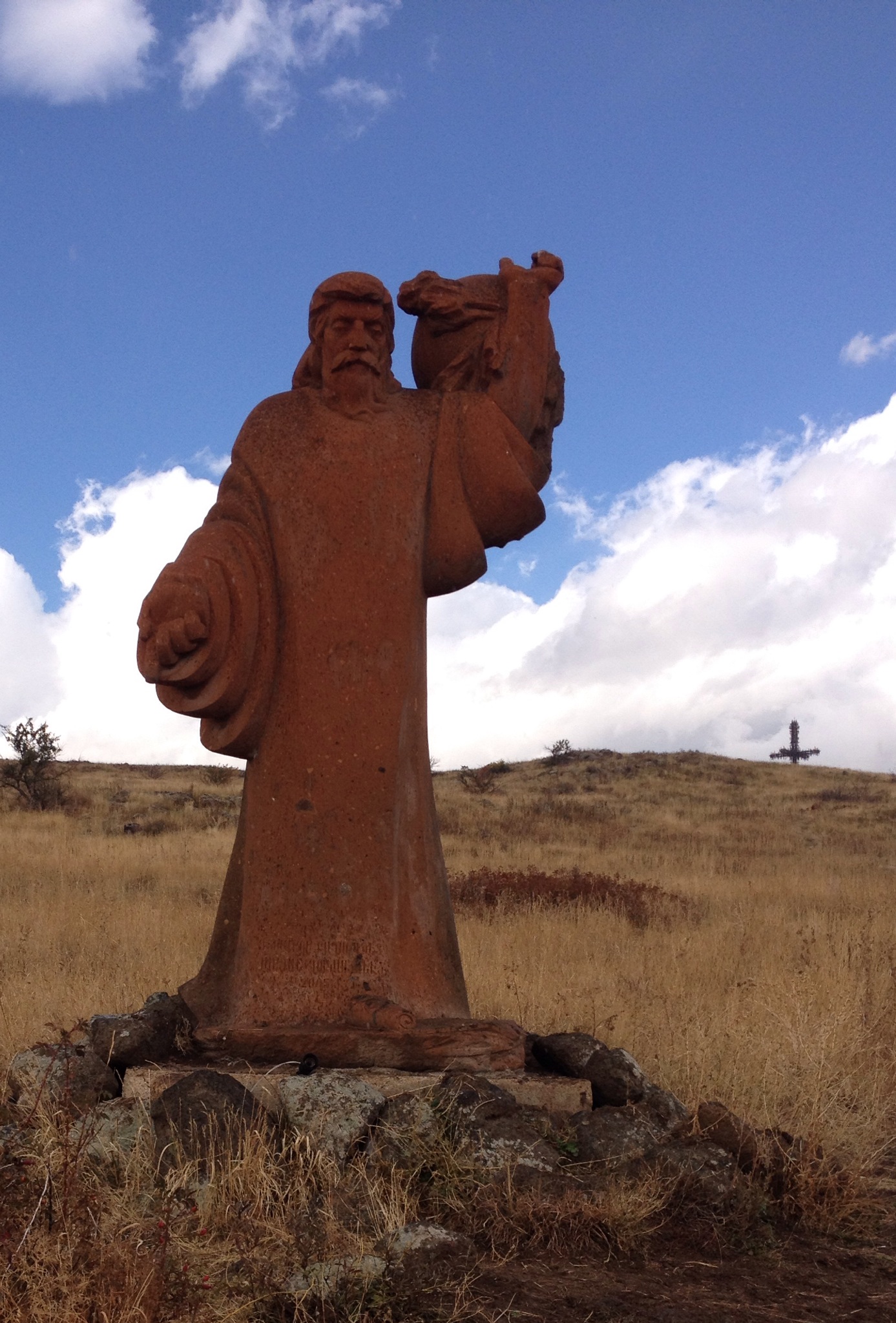
We stopped at an Armenian memorial site – the letters of the Armenian language picked out in rust coloured stone on the hillside with a large cross made of thousands of small crosses standing proud on the skyline. Armenians are staunchly Christian. Shortly afterwards we drove into the city of Yerevan the proud capital of Armenia. My first impression was the number of florist shops we passed – apparently Armenian women are constantly given flowers by their men – a trait I hope Keith picks up.

Tree lined wide boulevards, huge Russian buildings, parked stretched limousines (the first sighted since we left England), hundreds of taxis and fashionably dressed young people all indicated a buoyant social elite in the city. We are staying for three nights. Time to get clean and maybe purchase a warm sweater as it is cooler than anticipated.

Doing our homework, we had identified a Lebanese restaurant and we set out to have supper there. Despite instructions from the hotel staff, our taxi driver had difficulty finding the place and at one stage got out to search for the address on foot! The people here are really lovely. Eventually the restaurant was found and six of us had a terrific Lebanese meal.

Monday Tevali, a special monastery and another rainy bushcamp

The home stay, although a bit chilly, was something of an experience. From the outside it could be mistaken for a 1950’s council house in the UK. The inside was very different. As you entered the front door you were confronted with a sweeping wooden staircase up to the first floor. The wood in the house – and there was a lot of it – was highly polished and inlaid with dark and light shades. Downstairs the walls were all elaborate wooden panelling. Upstairs the walls were papered but the ceiling had ornate plasterwork and a large chandelier. Silk rugs hung over the banisters.

The long table where we had a feast for supper, was equally heavily laden for breakfast and steaming cheese dumplings were added to the dishes already in place when we sat down. The home made yoghurt was great.

After this substantial repast we set off for the town of Tevali to get supplies. The great news of the day is that Wendy and Sarah who had been ill, were to join us on route. It was fantastic news. Tevali was a fairly typical small Georgian town. Most people seem to buy their vegetables in the markets on a daily basis – we have seen no signs of supermarkets or out of town shopping for literally months!

While Emma and Simon went off to do the catering for the day, we had a scamper round the market ourselves. Despite having just eaten an excellent breakfast we succumbed to a wonderful cheese in flaky pastry turnover which seems one of the specialties and very yummy it is too!

I will draw a delicate veil over Keith and Helen’s hilarious purchase of new undies from two ladies in the market……the ladies were tickled pink and overcharged them mercilessly, but it was worth it for the entertainment value!

After all this excitement it was back in the truck to get some substantial miles under our belt to position us near to the border by nightfall so that we can cross into Armenia early on Tuesday. Our route initially took us across wooded hills magnificent in their Autumn colours. There were houses dotted amongst the trees. The road began to climb until we had reached 16,000 metres above sea level. While we are doing some metrics, we have now travelled 12,700 miles since we left Beijing, not counting the Caspian Sea crossing.

We travelled on, descending once more into a valley and eventually travelling through a sort of grassy desert landscape. There was no sign of cattle or sheep grazing and no trees or shrubs. Just short grass. During Russian times it was apparently used as an army training area. It was vast and very unfriendly looking.

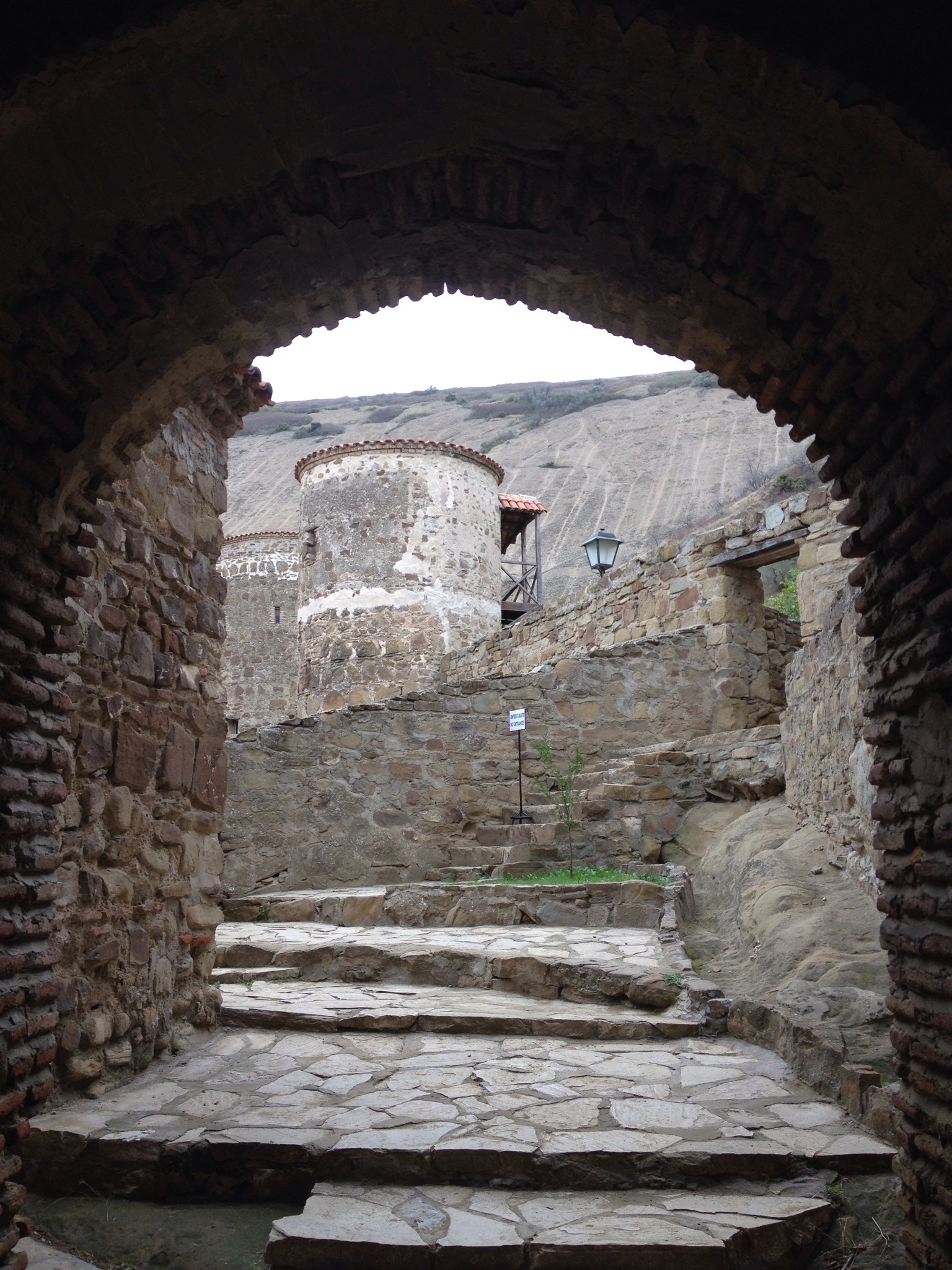
Occasionally we saw abandoned watch towers on the horizon. It was a very remote area and very close to the border with Armenia. Just before lunch we arrived at the site where at one time there were 15 different monasteries dating back to the 6th century. Most have been abandoned and all were either destroyed or vandalised during the Russian military occupation of the area.

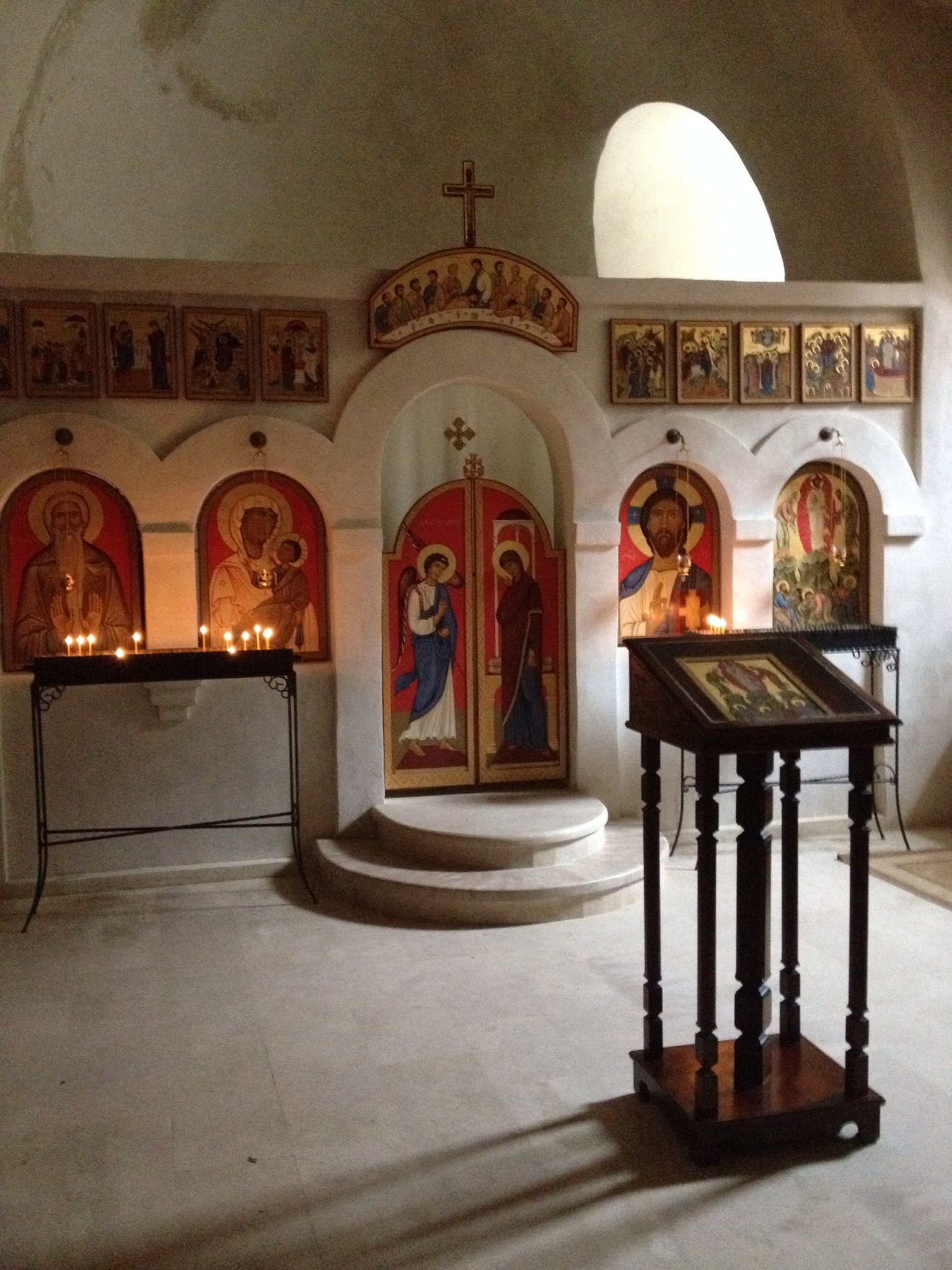
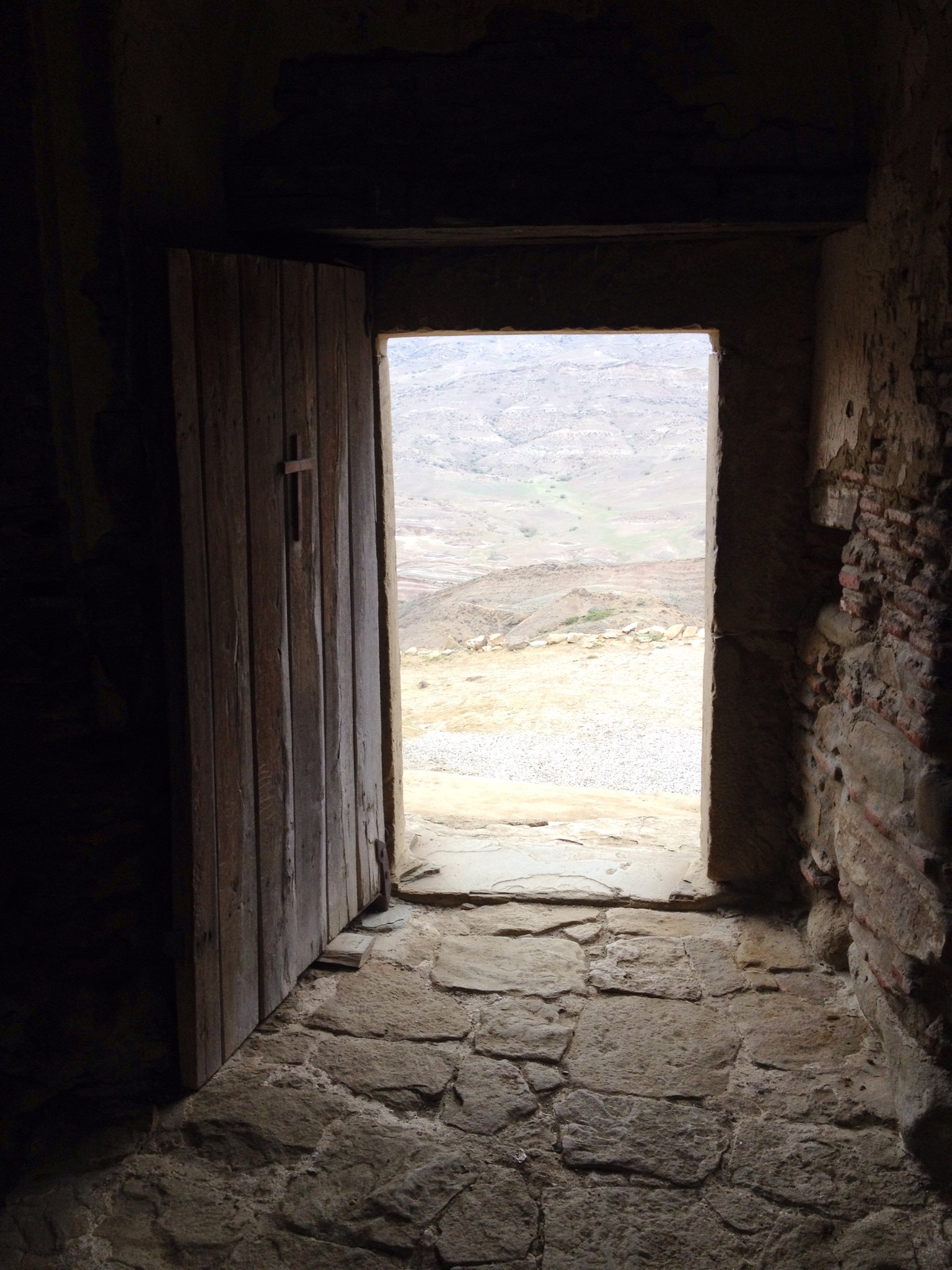
The one that we visited was the Davidgareja Monastery and was built into the hill – an almost troglodyte establishment. It was reconsecrated in 1989 and has close associations with Zaza (I understand this is the correct spelling of his name, although I think my approach was much more fun!) our guide. His brother had been a monk there, Zaza got married in the church (called the Church of the Transfiguration) and his children were baptised there. It is a place of such consequence to the Georgian’s that 3 visits are said to be equivalent to one trip to Jerusalem! The actual church was half built into the hill and half outside. It was beautiful in its simplicity. The site has still got archeological significance and Zaza is due to do a dig there in November.

Shortly after Davidgareja we were held up by a soldier in a camouflage outfit. After about ten minutes we were allowed to move on. We were so close to the border and its military accompaniment that we could hear the soldiers and their rifle practice. It was a bit sinister.

We pulled away from the border and over the brow of the hill came to the first settlement we had seen for many miles. The only buildings we had seen in the ‘no mans land’ we had passed through was an abandoned isolated Russian farm. We had been following a road that was little more than a dirt track for some miles, but this suddenly became a proper road as we neared the town. Trees appeared that had missing for hours in the near desert. Fences started to enclose land and surround houses. The Russian concrete, now deteriorating badly, was back in evidence. Emerging out of the other side of the town, there was a big power station and a rather bleak looking prison.

The weather had also been bleak for most of the day but the sun came out as we passed through another town, this time with high rise apartment blocks with brightly coloured washing waving like flags along the face of the buildings, relieving the drabness of the grey cement walls. Every time we pass through one of these places I think how lucky we are to live where we do.

A highway sped us on out into pastureland again with mountains in the distance. The odd monastery was sighted on the horizon and we turned off the road to set up our bushcamp at about 6.00 pm. After supper we had a drink to the girls return and adjourned to our tent, just as it started to rain. It rained on and off all night…..

Sunday – a busy day in Georgia

After an interesting breakfast involving salty cheese, rich home made yoghurt, a fried egg, salad and a pasta based rice type pudding at Nana’s we were off for what proved to be one of the busiest days of the trip.

It was the first day that the truck was really cold to get into. A definite wintry feel. As we left the town the outline of the Caucusus mountains could just be seen in the distance under the cloud which hovered below us over the valley below. First stop? The Convent we visited yesterday when looking for the monastery. It is the monastery. Considering that it is surrounded by Moslem countries, christianity goes back a long way in Georgia. Disciples are said to have visited including Simon and Matthew and by the 4th century christianity was the state religion. It’s had a number of setbacks (to say the least!) and for some time martyrdom seems to have been the name of the game, but Niño the Nun arrived and subsequently died at the Convent thus making it a revered spot for Georgian Catholics. Unfortunately, it being Sunday there was a mass on so we could not get in – I said I was happy to pass around my photos taken the day before……

We set off again. En route the slender pipes that are evident everywhere became a source of interest. The Georgians are quite creative with them. The pipes are usually painted red or yellow and travel along – say – 8 ft above ground level, they go up and over gateways, like picture frames. They apparently carry the natural gas which is piped into every home and it is certainly a novel way of making it available! The poverty of the country continues to be evident as we travel along. Towns have crumbling buildings, fences are falling down or have disappeared completely, graveyards were overgrown, their rusting railings enclosing dead stinging nettles.

The early morning had given way to cloud and then rain, but the sun emerged again as we stopped to visit Gremi an ancient township where excavations have revealed evidence of people living there in the 7th century BC. Gremi was a political and cultural centre and an important trading spot on the Silk Road. It had its heyday in the 16th century when it flourished for about 150 years prior to being demolished by the Persians. We received all this information in a nice museum at the site, delivered by a very helpful man whose English was heavily accented and was inclined to mumble under his beard (a failing of ZsaZsa’s too – it must be a Georgian thing!) so I cannot vouch for the total veracity of my facts here.

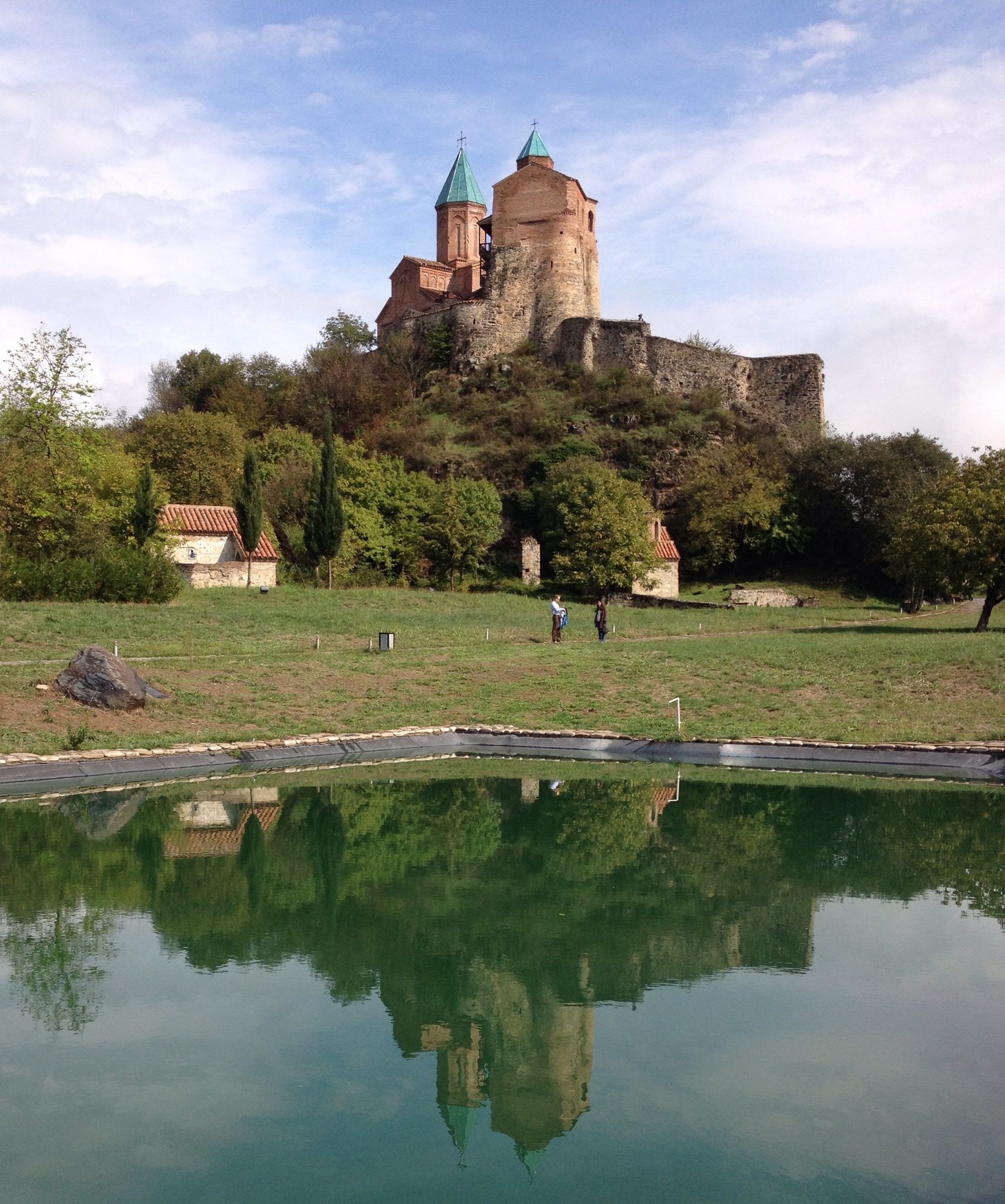
Back to the story. There is evidence of the area being divided into three sections – the market area, the church and tower palace sitting above things on a steep hill and the defense buildings. The market area had a large Caravanserai and evidence has been found of merchants trading gold, furs, precious stones as well as wine, horses and sheep. The area had its own churches and bathhouse. Up on the hill is the small Church of the Archangels built in 1565, still with many of its frescoes in place. It was busy with little girls in their sunday best dresses and patent shoes with gaily coloured headscarves and their Mums in their long brightly coloured clothes. The men wore dark suits. Candles flickered in the draught as the door of the church constantly opened and closed as people came and went.

Just a step away was the palace tower. The first floor had tall paintings in a slightly elongated figure style depicting the royal family of the time when Gremi was attacked by the Persians and relics of their life and times. They all looked slightly odd with small heads and long bodies.

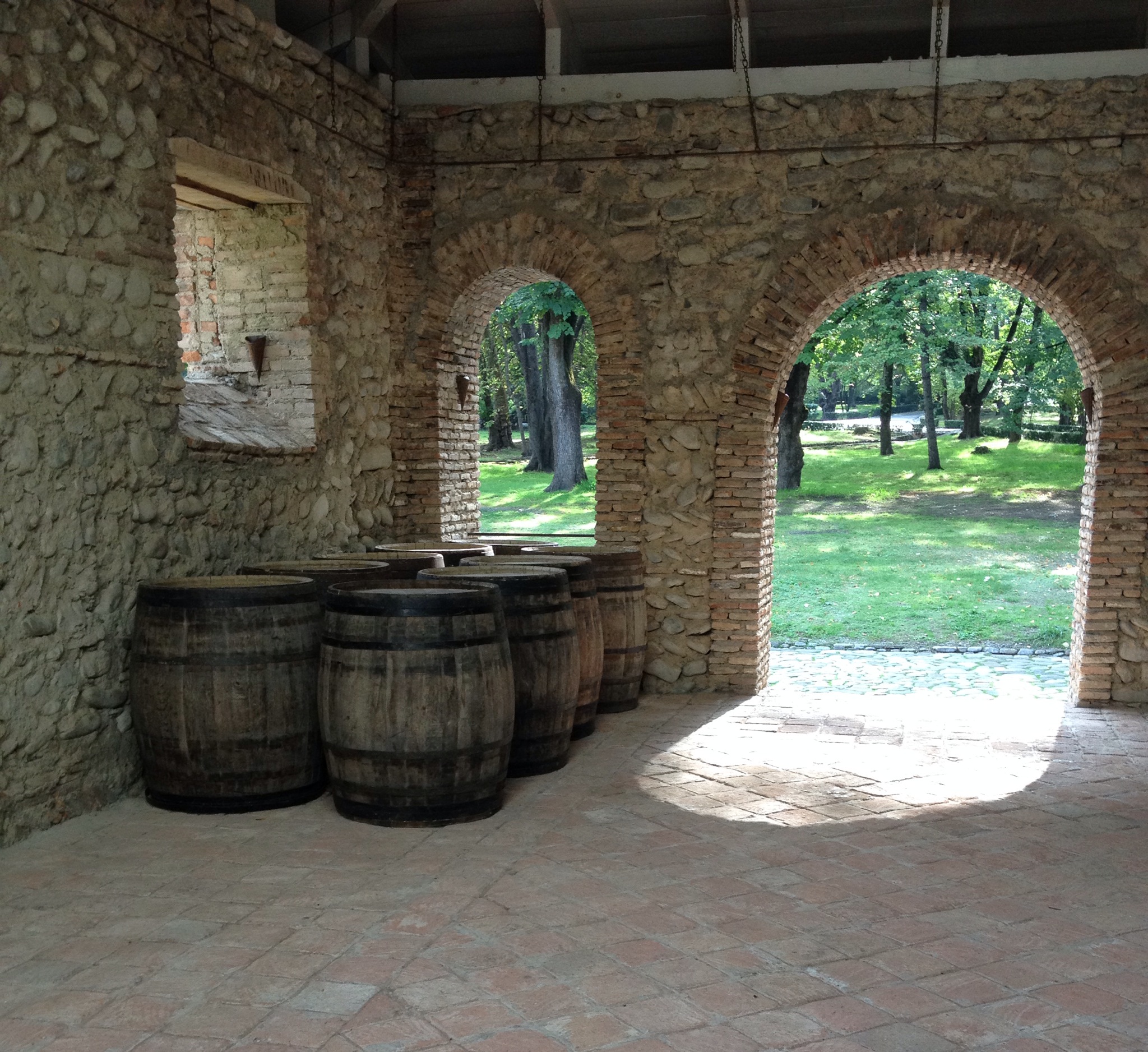
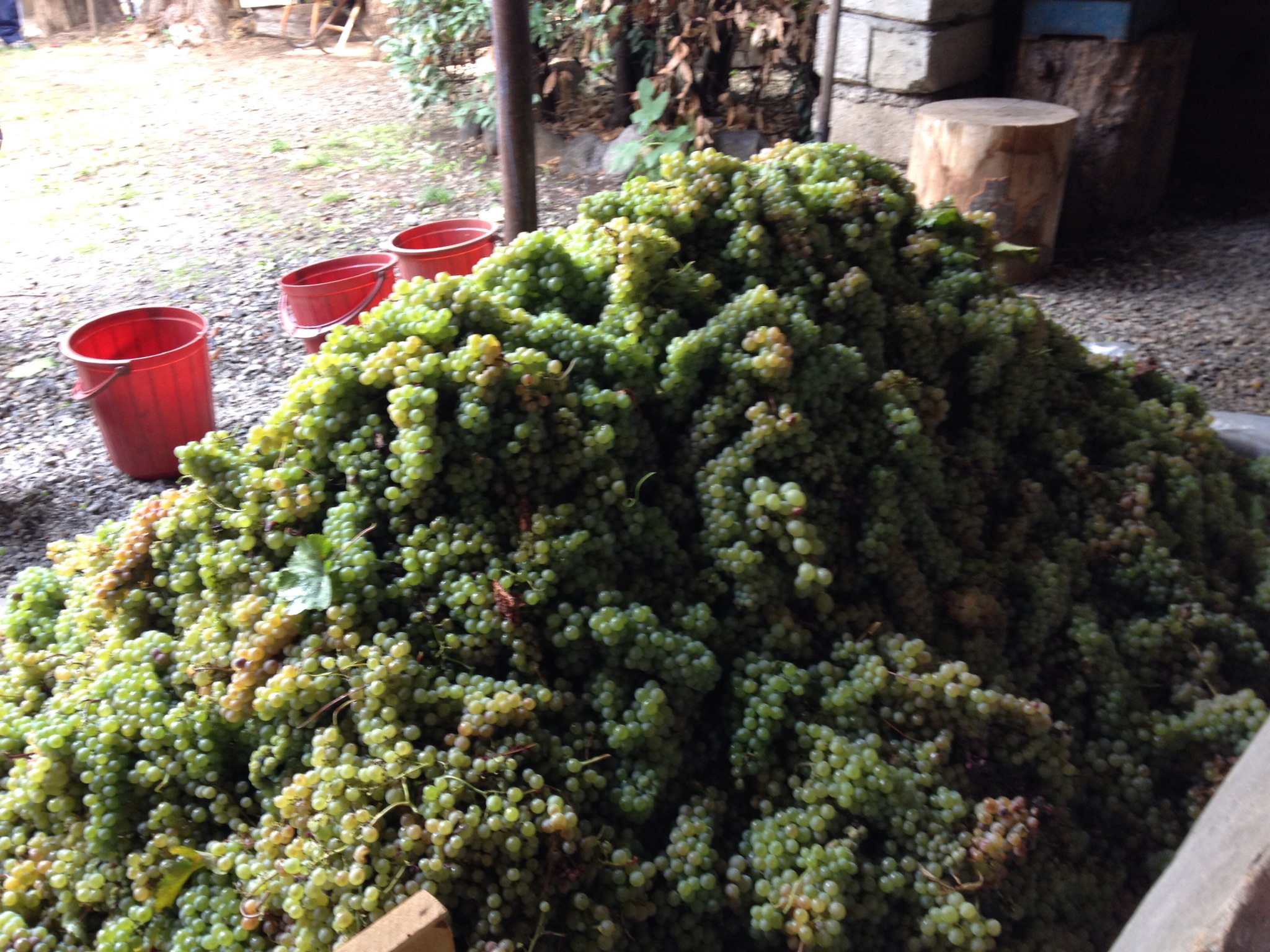
We left Gremi in the rain again and went off to have a wine tasting and fascinating demonstration of the Georgian wine making technique of burying the grapes in vast terracotta vats dug into the ground. These they seal with a sort of natural wax, place a large stone on the top and cover the whole thing with earth. The wine is definitely different to that that we are used to, but is very drinkable. They also had a still making their own vodka. After seeing the various processes we sat down to a veritable Georgian feast for lunch accompanied by the family’s wines and firewater. It was a very jolly meal with lots of toasts to country, family and absent friends.

The local wine museum, housed in an old stately home, was just along the road, so we opted to walk to (sober up?!) prepare ourselves for yet another imbibing opportunity.

The house had been the home of Prince Alexander Chavchavadze a poet and anti tsarist who was a godson of Catherine the Great. Half of the building had been destroyed by Lezgin tribesman who had taken members of his family hostage. Paying off the ransom to get them back had effectively destroyed the family fortunes. The house that remains is a sophisticated aristocratic home with three grand pianos (one a Steinway) and Limoges chinaware laid out on the dining table. Family portraits adorned the walls. The beds were Victorian cast iron like ours at home. The most amazing thing was the fact that there are still 16,000 bottles of wine
from 1841 in the Prince’s wine cellar. We tasted wine from what is now called the Tsinandali Estate using western wine making techniques and it was delicious, so much so that we bought several bottles for my birthday celebration later in the month. We wondered back to the truck through the English garden (designed by a Frenchman we learnt to our disgust!) very happy with ourselves.

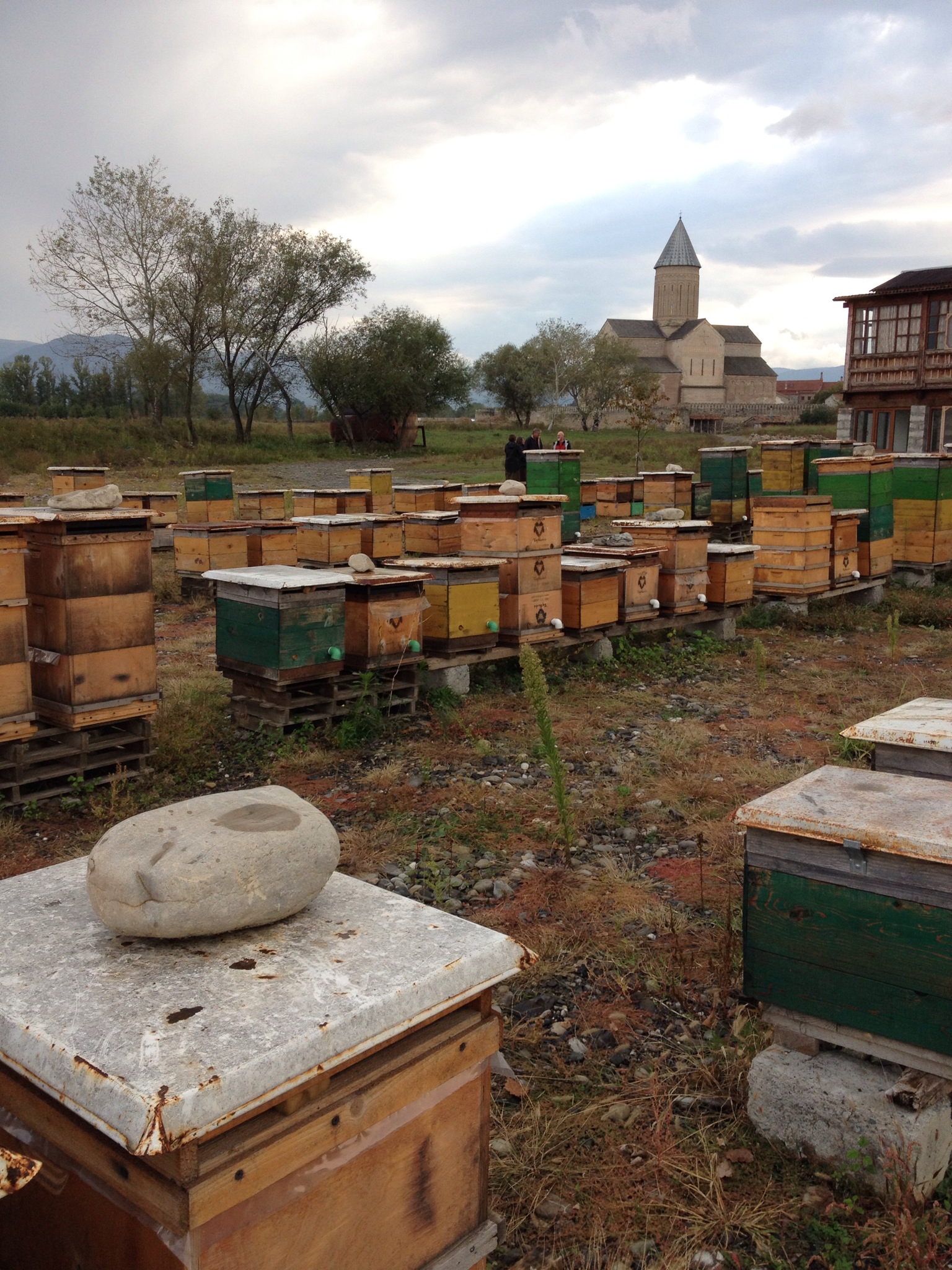
However, the day was not yet over. There was yet one more monastery. The Alaverdi Monastery. ZsaZsa our guide had actually worked on the archeological dig that has now been abandoned on the site. It is still a working monastery with bearded monks in long black robes, where wine and honey is made. They have been making wine here since the 8th century. The huge church towers above the landscape, the highest church of its kind when it was built. The dark of the cavernous interior was broken only by the flames of the candles placed there by the faithful. Above the door was a fresco of George and the Dragon – a seemingly universal Christian motif.

Because of ZsaZsa’s connections we were allowed to go behind the scenes to the apiary and meet the monk in charge of honey making. Honey is produced on an almost industrial scale with smart stainless steel equipment for processing wax and honey. We tasted the final produce, including yet another spirit of throat clenching proportions.

You will not be surprised to learn that it was by now after 6.00 pm and the sun was sinking behind the huge snow tipped mountains in front of us rearing up purple in the fading light.

We set off to our home stay in Telavi tired but having had a truly terrific day.