Monday – Tashkent

Our day in Tashkent was our own so after breakfast we asked the way to the nearest Metro station as we had heard that they were decorated like those in Moscow, which are very impressive.

After a bit of a walk we arrived at the Toshkent Metro station. Sure enough there were colourful majolica tiling in jewel colours on the walls. Knowing the ‘no photo’ rule we were careful to observe it. (Later we were told that one of the others had fallen foul of the system by trying to take a photograph and was asked to produce her passport….) By the use of sign language and guess work we were able to identify the train to the Grand Bazaar and the name of the station where we had to get off. The train itself was pretty utilitarian and fairly empty.

When we reached what we thought was our destination, we emerged to find the most amazing market. Every possible vegetable and fruit had its own area – potatoes, peppers, garlic, onions. The place was amazing. Inside under a great dome were meat, cheese and pickled vegetables. Upstairs were nuts. It was wonderful! There was a whole hall dedicated to bread – if only you could capture the smell! It was an amazing place – there were spices and herbs, baskets and sweets. All had their place. We wondered how you chose which stall to frequent!

Some time later, after a wonderful time looking round, we came across some Odyssey chums who had been adopted by one of the bread ladies who had fed them up on bread and tea! Peter our Australian friend was the apparent attraction! We decided to go and look for the main mosque together.

It was, therefore, quite a little crowd who, after quite a walk through a much older than any we have seen in Tashkent, arrived at the impressive mosque buildings situated in well manicured gardens. The blue tiling on the frontage and the domes was stunning. We had hoped to see one of the oldest copies of the Koran which is housed in the main building, but just as we arrived the building was closed for lunch for two hours. Some things you just miss by a whisker!

At that point we met up with two other members of the group and it was rumoured that a micro brewery had set up in the city, in what was advertised as a ‘short walk’ away. Perhaps an hour or so later we arrived at the identified location but the micro brewery had given up the ghost and was no longer operating. After a kebab lunch for those of us who had not been courted at the market and a beer, we headed back to the hotel by taxi, having promised to go with the girls who have responsibility for the drinks on board the truck to restock the ‘fridge. So, after an hours siesta, it was off to the supermarket. Here we did very well in that one of the young men from the store volunteered to escort a trolley with our purchases to the truck so we did not have to carry what was quite a heavy load. A result!

On the way back, with our trolley steering escort, an Indian restaurant was sighted. Quelle excitement! A table was booked, but we were told the chef went home at 8.00. This all sounded a bit odd, but we agreed to arrive at 7.00 and order straight away, such was our enthusiasm for an Indian meal.

What actually happened was even more odd. We arrived, our numbers having doubled, everyone having thought it such a good idea, and were handed a menu but were told there was only chicken. Then menus were removed and we were told it was a set meal and the price. OK we said. We got some drinks and waited. And waited. A number of Indian men arrived but no food. The Indian men spoke English. They said a belly dancer would be arriving but there would be no food until 8.30 (when the chef would supposedly have gone home?). As it was still only 7.30, we decided that was too long and we would leave. We told our waiter who said that was not right and our food was just coming. The Indian gentlemen left. Our meal came – it was very good. As soon as we had finished the bill was produced because we were told we had to go (nicely). No belly dancer. It was 8.30. What was all that about?!
Sunday the Fargana Pass

Sure enough when we emerged from the hotel five white taxis were lined up with numbers on them – our convoy. We were three to a car.

We travelled with Richard which was great fun. The cars were immaculate and had seat belts! In fact all the cars we saw on the streets looked pristine – as if a bump could require you to be off the road. The town was squeaky clean – no litter and even dust looked as if it would be out of place. It all almost sparkled in the sunlight. We passed a large football or sports stadium and lots of large commercial buildings. This was a thriving place.

We drove out of Fergana and saw the occasional horse and cart. Cotton fields abounded, some with pickers out at work. I desperately need a cotton picking photograph but we were advised not to take photographs out of the windows of the car.

After about an hour and a half we came to Kokand City. Kokand in its hey day had been an important trading city and the Khan of the once large emirate built his palace here. Having said this, three years after it was built in around 1860 the Russians came and destroyed the girl bit, the Harem. The Khanate must have been huge bordering China on one side and almost Turkey on the other. The mosaics and tiled domes of the palace shone in the
late morning sunlight as we walked towards it through immaculate gardens and the white pillars of a gateway.

Up close the colourful tessori in amazing patterns became clear. Khudayarkhans Palace even in its refurbished state was quite something.

It cost 50,000 Uzbeckistan Som to get in. Keith had changed money and 3,000 Som equals one American dollar. We changed $100 and did not know what to do with the great blocks of money we received in exchange. The people count it amazingly quickly – probably because they have to. The young cashier at the palace had a large abacas on her desk……

We had a local guide who told us all about the palace, interpreted by Rustom (spelling?) the Uzbeck guide who is travelling with us. It was a very detailed commentary but certainly put the whole moving feast of Central Asian boundaries in context.

We had not gone far beyond Kokand on our journey when there was a major checkpoint. Machine gun toting soldiers with black balaclavas revealing only their eyes stood and watched as we were made to leave the cars and stand in the blazing sun while our passports were taken to a booth for checking. All around us were cars being searched and people being interrogated, about what we did not know. After about twenty minutes we were told to get back into the cars and go. This we did with some alacrity.

Lunch was taken on shaded day beds in a fairly formal garden with lots of water and wooden bridges. It was very pleasant with a welcome breeze from swaying birch trees which were in evidence for the first time.

Moving on again, we eventually came to the Namangen pass itself – a high point from which you can look down on the switchback road below as it tacked down into the distant valley. Our convoy stopped for us to take in the view and photographs were allowed. At this point things started to really speed up, or so it seemed. Although I could not see the speedometer from where I was sitting, I was conscious we were travelling at quite a pace. As we neared the floor of the valley, the pace seemed to be increased. Lane discipline is very lax and because of roadworks it was often down to a single lane in each direction. There was a lot of military presence on the road.

The outskirts of Tashkent (or Toshkent as they spell it) arrive long before the centre with the usual commercial and industrial areas of any modern city. The city centre has broad highways through it in the typical Russian style and has been modernised as a result of the damage caused by the bad earthquake which took place here some years ago.

Our final lap to our hotel was made even more anxious by the fact that our cars were running out of petrol. Petrol is in short supply in Uzbeckistan and we arrived at the hotel with many of the cars on empty. However we had made it and as we pulled up outside it was good to see that Penelope had made it too. There she was parked in the narrow road outside the hotel.

Saturday – Goodbye Kyrgyzstan and Hello Uzbekistan

We were out of the sleeping bags early because for days there had been dark warnings about the Ubekistan border crossing and there was a feeling of tension in the air. Breakfast over – neither of us was on cook duty – the tents were packed away for the last time for a couple of weeks. Ubekistan does not allow a lot of things, one of which is camping.

We left the pasture land to the cows and sheep and saw women hand milking cows in the field as we left the area. Back on the road it was only a few miles to the border. First we had to leave Kyrgyzstan. In actual fact the border post was much more up market than the one when we entered the country, but no exotic wallpaper. A sort of ‘portakabin’ arrangement. Passports duly stamped to show we were leaving Kyrgyzstan, we all piled back into the truck for the dreaded entry into Uzbekistan. First step was being lined up with passports in a fairly small room with local people who had bags tightly bound with cling film type material. There were several military types in charge of operations. We queued at a counter to see one of them, but some of the local people were taken into a separate room. Those that weren’t kept trying to get between in an effort to get to the counter in front of us, so sharp elbows and blocking strategies were required to hold off the jostling. The man behind the counter told Keith he looked like a ‘special agent’ – hilarious!

A medical checkpoint’ came next. This meant we got off the truck again a hundred yards further along with all our bags and had to hand our passports to a man in a white coat who wrote our name in a ledger and pointed what looked like a white gun at the head of each of us in turn. I think it was a sort of thermometer. No-one actually said. It felt a bit like lambs to the slaughter. Whatever it was, I guess we all passed muster as we were all allowed to the next stage. This involved a large form and another shed.

The form was quite detailed and had to be completed twice, once in the English version and then you had to remember what it said as the second version was in Russian – the layout was the same but the lines were very close together. All sorts of questions were asked in a way that the information they wanted was not clear. The document completed, we lined up again in front of a man at another desk while watching the bags being completely unpacked and all cling film wrapping being torn off the luggage of those before us. We had been told that no-one was to laugh or do anything to cause offence. We weren’t likely to to do either as there was not much humour about! There were two large German shepherd dogs outside chained up and looking very bored. A nervous giggle might have caused a lot of excitement. It was all a bit weird and it was obvious that they are not geared up to too many people wanting to cross the border – there were only about six guards on duty in total – a frenzy of people would have them in a real tuck!

Having got through that check we lined up again with bags and went through a body scanner that bleeped but no-one took any notice and then went to where the bag opening was taking place. The checking of our bags in fairness was very perfunctory, a quick look through the photos on my iPhone – did I have any morphine or religious tracts?(!) Once I answered ‘no’ I was told to close the bags and go. Keith had the bag with the remedies in it that we thought might cause concern and I had got Saied to write out what they were, but they really were not interested. In time we all got through but then had to wait while they searched Penelope.

The whole process had taken no more than two hours, a record by all accounts.

This done we were off, heading to the Fergana valley – the ‘bread basket’ of Uzbeckistan but growing cotton instead of grain. First we had to buy insurance for the truck that had to be purchased in Uzbeckistan.This showed every sign of taking more time than the border crossing so it was decided that we should set up our lunch on the side of the road. This would have been slightly attention seeking behaviour in any event, but add to the equation the fact that the children were just out of school and it was mayhem! Within minutes we had a large audience of smartly dressed young people (the girls in tartan) all wanting to practice asking your name in English. It was like the parrot house at the zoo! It was certainly not conducive to digesting lunch very easily.

Every so often someone would come along and shoo them away and then another group would form. In time the insurance was obtained and the lunch equipment returned to the truck under the watchful eye of our audience and we were off to a chorus of goodbyes and upturned faces.

Uzbekistan is very noticeably different to Kyrgyzstan. From the outset roads and housing had improved. There was consistently Tarmac on the road, roundabouts appeared and there were bus stops. Everything seemed more organised and tidy. What was interesting was that we saw more bicycles – all are of the sit up straight variety (the old Raleigh bike came to mind) with ‘no nonsense’ handlebars and no gears. They all seemed the same size too – small boys stretched their spindly legs to reach the pedals without losing face.

The afternoon wore on while we made these observations. Cotton is the predominant field crop. I had read a bit about this. Cotton is not a natural plant in Uzbeckistan and in the effort to provide the water it needs the Aral Sea has more or less dried up. It does provide work for a lot of people, some voluntary and some conscripted by all accounts.

On our route to Fergana, in fact just outside the town is the Margilon silk works. Here silk is still spun and worked by hand. We watched all the processes carried out by the ladies who worked there although there were only a few around as it was Saturday afternoon. The factory (for that is what it is) dye the silk with plant and chemical dyes, weave the fibres into fabric and make carpets. It had once employed thousands. It now employs just over a hundred. We saw a whole loom room inactive. Commercial realities have overtaken the hand crafted product. We saw girls working on carpets that had been commissioned and had been in the making for two years already and were still a long way from finished. The cost could not be calculated. The patterns were complex.

Our guide told us that Uzbekistan is the 4th largest silk producer – a position it sometimes loses out to Vietnam. I wondered how they made this calculation. The inevitable shop had some amazingly beautiful things in it.
After a few purchases and having watched the girls leaving the factory being searched – I think a carpet in the bag would be a bit obvious – we left Margilon for the Fergana city centre. Fergana could be a wealthy and well organised city anywhere. Broad thoroughfares, wedding shops and car showrooms were all in abundance.

We reached our hotel and there was a wedding party going on complete with disco music that thudded through the walls. It was still going on when we returned from a rather chaotic dinner. Emma and Simon had to leave early to take the truck over the Fergana pass as large vehicles of people are not allowed. We are to follow in a cavalcade of taxis tomorrow……

Friday Arslanbob and the Walnut Forest

Another beautiful day. Breakfast was at our Roman table but this time we were given 5 cold pancakes each! An interesting start to the day! After consuming one or two we escaped the table and had the opportunity to have a closer look at our surroundings.

It appeared to house three generations of family. The matriarch looked quite old as she had no teeth but judging by the age of the younger couple she was probably my age – which is a worry! Anyway, she was obviously head of the household and had some lovely teapots! Her husband wore a suit, his hat and had the required gold teeth when he smiled. The young woman of the house and the mother of the small children was stunning. Her husband seemed jolly but not around much and the children were lovely.

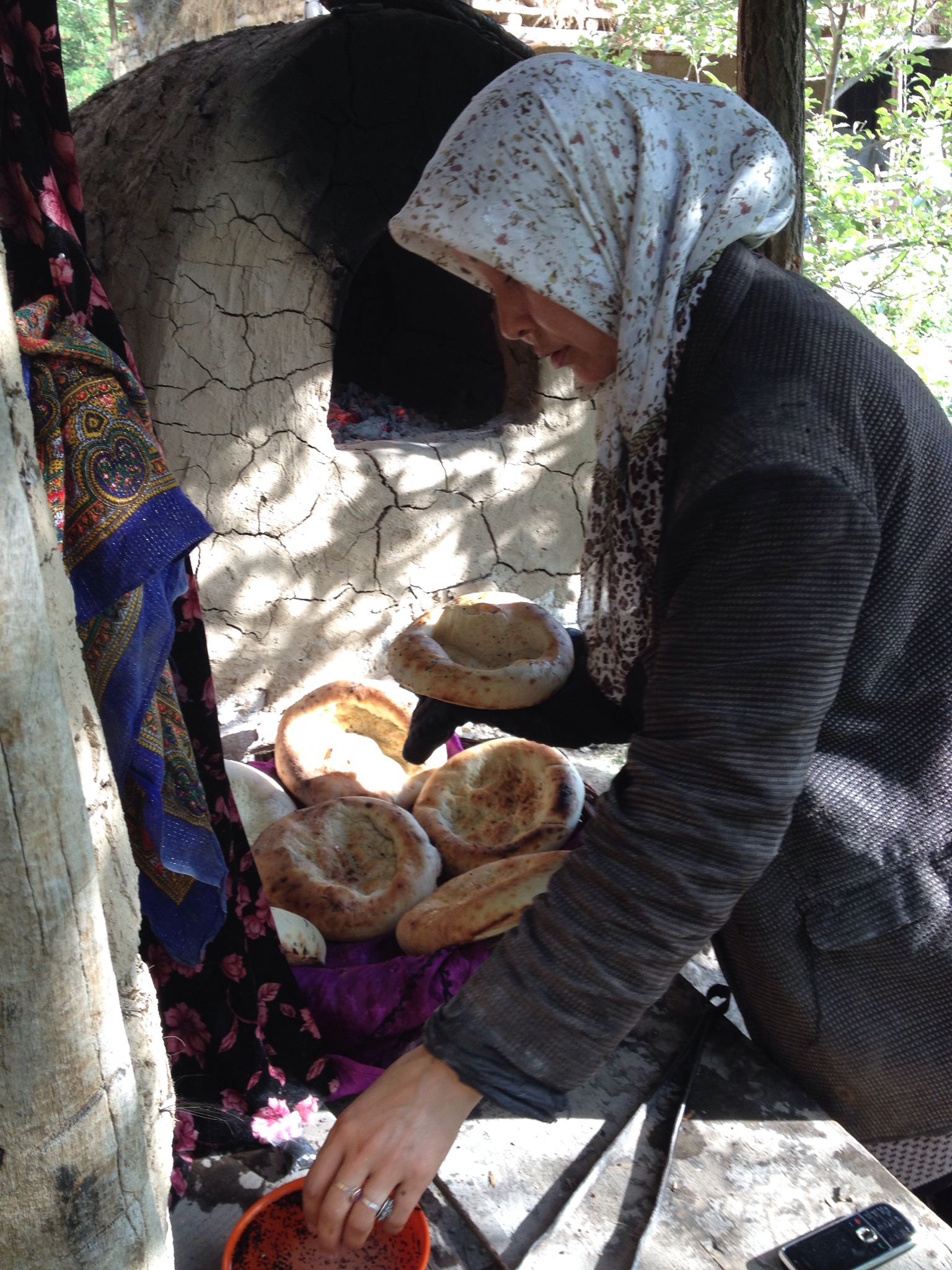
It was a large house with ducks, turkeys and chickens running around the garden full of flowers, at the end of which was a shaded day bed for pre dinner lounging. There seemed to be an inside and outside kitchen and I was delighted to find an outside bread oven alight and being used by our young Mum to make the family’s bread for the day. The flat loaves are placed on the wall of the oven to cook and then browned on the top on the floor of the oven. Great fun. They also had rabbits in a hutch and ducklings. (They did not look like pets….) There was also a barn full of straw.

The home stay family waved us off as we boarded Pendelope to collect our chums who were staying at another establishment. We left Penelope in the town square causing chaos and transferred to local jeeps to go up to the walnut forest. Goodness knows how old the jeeps were but they had few windows and of course no seatbelts. Our three conveyances set off with a roar as we left the square and started moving up a dusty track that took us up past the route of our walk the day before. We saw various people on foot on the route and the occasional car and even a lorry. As we left the town behind larger houses could be seen, either recently built or still in progress. Apparently these are funded by young people who are working in other countries and are sending money home for their palaces of the future to be built in their absence.

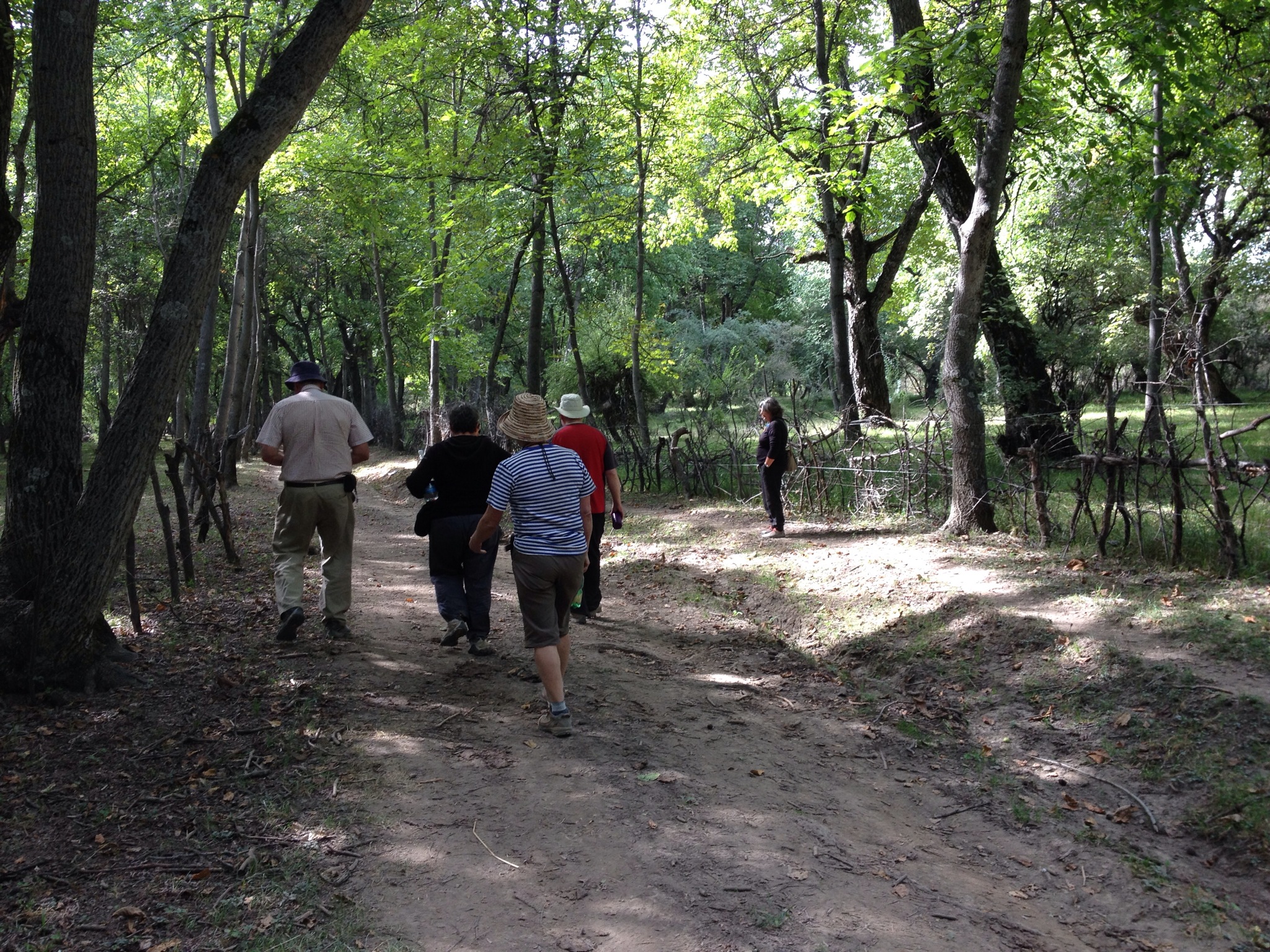
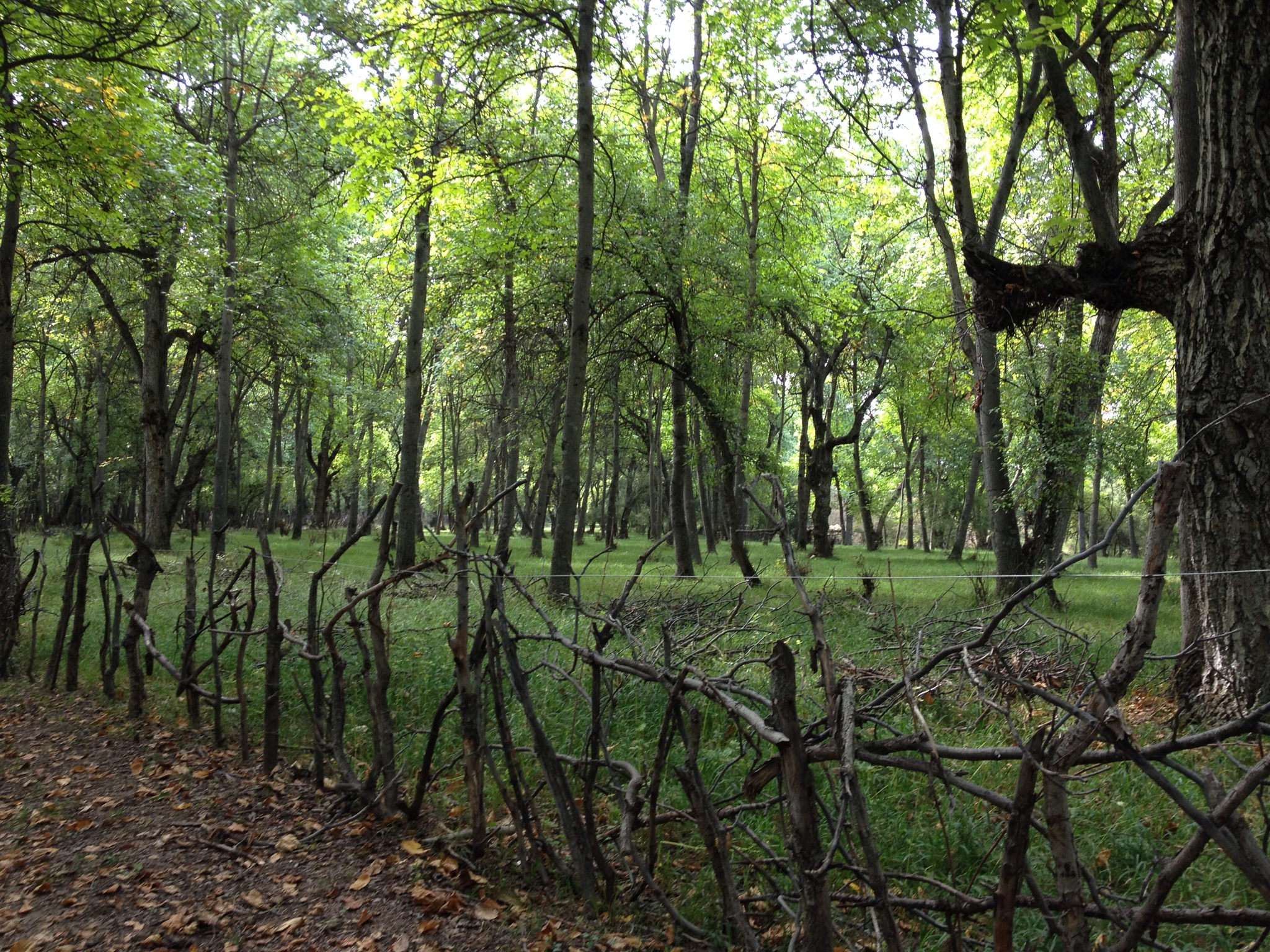
The walnut forest, when we reached it was beautiful. It is a natural forest. Old trees with a large canopy of branches ensured that the whole area was bathed in dappled sunlight. The air was soft and apart from us the place was silent. We got out of our jeeps and wandered along paths made by years of walnut pickers who travel to and live in the forest during harvest time. The forest itself is owned by the state with parcels of it rented out to families. The various family holdings are marked out by spiky twig fences. Each family is responsible for looking after their piece of forest. They then have to give a proportion of the harvest from their trees back to the state and they can sell or keep the rest.

Sadly, due to the dry summer the harvest in a few weeks will be poor. Certainly the walnuts we found on the ground were very small. This of course did not stop me getting walnut dye all over my hands getting into them. Not very attractive!

After our forest visit we went back to town and had our lunch just before everything closed down for the call to prayer. This is a much more Islamic environment than we have experienced anywhere else on our travels so far.

Sadly we had to leave as it was all very interesting, but the Silk Road calls and we had to find a site for one more bush camp before the Uzbekistan border.

An emergency within his company meant that Saied had to leave us just outside the town of Osh to get a ‘plane back to Bishkek to rescue another tour party, so our farewells to him were foreshortened. I was sorry to see him go as he was a lovely young chap with great ambition and high ideals. I hope it all works out for him. We learnt a lot about Kyrgyzstan from him. Saied flying back to Bishkek also made us realise the sort of mileage we have been covering.

After dropping him off we kept going to find a place to camp overnight about 30 kilometres from the Uzbeck border. To the surprise of the shepherds, their sheep, a cow herd and a herd of cows we settled on the field in which they were grazing and put up our tents. All was very amicable until one of the cows started to drink the bowl of Dettol water we rinse our hands in and had to be encouraged to leave the camp area…… I guess they were here first!!

Thursday reservoirs and Arslanbob

It was my cook duty day, so I got up early to ensure that I could help Keith take the tent down before reporting for action at 7.15. We are getting better at getting the Ritz down and in its bag, having been heavily coached by Richard, an overland veteran.

As the sun peeked over the distant hill several turkeys decided to provide a wake up call to any of those who might have considered lingering for an extra few minutes tussling with their sleeping bag. I don’t think Keith’s will ever be his ‘favourite’! Sleeping bag, that is.

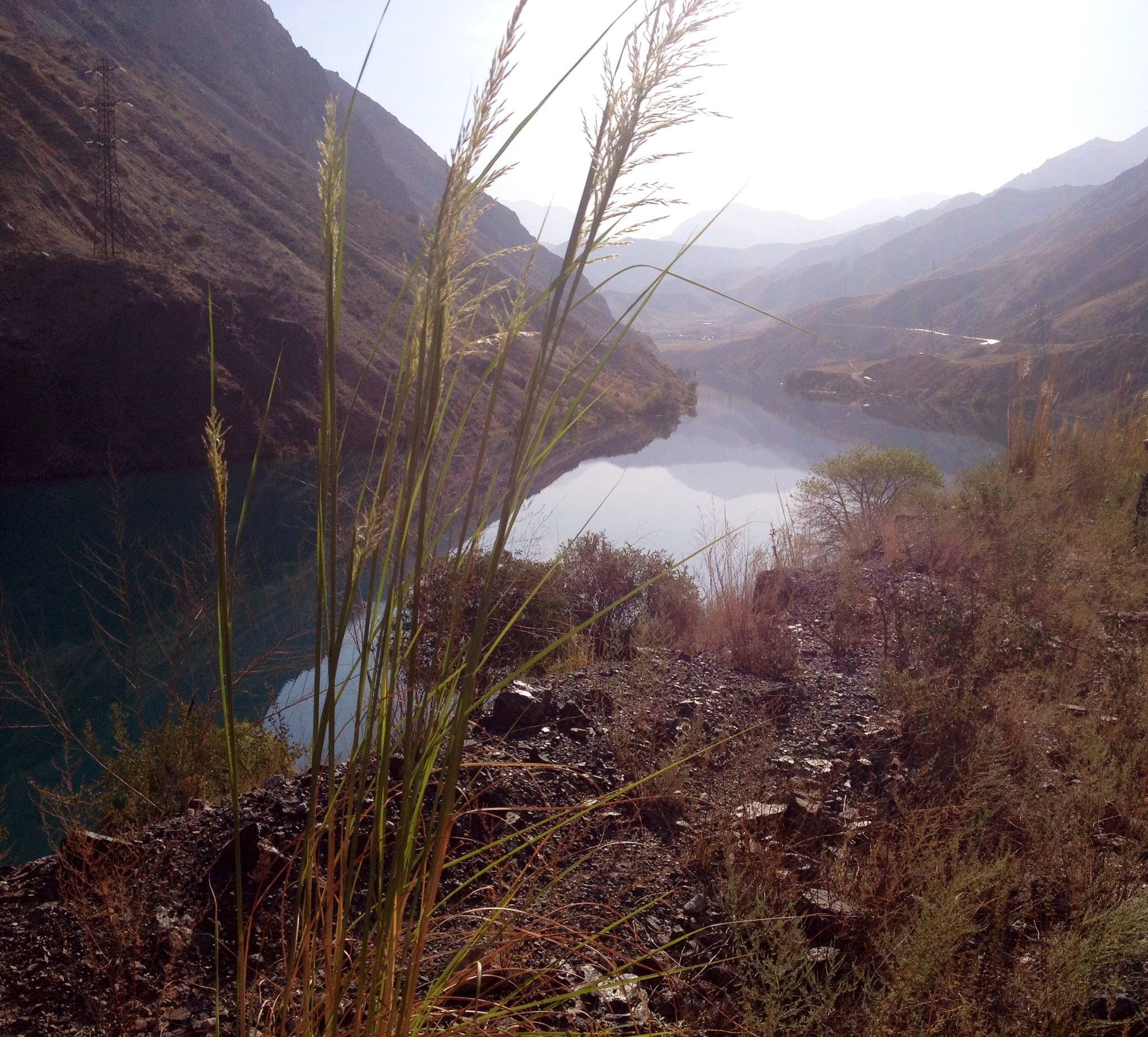
Breakfast over, we made the bumpy journey back up to the road. The reservoir was behind us and we were back en route to Arslanbob. (The name means Lion Gate.). It was not long before we were again travelling up between craggy cliffs. To our side was a very turquoise blue water way. The reflections in the water were tremendous. After half an hour of trying to capture the view from the truck window, we had a camera stop which was unusual, but it was such a stunning sight. Unfortunately we find it is often difficult to really capture on camera the amazing scenes that we see because the landscape is so vast.

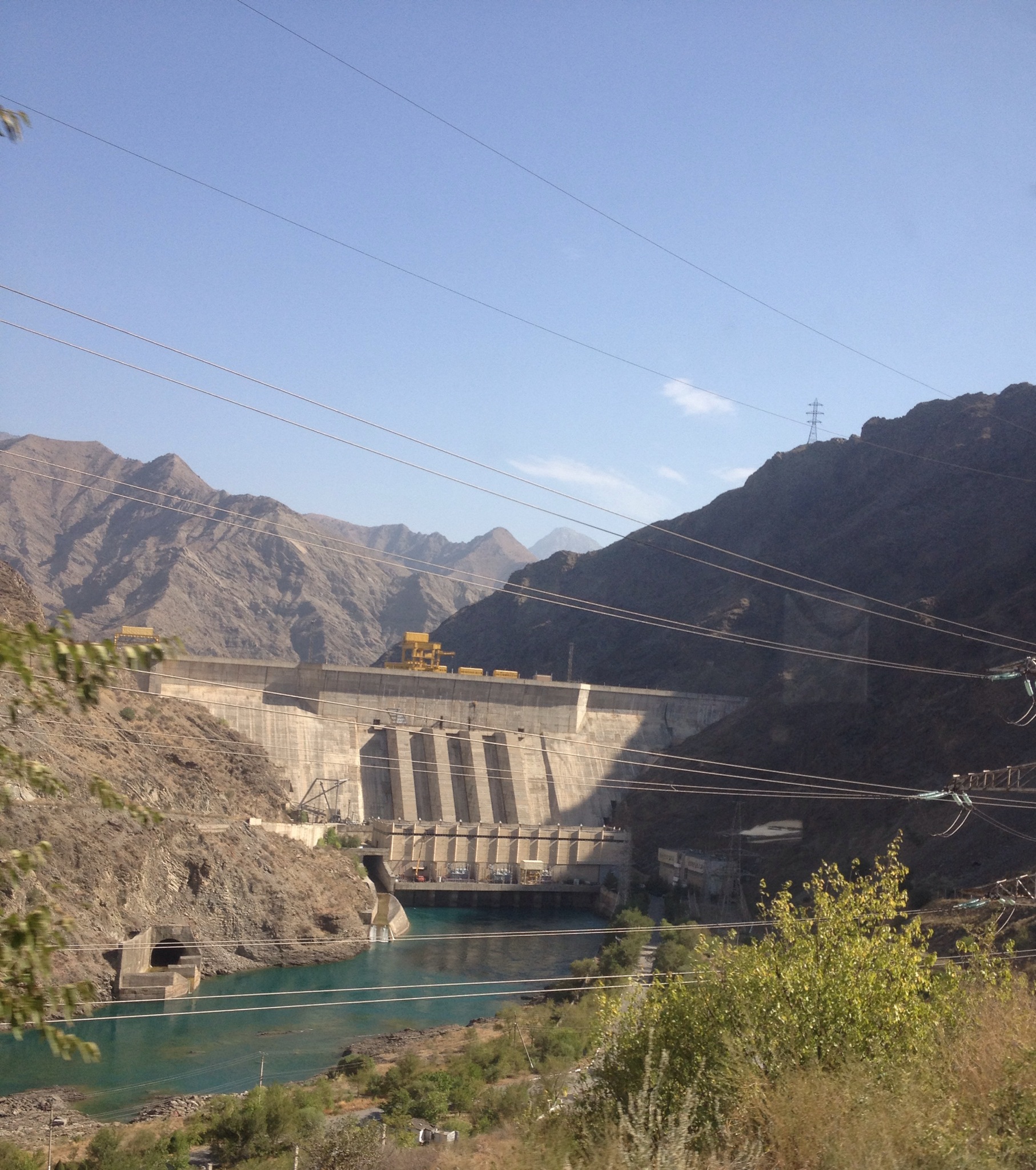
We eventually came across the reason that the waterway was so deep. A large dam blocked the way between two crags at one point, damming the water in the canyon and rendering the water level the other side very low. It looked a very Russian use of concrete. The stoney hills continued and a large conurbation appeared on the side of the now much lower river. It was like an oasis of green trees and houses in the middle of sandy coloured hills. Apparently it was a coal mining town. Kygyzstan has a number of coal mines of its own but imports coal from Kazakstan as well as the Kyrgyzstan road system is not good enough to enable them to get their own coal around the whole country. Coal is used for electricity and heating in the winter.

After a tunnel, the landscape changed abruptly and the earth was red. We saw our first cotton fields – more about which when we reach Uzbekistan. Uzbekistan can now be seen a couple of kilometres away over a barbed wire fence. It is ‘two sleeps’ before we reach the border.

The houses are noticeably more substantial now, often two stories and made of industrially made bricks rather than the red mud bricks that have formed the majority of the building material in the rural areas up until now.
Often houses are built around courtyards with large double gates providing a rather formal entrance. Roofs continue to be some sort of corrugated metal – often silver, grey, bright blue or green in colour. Frequently there is an open space under the roof covering stuffed with hay.

Suddenly the valley opened out again and a broad, dry river bed then appeared and remained with us when turned off what had been a dirt road for sometime onto a narrower dirt track. The road to Arslanbob. After a lunch stop taken under the shade of an abandoned petrol station, we were soon in the ‘metropolis’ that was Arslanbob, much to the mystification of the Arslanbobians. We might have landed from Mars, such was their seeming awe and interest.

This area was closed to outsiders until recently due to ethnic tensions, so very few tourists go there, if they do it is for trekking in the summer and skiing in the winter. Certainly people were much more conservatively dressed and there were no western fashions. Many women wore coats down to the ground with square shoulders in all sorts of materials (some quite exotically sparkly) and all wore the ubiquitous head scarf. Groups of elderly men with long beards sat in groups and we saw more day beds in use socially on verandahs and in cafés. We parked in what felt as though it should have been the market square although there was no market.

There were a few shops and food stalls around, but this seemed a town catering for its population not the random visitor.

Our accommodation for our overnight stop was in home stays. It is worth commenting on the home stay arrangements in Kyrgyzstan because it is an amazing system that seems to work well for everybody. Tourism is a key aspect of the country’s economic growth and so that as many local people as possible can benefit, an operation called CBT has set up a network of local families willing to provide a room or rooms in their homes for travellers to stay. There is usually a local co-ordinator who it seems is informed as you approach the town or village, often very late in the day due to signal issues, that you are coming and want accommodation for the night. I have visions that between the time that call comes through and your arrival there is a flurry of activity as rooms are requisitioned and old people are thrown out of their beds and areas are cleared so that when we arrive it all looks as if has been ready for ever. We saw evidence of this in our accommodation in Arslanbob.

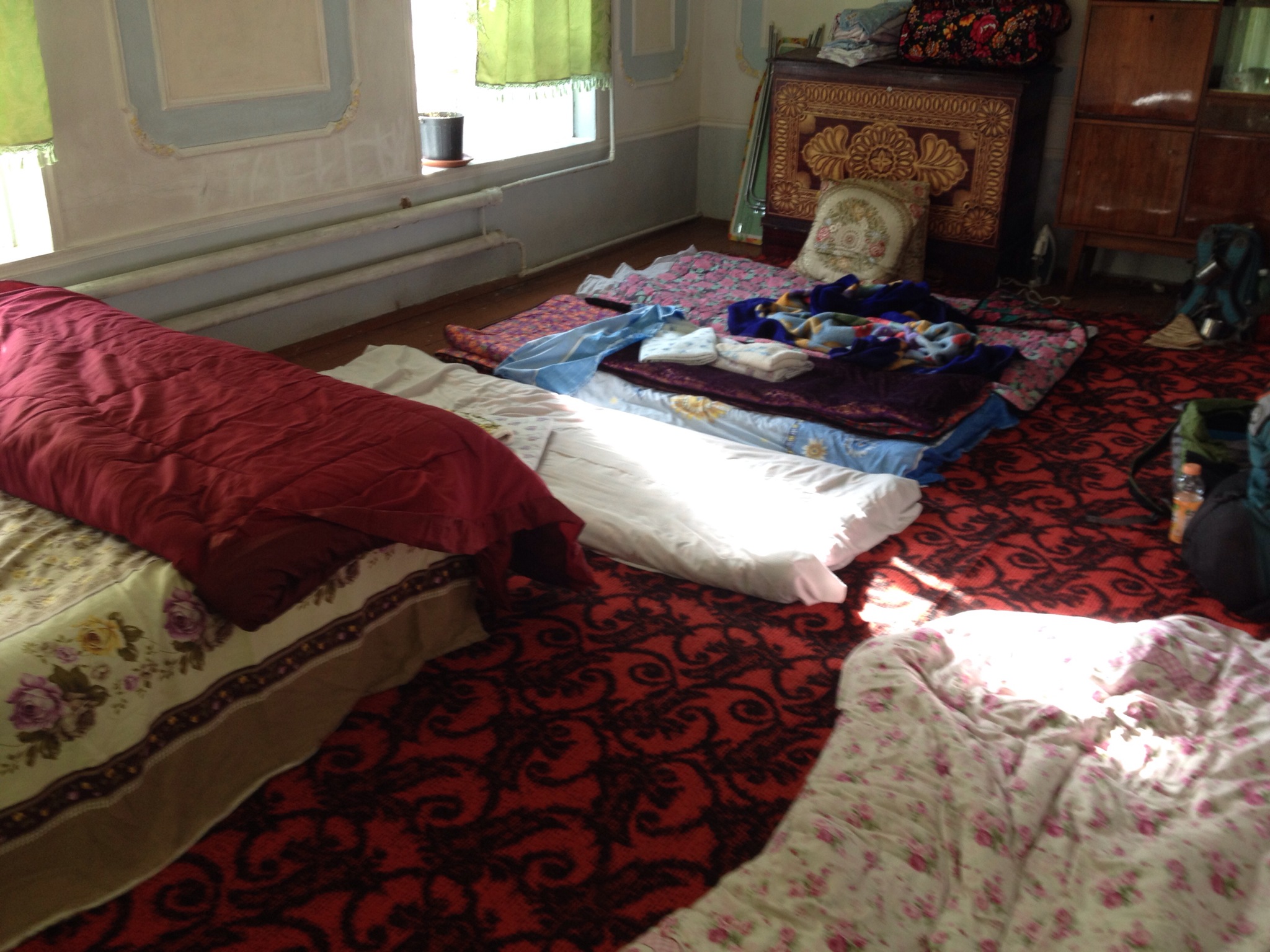
When we arrived, Keith, Helen and I were shown into a large room that was, I would have said, originally an elegant salon or sitting room by its decoration. It had ornate ceiling and walls and a fairly modern sideboard with a mirrored area for glass and ornaments and another glass fronted cupboard along one wall ( now concealed by a curtain) and then a double bed and five beds on mats on the floor. An outer room had perhaps another five floor beds.

When we returned from a slightly more energetic walk than anticipated – our request for a short walk ‘so we can see more of the village’ was interpreted as ‘a high level walk so we can look down the village’ so two and a half hours later – the outer room had been turned into a Roman style feasting hall with a table about 6 inches off the ground groaning with food. I am never good at sitting cross legged for long periods of time and if you stuck your legs under the table they were in the person opposite’s face! All very tricky.

When we were eventually settled into our chosen sitting positions, ‘plov’ – the national dish of a sort of lamb and apricot pilaff – was served with home made bread followed by water melon. All very scrumptious but by the end of the meal I was crippled with cramp and hobbled off to our ‘bedroom’ for a night ‘a quatre’ with our jolly antipodean chums.

Wednesday en route to Arslanbob

We set out knowing we were not going to be able to reach Arslanbob, a place name that has fascinated Keith since he heard of it. He thinks it sounds like a character ouT of The Simpsons…… Arslanbob’s main claim to fame is its large walnut forest, said to be the largest in the world – but this is to come. First we have to get there.

It took a long time to leave the suburbs of Bishkek behind us and it took even longer to run out of Manas statues as they kept appearing at the most unlikely locations along our route. For some time the roadside was lined by ribbon developments, some of them quite busy with shops, stalls, houses and vehicles all vying for space. Eventually these gave way to cornfields – much larger than we have seen before with large haystacks (why don’t we do haystacks anymore?) and wagons piled high with hay. As we got further away from the towns, the mountains – always in the background, became more prominent. The odd houses we passes sported fruit trees in their gardens. Apples and pears seem to be the main crop.

Poplar trees seem to very popular for lining the road, French style, and providing wind breaks to fields. We are back to very battered Russian cars and trucks, noticeably different to the sophisticated saloons of Bishkek! The scenery is like a kaleidoscope of ever changing vignettes – stockmen on horseback herding cattle, power stations, mosques, scrubland with sparsely scattered trees, the occasional checkpoint which often is not a checkpoint at all. We got through one in exchange for a bar of chocolate!

We then became aware of entering a steep canyon. Cliffs of rock towered above us as the road followed a twisting river. The water was totally clear with no sign of the glacier silt that has clouded other rivers and streams that we have come across. There were soaring areas of scree and others of sheer indomitable rock. The road twisted and turned. We have become connoisseurs of the road surface and this was was very smooth – apparently the road was built by the Russians and is maintained by The Turks. We were to become even more appreciative as the canyon grew wider and we zig zagged up the mountain. We continued climbing, passing any number of vehicles that had overheated or broken down, but Penelope growled her way up for many kilometres. When we reached just short of the top (over 3,500 metres) there is a three kilometre tunnel and we joined the queue of traffic waiting to enter. The cause of the hold up? A hard of sheep were walking through. It could only happen here! Some time later they came tripping out with a shepherd on horseback at front and rear and continued on their way down the mountainside!! Unbelievable!

When we reached the other end of the tunnel there was a bit of a delay while a toll was required and rejected (there is an on-going debate as to whether we are a truck or a bus!) and we started our descent into a vast, wide valley, one of the largest and coldest in Kyrgyzstan. In the winter the temperature can get down to -40 degrees because of the wind that cuts across the plain.

We stopped for lunch shortly after descending to the valley floor and then drove on through the afternoon. We played scrabble with the Girls and dozed and chatted. Late in the afternoon a large blue reservoir came into view. Like all things to do with water in Kyrgyzstan it covered a large area. The road towered above the water as we followed the contours of the lake at several kilometres distance. At about 5.30 we turned off the highway and descended onto the shingly scrubland between the road and the water’s edge.

Once again it was an amazing location for a bush amp site. We had arrived at our stop for the night. It was the Ritz to the fore and once again a wonderful view from our bed!

After an excellent chilli supper and a couple of tin cups of wine, we were given a briefing on what to expect from the Uzbekistan border, well known for being problematic. We are forewarned.

It is the halfway mark of our journey. We have travelled across two countries. In the time we have left we will travel through six more. Truly the journey of a lifetime!

On a less uplifting note, there was a strong breeze as I adjourned for the night and cleaned my teeth. The next morning was to reveal the liberal coating of toothpaste that I had successfully managed to spread about my person in the process. You can’t say that I am not thorough in all things!

Tuesday – Sightseeing in Bishkek

After an excellent night’s sleep, we were delighted to find that the hotel provided a great breakfast of indeterminate but tasty things. Having made the most of this, we set off for the Uzbeck Embassy for the majority of our party to get their visa. Keith and I had been able to get these in the UK but they had not been available from the other countries represented. Although there had been dire warnings of the length of time it would take, we went along because Saied was offering a city tour straight after the Uzbeck drama… In the event there was no drama. The visa requests were delivered and they were told they would be ready for collection later in the day – so we were off for the tour of Bishkek.

Our first impression of the City when we arrived proved to be very accurate – it is a busy, organised metropolis of many different nationalities. It is also a city of many statues. As we walked up to a large modern work representing the freedom of the Kyrgys people, where a flame constantly burns, a man passing said ‘Americans go home’ but this is the only animosity we have experienced thus far and we were all very quick to point out that we weren’t American and were given a smile in return.

Many of the parks, buildings and sculptures are very Russian looking, except for the big sculpture of Manas the mythical hero of what is reckoned to be the worlds longest poem. He is straight out of Kyrgyzstan folklore. The opera house is quite beautiful with its pillared frontage and figures of wisdom on the roof.

There are places and buildings associated with the various revolutions that have taken place, the most recent in 2010. All now is calm, except for the traffic which is quite frenetic.

Our tour over, we adjourned to a coffee shop and then Wendy, Sarah, Keith and I went off in search of a few more bottles of Chilean wine that Keith found in Karacol. This mission having been successfully accomplished we returned to the hotel for a rest.

The evening started with a round of beers and then we went on to a restaurant recommended for its vegetarian food, to get there we had to take a cab. We were looking for two as there were 6 of us, but the cab driver said we could all get in so we did, to much hilarity!