

Daylight and our first city tour on a very chilly morning gave us our first real sighting of Bukhara. I think it looks how I expected Samarkand to be. Sandy domes mark street junctions and a number of madrassah courtyards house craftsmen in small shops in the old school rooms arranged around a central garden.
The town square is large and sports some very aged mulberry trees which shade a large pool in its centre. It was probably this pool and the other large pools like it (there were originally 114!) that were scattered around the old town and formed its water storage system that gave rise to Bakhura’s reputation as a plague city. Luckily these have now been overtaken by a modern water system introduced by the Russians during their period of tenure.
Bakhura is thought to be 2,500 years old and although now built on desert, was originally very verdant and a great hunting area. It was once the capital of Central Asia. Alexander the Great passed through and introduced a coin system which in turn gave a basis for trade. Genghis Khan did his usual demolition job and murdered all the children when he passed by, but Bukhara’s fortunes improved during Timor’s time. In the 17th century it formed part of the Persian dynasty. The Red Army demolished a lot of the old city again in the 1920’s. It is now heavily restored, but it’s sandstone facades continue and I find them much more pleasing and perhaps a relief from the highly decorated tile work we have seen.
The main square had two large madrassah buildings on it. They all take the same form – a large portal leading into an enclosed courtyard. The third building in the square would have accommodated the dervishes or holy men who would have lived off the city as the keepers of the faith. We wandered on out of the square under the small dome where the stall holders were setting up their stalls. We passed the site of a Caravanserai, where business men or traders would have been housed and set up their stalls in the past, with an area for their camels and donkeys in the central courtyard.
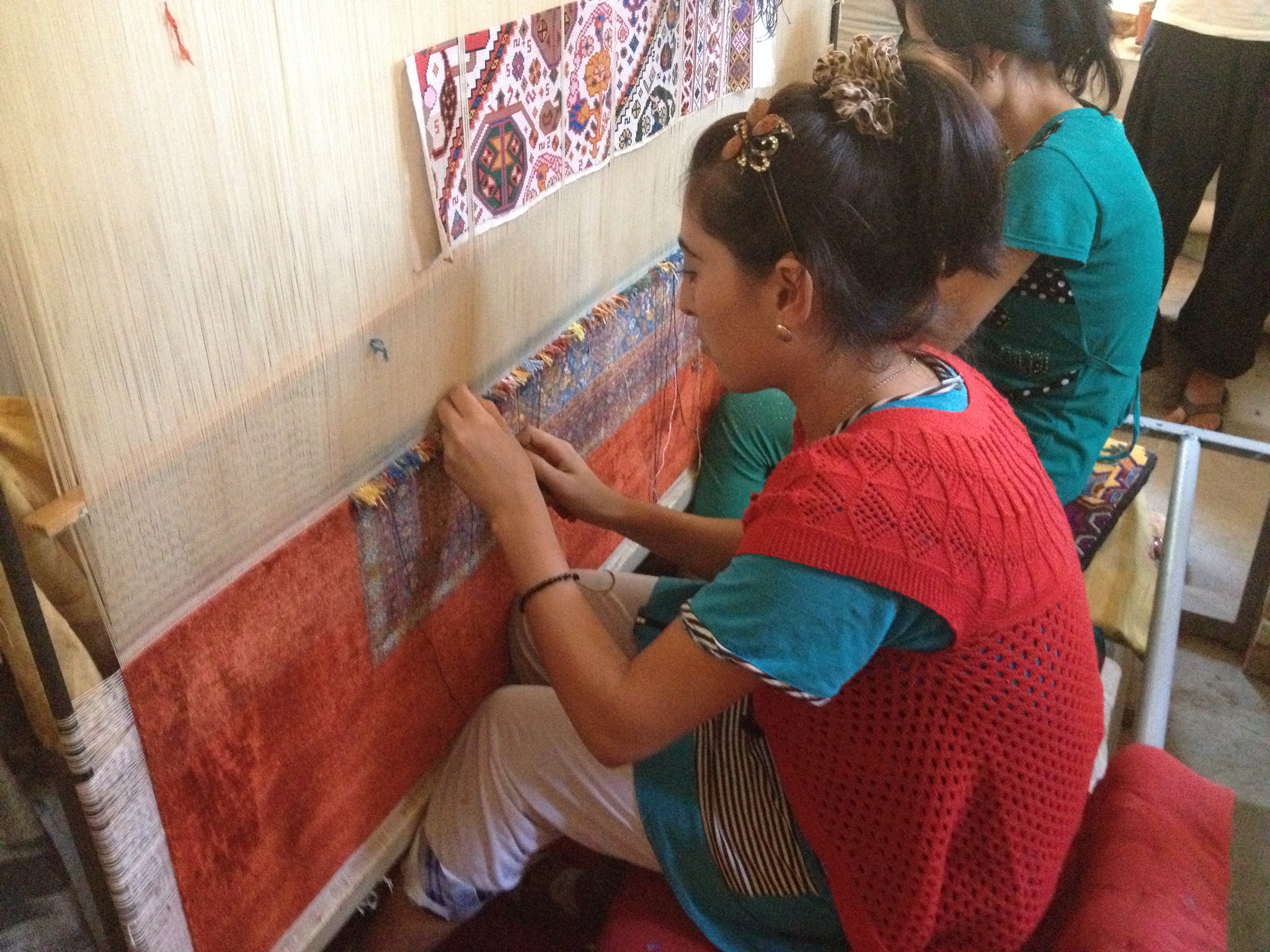
We came to the old Registan which would have been the original town square and execution site. We saw mosques and minarets – the tallest towering over us and previously used not only for the call to prayer, but as a look out post and lighthouse for those arriving across the desert. It was also used to push people off the top – I can only imagine that they had been particularly naughty to meet this rather nasty end. We visited a carpet museum and carpet warehouse, the gold market and the only ATM in town. It looked very new and dispensed only crisp, new dollar bills – the local Som being far too cumbersome! Eventually Bukhara prison came into view – a particularly nasty spot incorporating a deep prison pit in the centre that once accommodated two British chaps who fell foul of the Emir and were ultimately beheaded.
We drew a close to the day’s perambulations, parched but enchanted with Bukhara. The gentle domes and sandstone have charmed us all. By now it was very hot again, so a shady lunch spot was found and then we retired to our room for a rejuvenating snooze.
The evening saw us out for another rooftop meal. It turned out to be the worst meal of the trip so far – it was freezing cold, we were eclipsed by a full coach load of Germans demanding vodka, the food for the majority of our little party was grim and we were overcharged by 40,000 Som on the bill. It took over an hour to sort this out, by which time the bill had been halved by the management who acknowledged their mistake and I, for one, was nearly in tears. The moral of the story? Beware of Lonely Planet recommendations!


We emerged from the hotel to face another ‘guard of honour’ of police. The round up of students continues in a quiet but orderly way. It did feel a bit weird and the chatter on Penelope ceased until we were through the area.
Before long we had passed the lady street sweepers with their faces swathed in colourful scarves against the dust and passed the thick, crumbling city walls of the old city.
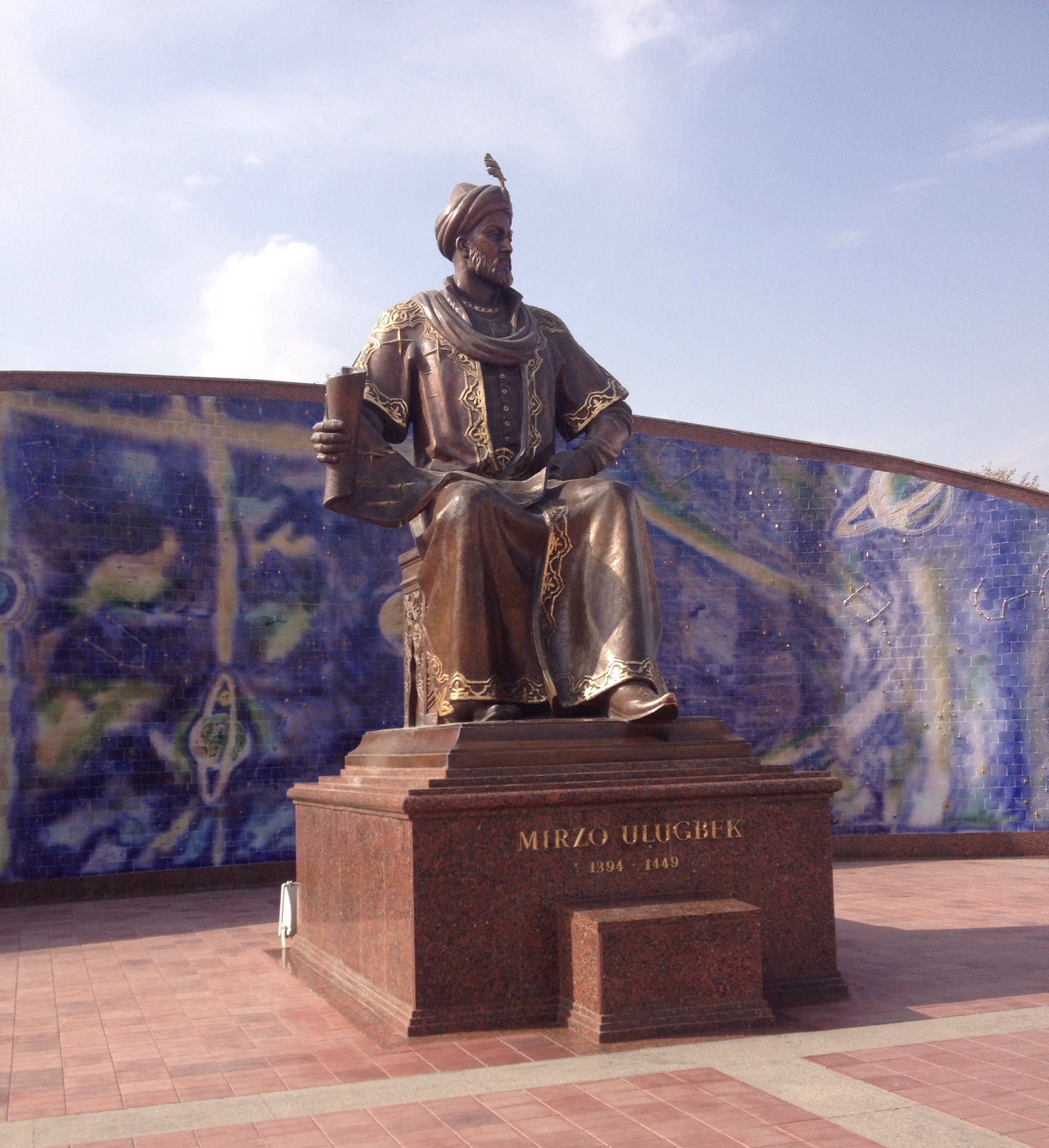
Our first stop was Ulug Beg’s Astronomical Observatory. A large bronze statue of the great man sat outside the observatory area. A famous astronomer and free thinker in his time, he was beheaded by a coalition of priests and his son for his efforts to ensure everyone was educated and his peaceful approach to leadership. There were no wars while he was in charge. He is, however, most famous for his astronomy. He identified one of the earliest lunar calendars, that was subsequently found to be out by one minute, in the 15th century. Another reason he was not very popular amongst the intellectuals of his time was because he subscribed to the view that the world was round, when those around him were of the flat world thinking. He was said to have created the first globe.
The actual observatory site was raised to the ground by the Russians and his, like all Uzbekistan books were burned (he had an apprentice who escaped to Persia when he was beheaded). Once again there have been major renovations of the area. An odd shaped building showed the ruins of the large sextant that Ulug Beg built and you could identify the enormous circumference of the Observatory by the size of the archaeologists’ excavations. There was an interesting museum that had a scale model of the original buildings and had books and pictures associated Uleg Beg showing him in association with other great Rennaissence astronomers.
We eventually left Samarkand and its bright yellow taxis for Bakhura, the city that took over as the Uzbekistan capital when Samarkand fell from favour. It was six hours drive to Bakhura, a desert city. On the route initially the road was lined with ladies selling their bread. Very occasionally we saw a horse or donkey drawn carts. Most of the traffic was smart cars and the very rare bus. Most of the vehicles run on propane gas and the buses carry several cylinders on the roof. Which seems something of a dangerous pursuit to me. All the way along what was a very bumpy and potholed road were empty, very smart, but non functioning service stations.
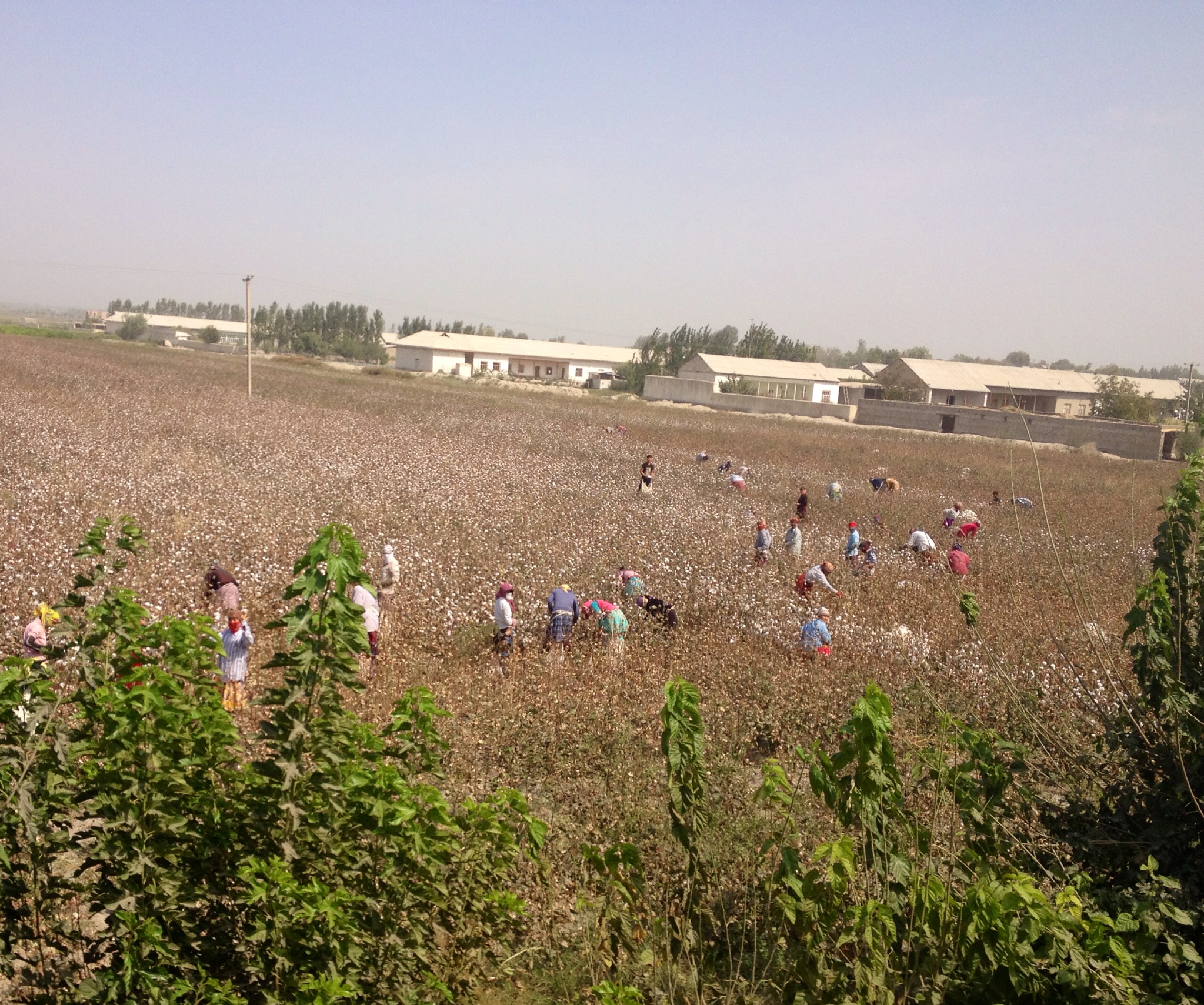
The most frequent fields were full of cotton. It is obviously very ripe with its white crop of cotton clearly visible from the truck. Some fields were full of pickers busy at their task in the hot sun. Tractors with trailers full of the result of their labours could be seen on the edge of the fields.
There were several new housing developments going on. The majority of new housing are single story houses, painted a puce pink, fronting straight onto the road with a small car port on the side. They are all attached to each other. The workmen seem to live in obsolete shipping containers. They must be really hot inside!
Late afternoon saw us arriving at our hotel in the outskirts of Bakhura. It is a much smaller city than Samarkand and although it felt as though we were very much on the outside of things, we were in fact not far from the city centre.
When we emerged from our room to go to supper, it was to feel a cool breeze which made our rooftop meal a rather chilly affair. It was, perhaps, our first experience of an autumnal evening. To get to our restaurant we had our first exposure to the stalls and bazaars of Bakhura. The breeze flapped the goods on display and stall holders called out as we passed.
It might be a good point to mention here hotel bedding arrangements. The first time we experienced it! On pulling back the counterpane there is just a pillow and bottom sheet. On closer inspection you find another sheet neatly folded for you to do with what you will……. This sheet does not fit the bed so you tend to spend the whole night tussling with it!

We left the hotel at 9.00 and piled into Penelope to get ‘down town’ where the main historical sites are. We had not gone far when we passed several large trucks with bedding – sleeping mats and blankets – piled high in the back. There were large numbers of young people milling about and a few parents. Scattered among them were some police. We moved slowly forward again and then stopped. Rustom, our guide, got out to see what was going on and shortly afterwards we were again moving forward. The hold up was caused by the official gathering up of students who all have to spend a certain amount of time picking cotton. They were being rounded up to be taken to the cotton fields.
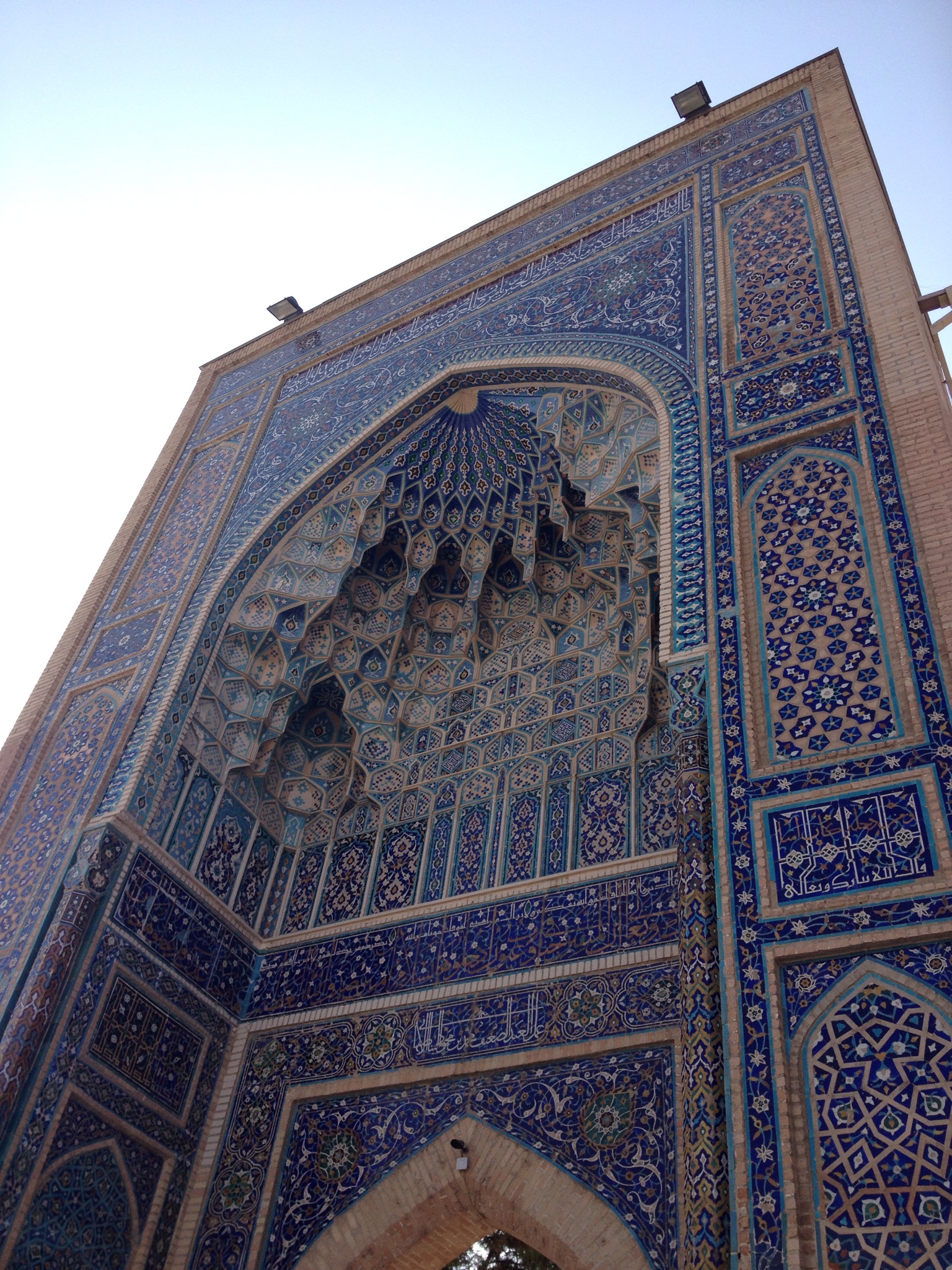
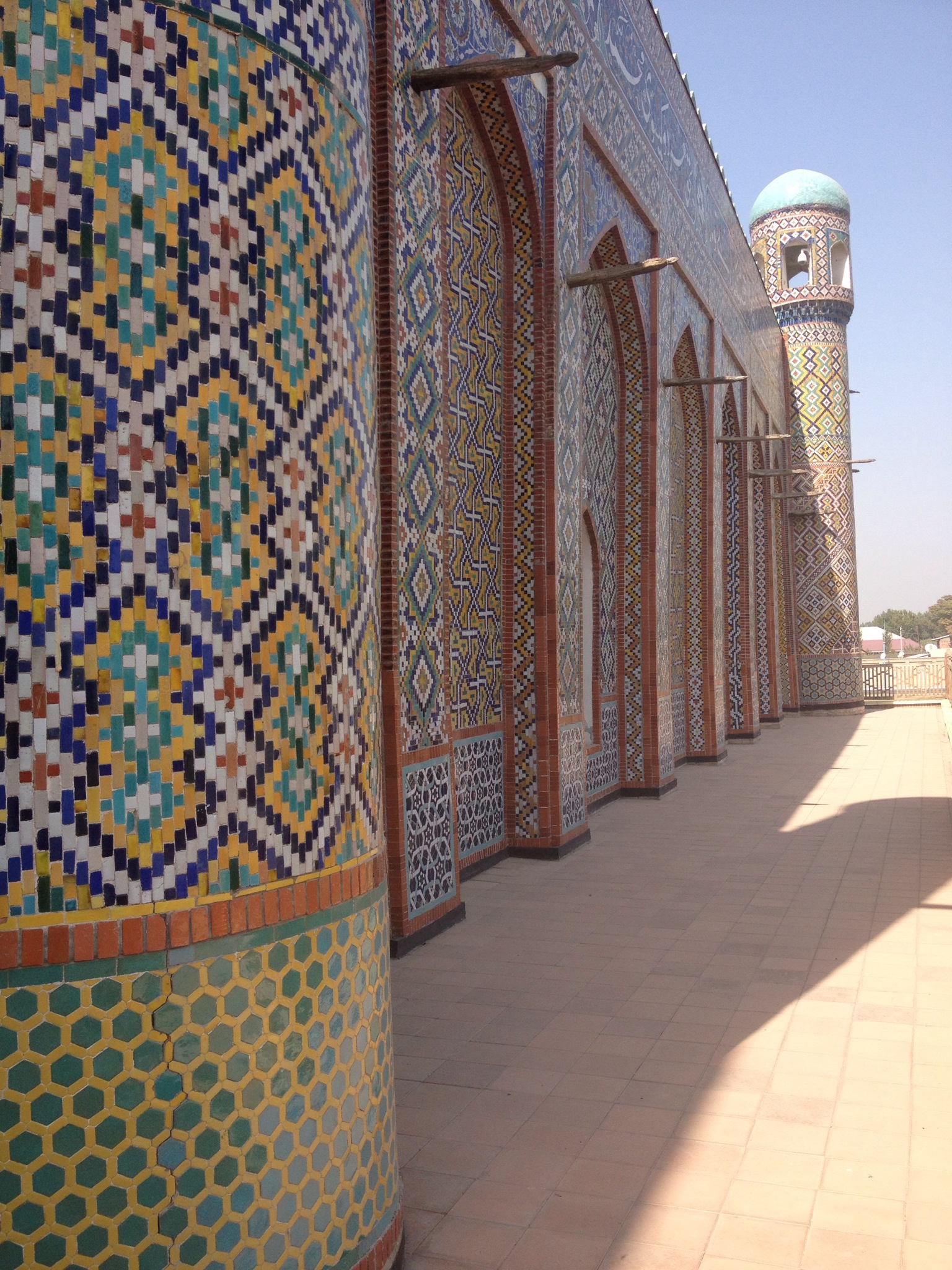
We moved on to our first port of call, the tomb of Timor and a few of his relatives. Like most things in Samarkand, it has been restored, but nevertheless it was a very impressive sight. First a huge gateway, covered with blue tiles and shining in the light, with the dome of the mausoleum behind it. The patterning on the tiles soared above us as we went through the portal to the area behind with the mausoleum ahead of us. Built by Timor for his favourite nephew, he was to end up being buried there himself after dying suddenly and unable to be put in the place he had identified for himself. The best laid plans……..
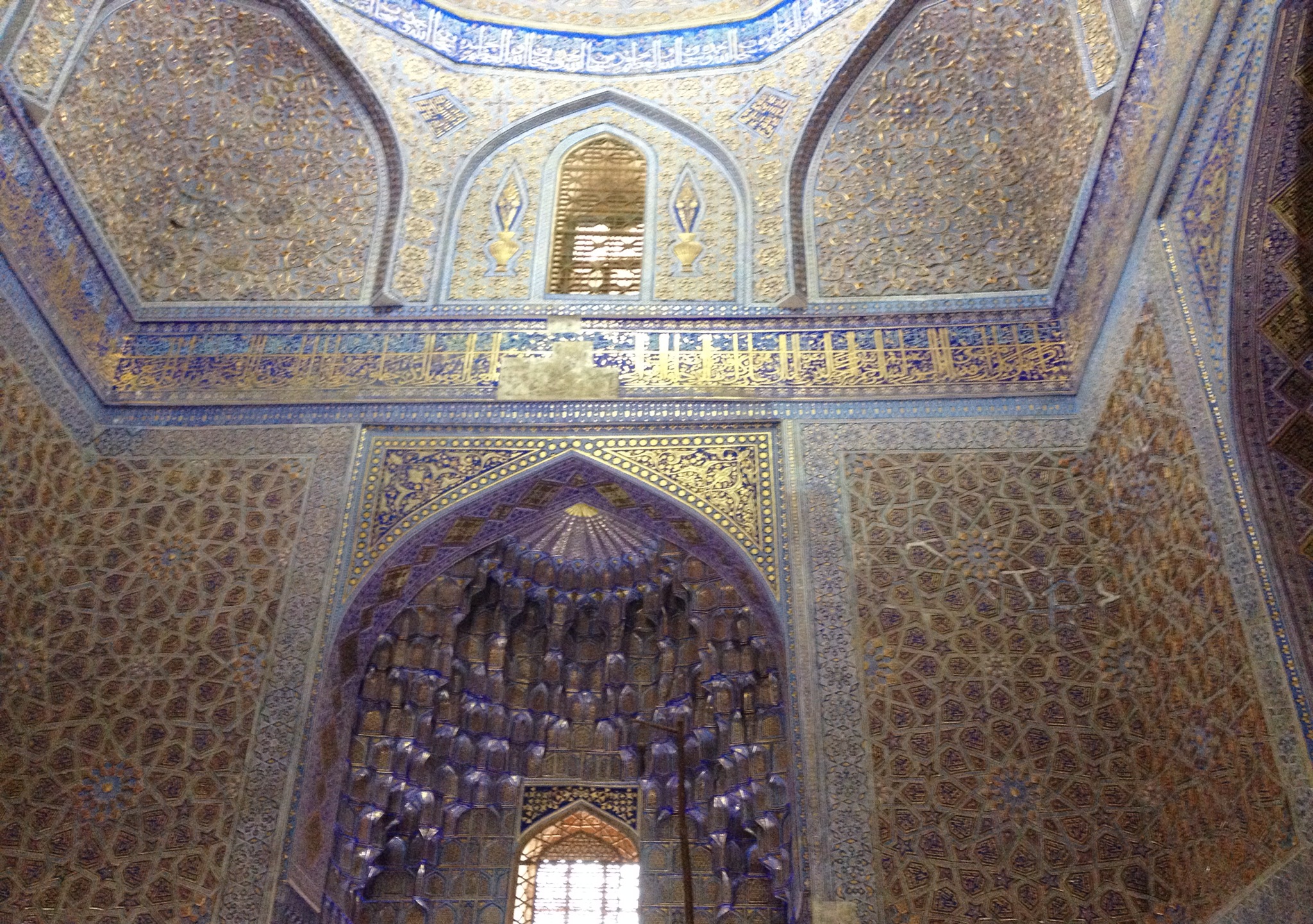
The interior of the mausoleum itself was just incredible, gold and blue glazed tiles shimmered all around us and high up into the inner dome which was gold. On the ground were the tombs. All were huge slabs of marble and jade.
The unusual thing for us was the number of other western tourists. For so long we have been travelling to places where we have been either the only visitors or formed part of a smattering. In Timor’s tomb we found ourselves surrounded by the languages of France, Italy, holland and Germany. It was a bit of a jolt.
We left the marine light of the mausoleum’s interior to emerge into the bright sunlight again. Blinking against the light we wondered the grounds and found the back and unrestored part of the building. Although not so colourful, it’s lines were none the less impressive. Everything to do with Timor is on the grand scale!
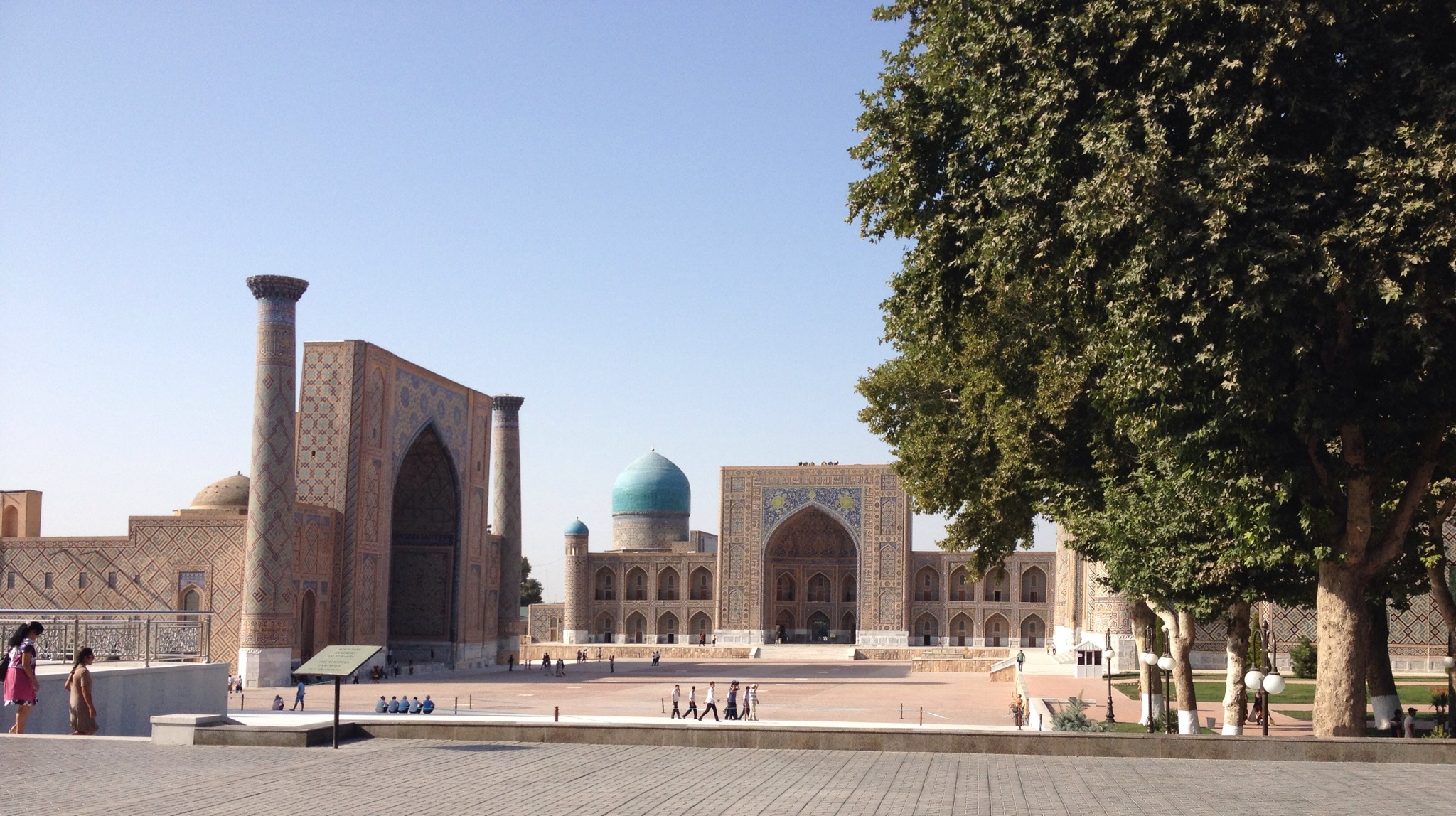
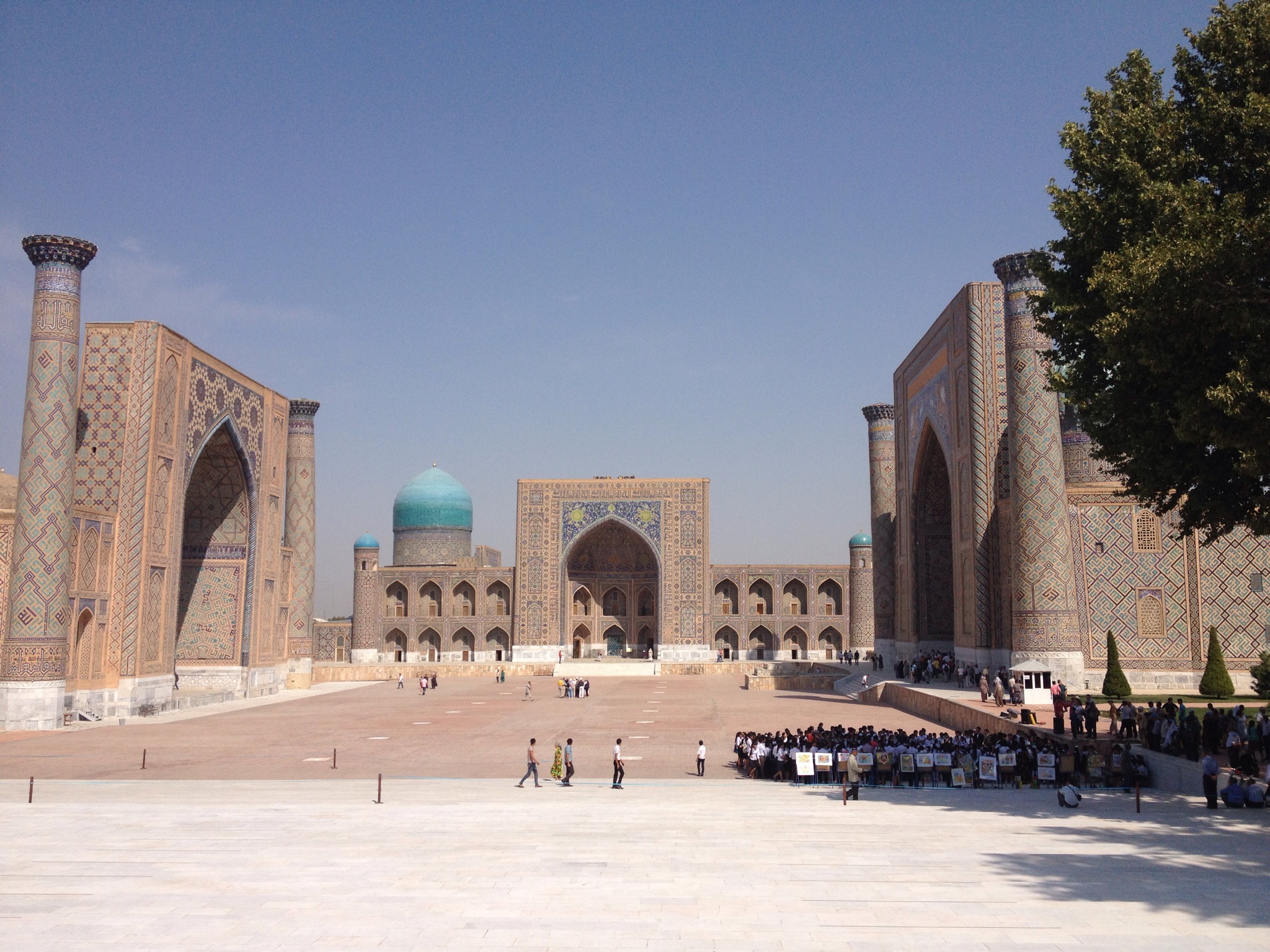
Our next stop was the Registan. This was originally the big square and commercial centre of Samarkand, where all the traders met and would have been a riot of colour and activity. It is also where people would have been put to death. Today it is a pristine, enormous paved area in front of three magnificent buildings – two madrassahs. and a mosque – that line the three sides of square. Although the term ‘madrassah’ now has the bad press associated with religious extremism, in the past it was just a place of teaching. Each ‘madrassa’ taught a different subject.
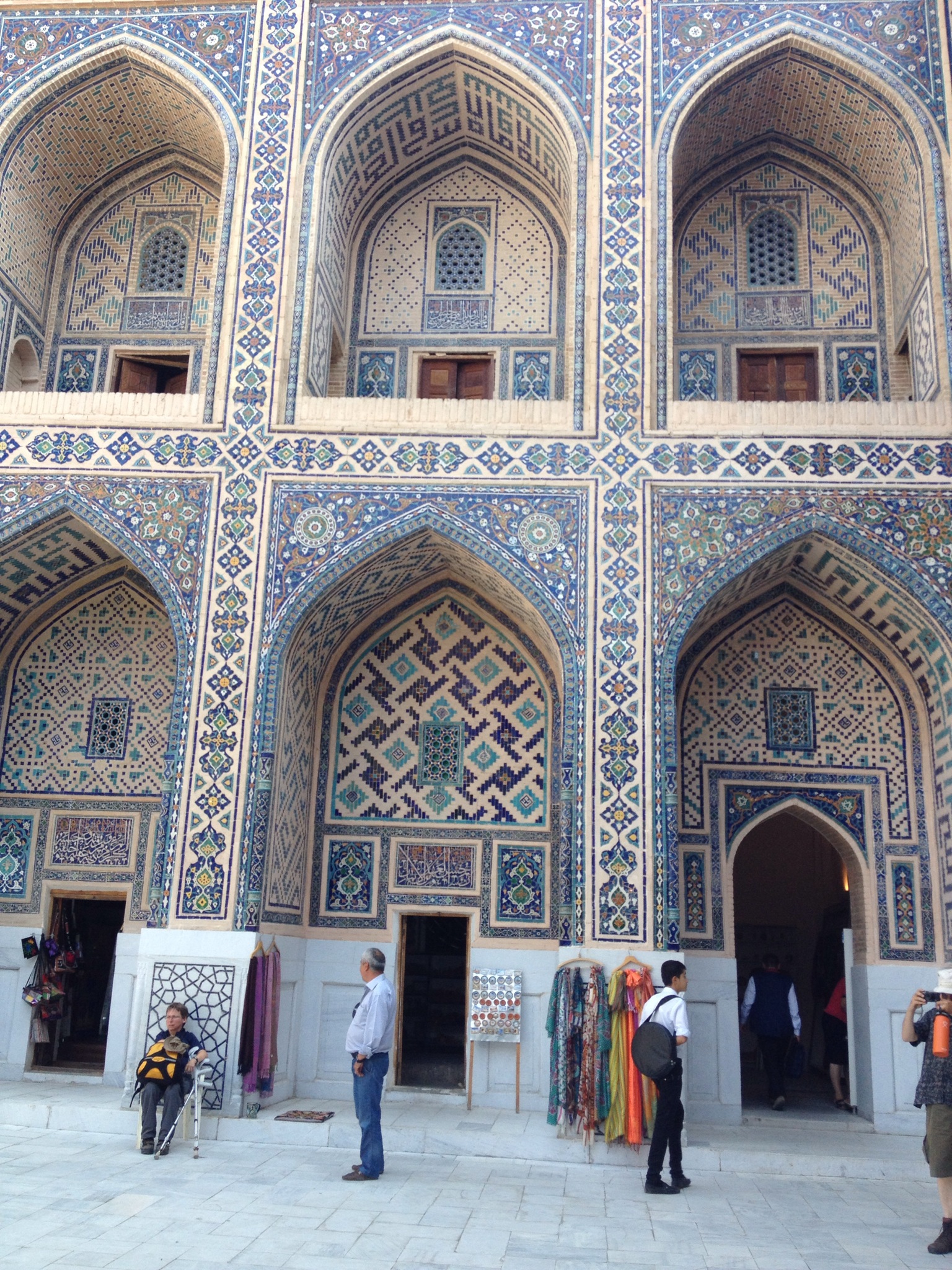
The first building we entered was the madrassa of Ulug Beg, the man who built the Observatory on the outskirts of Samarkand. He was another nephew of Timor and sounds a generally good egg. He believed that everyone was entitled to an education and opened the school for teaching mathematics and astronomy. Once again the building has been renovated by the Russians and later restoration took place as a UNESCO site, but nothing could detract from the beauty of the place. Once again a large portal on the square opened into an inner courtyard with two tiers of ‘classrooms’ surrounding the courtyard. The ground floor rooms are now shops. It would be nice to think that the stall holders who previously filled the square outside made up the shopkeeping population, but sadly this is not the case. The shops were very upmarket, the shopkeepers very well dressed and very different to how one imagines the stall holders of old to be.
We visited each of the buildings in turn. Each had been renovated, but there were some areas still being tinkered with. Outside of the Registan was a domed building where the Silk Road traders of old would change their money to the local currency to enable them to trade. This is now an art gallery.
We moved on to the Grand Mosque. Another huge portal entry into the mosque grounds. In the centre of the area in front of the mosque itself was an enormous Koran stand made of stone. The mosque complex was not so highly patterned and there was much more sandstone to be seen. For some reason the building had to be completed very quickly (folklore provides various stories about this) which resulted in it deteriorating more quickly because it’s foundation were not robust enough to hold it up. Although it has been subject to renovation, this was not as all encompassing as other buildings we have seen and in fact it’s interior had not been touched. It is no longer used.
After a wonderful morning of sightseeing of the most amazing kind, it had taken place in fierce sun and heat, so we adjourned for lunch on the balcony
of one of the artisan shops that line the pristine walkway between the Registan and the mosque. We had wonderful Greek salads and shredded carrot with a yummy but mysterious dressing and cold drinks. Accompanied by a yoghurt dip and the local bread, it is our favourite lunch.
The dangerous bit was the shop – and I succumbed! Keith bought the wonderful jacket I found for my birthday! What a lucky girl, but what hard work to make a purchase! The shop had no card machine, no-one uses banks (all money changing takes place on the street) and no ATM in Samarkand. We eventually cobbled the money – which as you can imagine as I was involved was not inconsiderable (!) – by borrowing from one of our travel chums.
After the retail excitement we took a step through a wall that had been built to separate the up market shops from the local residential area and were in a different world – narrow roadways, traditional single storey dwellings and jolly local people. There was a wedding taking place and beautiful young women giggled and chatted. Sadly we did not see the bride. After our local wondering, Keith and I meandered back to the hotel to prepare for the evening’s entertainment. We were to form part of a small, but beautifully formed group who had signed up for a Uzbekistan wine tasting session.
It was quite a trek to the wine ‘factory’. The lady who led the proceedings was great fun although I was a bit shocked to learn we are the same age……. However – to move quickly on – there was no hiding place on this tasting – no spitting out. Madame insisted that every drop should be drunk! We moved through white and red wines and eventually brandy that were of varying degrees of acceptability until the last which was absolutely awful. We were told it had won awards and was know as the ‘Elixir of Life’. It was not grape based but instead a concoction of herbs and spices in liquid form. I was not sure whether it was to be rubbed on or drunk! A fun evening, but I don’t think the Uzbekistan vineyard is one to look out for!!!




Samarkand. I was excited at the thought of Samarkand. It was a place that, for me, conjures up a picture of a city shimmering in the heat, of camels and traders and the air tainted with the smell of leather and spice. I guess this all comes from thoughts of the Silk Road and my reading around it. Whatever it was, I was excited.
We left Tashkent on yet another sunny day – we have been so lucky with the weather and have had no rain since Pingyao in China – all those years ago, or so it seems!
The countryside now is very ‘grown up’. There are large fields watered by a comprehensive network of large concrete irrigation channels. All sorts of crops are evident, some fields are lying fallow but are tilled – looking alert and ready for action – and the inevitable cotton. For some time a railway line runs parallel to us with stations appearing at odd intervals but looking more like bus stops than anything else. Long goods trains trundle past with a range of goods wagons – tankers, ships containers and some just open with a wooden framework, their contents delivered or still to come.
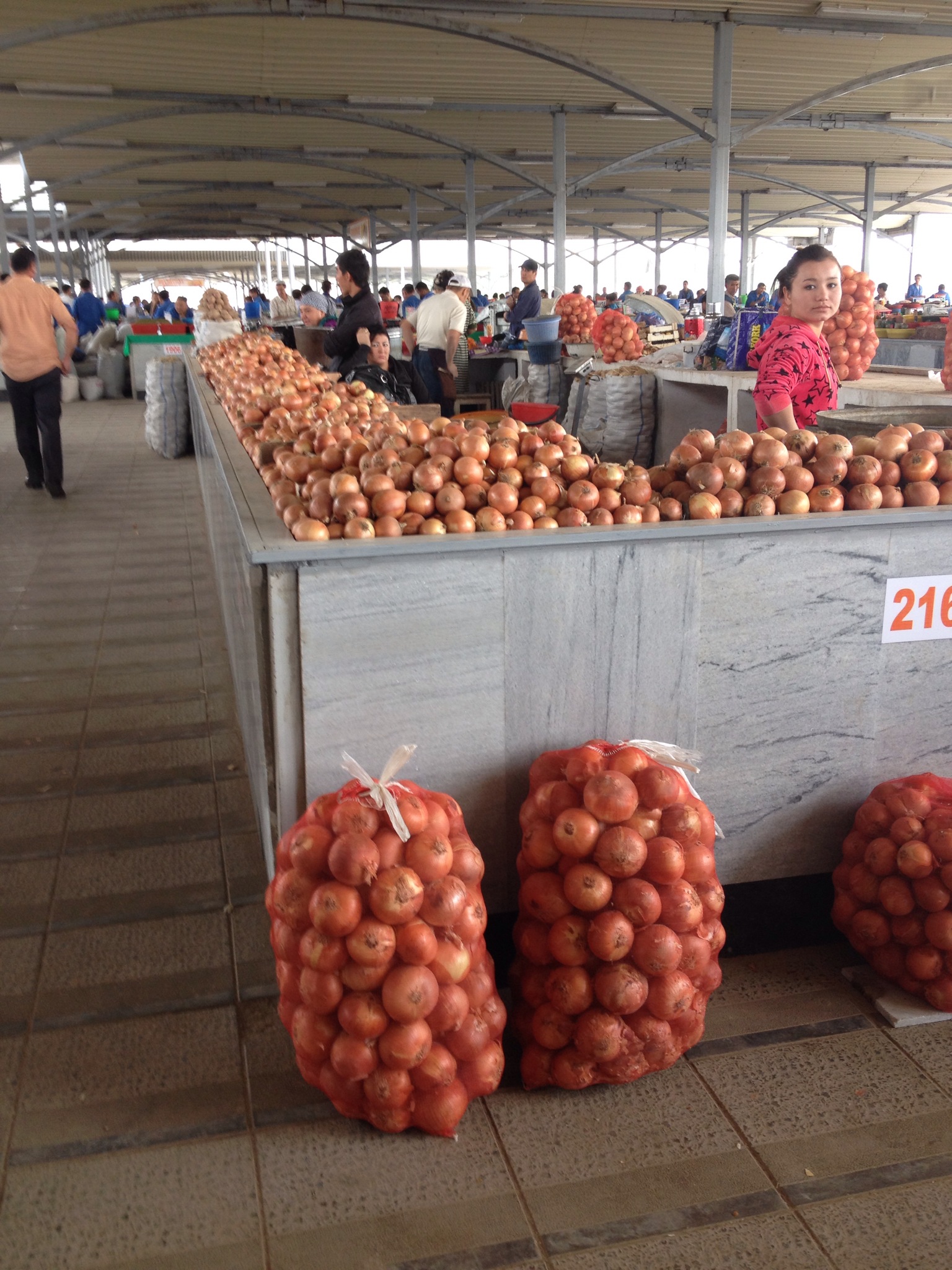
Many of the rural roads are edged with stalls selling large water melons and squash, the stall holders sitting patiently under any shade they can get and spattered with dust from the road. There are so many I cannot see how any can earn a living wage.
In contrast, the majority of cars that pass us are up to date and in good condition. Chevrolet seems the car of choice and white the preferred colour. The number of cars is interesting given that there is a fuel shortage. When we first heard of this when we were driving over the Namangen pass in our fleet of cars, we thought it a temporary issue. However, it appears to be a permanent situation. The truck seems to make a fuel stop very infrequently, but Simon took the opportunity when he could of filling up and mountains of notes were handed over.
The other driving issue is the checkpoints that appear at very regular intervals. Sometimes we stop and sometimes we are waved through – there seems to be no rhyme nor reason to it.
As the day wore on we were back to an area of desert with the vague mauve shape of mountains in the far distance. I dozed….., Then we were there!
Samarkand, one of the most famous cities of the Silk Road. Cross roads to China, India and the West. Capital city of the mighty Timor. Demolished by Gengis Khan. It rose and fell so many times. And we had arrived.
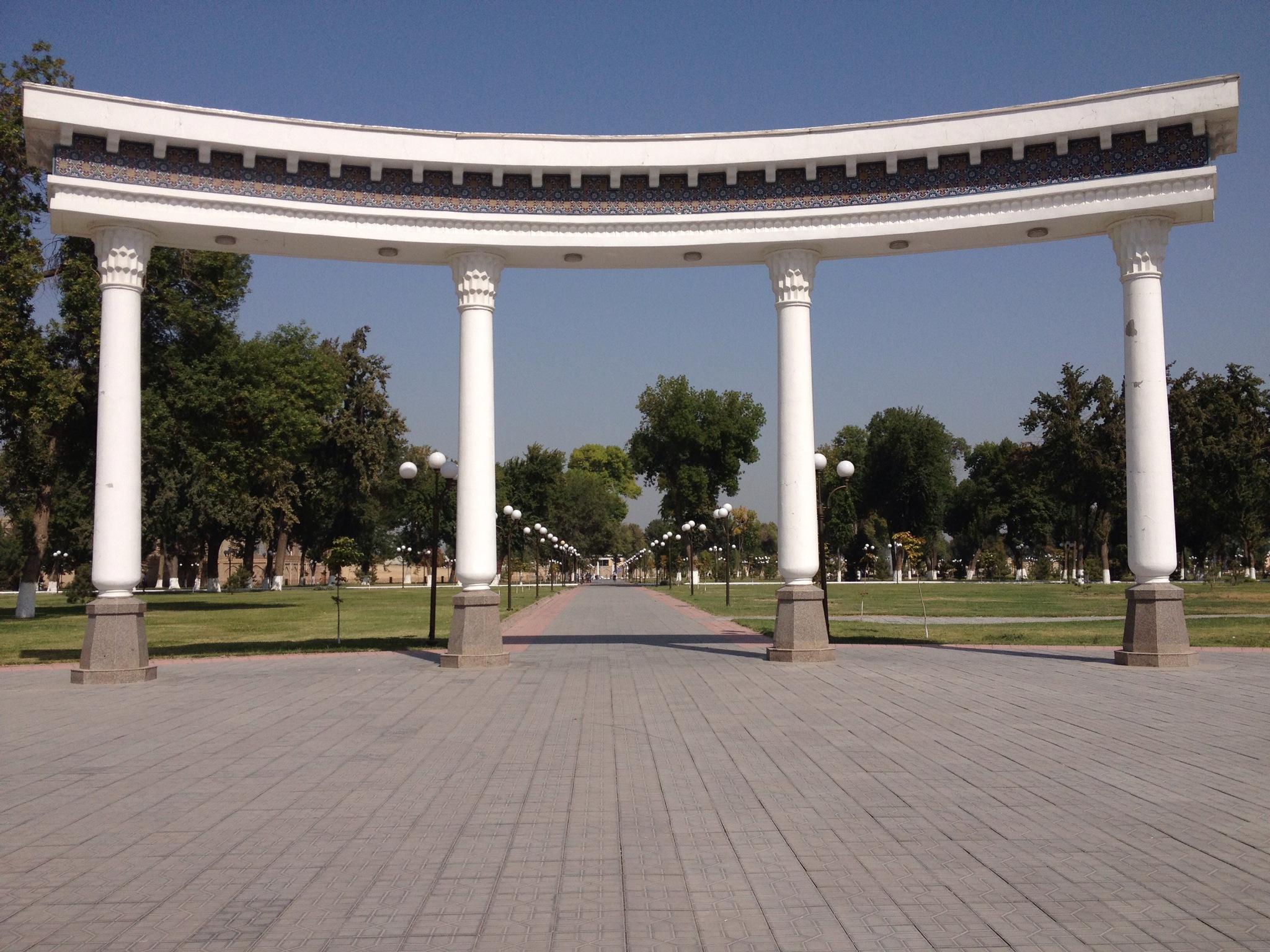
Our first ancient sighting was Ulugbeg’s Astronomical Observatory, a tile covered building sitting on raised ground outside of the crumbling city wall. We then entered the city. Once again the wide boulevards of a Russian city with lots of trees lining the road. Before long we came across the enormous statute of Timor – hero of the area who made Samarkand his capital in the 1500’s. He stares over the main road roadways, still a heavy presence.
Our hotel was light and modern, but the wifi which have not had for several days was poor.
We ate supper in the outside courtyard of a large restaurant called the Samarkand where two men played typical Uzbek music on a drum and violin and lost the battle with the disco music of a wedding inside. The decor of the place was very modern and interesting – a mix of mosaics, whitewashed walls and exposed brickwork.
The walk back in the dark was a bit scary as we had not thought to take torches, there are no street lights and I think the paving is the original city paving from 600 BC! It was certainly haphazard and subject to large craters opening up when least expected! Despite this the journey home was accomplished and we adjourned with a sightseeing day in Samarkand ahead of us! Great!
 pollytheperil